By Dr. Asnat Raziel, bariatric surgeon specializing in obesity treatment, metabolic health and healthy longevity; Director of the Multidisciplinary Center for Obesity Treatment, Assia Medical, Assuta Ramat HaChayal, Tel Aviv
Orthorexia: when healthy becomes dangerous
Orthorexia is a compulsive preoccupation with eating “right” and “pure.” It usually starts with a sincere desire to be healthy. Little by little, however, the rules take over your life. That’s why it’s important to recognize the fine line between a healthy lifestyle and a hidden eating disorder.
Wellness culture and its dark side
Over the past decade, talk about health and proper nutrition has become more dominant than ever. Social media, tracking apps and smartwatches have created a high level of body awareness. Alongside the benefits, though, a gray zone has emerged. In it, the wish to be healthy gradually slides into rigid, obsessive behavior.
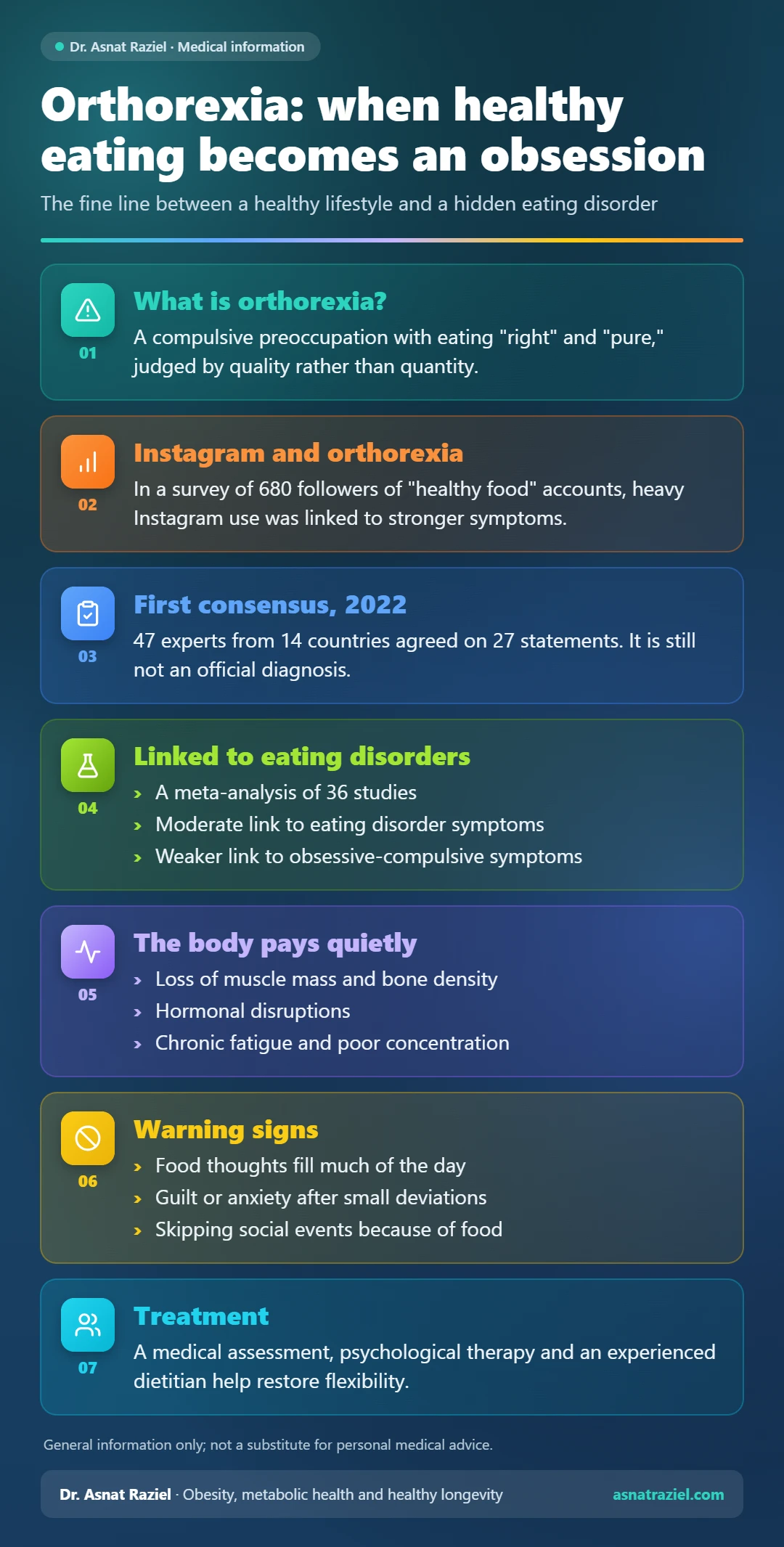
Social media plays a part in this. For example, a survey of 680 followers of “healthy food” accounts showed that heavy Instagram use was linked to stronger symptoms of orthorexia. In many cases, the disorder disguises itself as “discipline,” “control” or “a healthy lifestyle.” As a result, it earns compliments instead of concern.
When being careful turns into an obsession
The difference between healthy eating and an eating disorder doesn’t lie in the type of food. Rather, it lies in your relationship with food. When food becomes the focus of your thoughts, there is reason to pause. Likewise, when a small deviation from your menu triggers guilt or anxiety, something has already changed.
Healthy eating should add quality of life, flexibility and enjoyment. By contrast, when it comes with constant tension, fear of food and a need for total control, it has become a worrying pattern. In other words, the question is not “What am I eating?” but “How much space does food take up in my head?”
What is orthorexia, according to research?
The American physician Steven Bratman coined the term in 1997. A review by Dunn and Bratman describes people who restrict their diet based on the quality of food rather than its quantity. In the end, their “healthy” diet leads to malnutrition or impaired daily functioning.
For years, there was no uniform definition. A 2018 narrative review identified three core features. First, a compulsive preoccupation with healthy eating. Second, distress and anxiety when they break their own rules. Third, harm to social life and, at times, malnutrition.
In 2022, 47 experts from 14 countries published the first consensus document. The experts agreed on 27 statements, which became proposed diagnostic criteria. Even so, orthorexia is still not an official diagnosis in the psychiatric diagnostic manuals.
How orthorexia relates to eating disorders and anxiety
People with this pattern are not necessarily very thin. Sometimes others even praise them for their “impressive lifestyle.” In practice, however, avoiding entire food groups and fearing any deviation harm both physical and mental health.
A meta-analysis of 36 studies found a moderate association between orthorexia symptoms and eating disorder symptoms. The link with obsessive-compulsive symptoms was much weaker. In addition, a 2025 umbrella review linked the disorder to compulsive exercise, perfectionism and obsessive-compulsive traits. So the fact that it is not an official diagnosis doesn’t make the potential harm any smaller.
Weight loss doesn’t always mean success
In a society that idealizes thinness, people almost always see weight loss as an achievement. Sometimes, though, it hides an unhealthy process. Examples include extreme avoidance, compulsive exercise or losing touch with hunger and fullness cues. Even overdoing healthy habits can take a toll.
In many cases, the disorder actually begins with a decision to “be healthy.” Then comes reinforcement from the people around you, from a coach and even from the care team. Because no one questions it at this stage, it can deepen and become entrenched without anyone recognizing the danger.
The body pays the price quietly
Hidden eating disorders are not always dramatic. Nevertheless, the damage adds up. Loss of muscle mass, lower bone density and hormonal disruptions are part of the picture. Chronic fatigue and difficulty concentrating also appear. Extreme training can affect the brain and memory as well.
Sometimes test results are relatively normal, yet the person is exhausted and constantly preoccupied with food. The gap between a “healthy” appearance and how the person feels inside makes the problem even harder to spot. That’s why it’s worth getting to know eating disorders in modern medicine in all their forms.
Warning signs of orthorexia
Here are some questions worth asking yourself honestly:
- Do thoughts about “proper food” fill a large part of your day?
- Does a small deviation from your rules cause deep guilt or anxiety?
- Do you skip social gatherings because of the food on offer?
- Is your list of “allowed” foods getting shorter and shorter?
- Is your overall feeling one of control rather than enjoyment?
Answering yes to several questions is not a diagnosis. However, it is a good reason to see a professional who is experienced with eating disorders.
True health includes flexibility
Perfection is not the yardstick of a healthy lifestyle. Instead, what counts is the ability to listen to your body, mental flexibility and a relaxed relationship with food. Being able to eat for pleasure and join events without anxiety is a key marker of health. A stable body image is also part of this picture.
When health becomes a project of control, it loses its essence. That’s why early recognition of rigid patterns matters so much.
How orthorexia is treated
There is still no standard treatment protocol, because the definition itself is relatively new. Nevertheless, professionals rely on the tools used to treat eating disorders. First, a medical assessment checks for nutritional deficiencies, bone health and hormonal balance. Second, psychological therapy helps break down the rigid rules and the anxiety around them. In addition, guidance from an experienced dietitian gradually brings back foods that have disappeared from the menu.
The goal is not to give up healthy eating. Rather, the goal is to restore its flexibility. The people closest to you also play a role. It helps to stop praising restriction and to pay attention to mood, energy and social life instead. That way, you can recognize the disorder before it becomes entrenched.
The bottom line on orthorexia
Orthorexia begins with good intentions and sometimes ends in a prison of rules. Ultimately, healthy food should serve your life, not run it. If you recognize yourself or someone close to you in this description, don’t wait. Reaching out to a professional early can prevent a slide into a full-blown eating disorder.
This article provides general information and is not a substitute for personal medical advice.
References
On orthorexia nervosa: A review of the literature and proposed diagnostic criteria
Definition and diagnostic criteria for orthorexia nervosa: a narrative review of the literature
A consensus document on definition and diagnostic criteria for orthorexia nervosa
Understanding Orthorexia Nervosa: A Systematic Review of Meta-analytical Findings
Instagram use is linked to increased symptoms of orthorexia nervosa