By Dr. Asnat Raziel, bariatric surgeon specializing in obesity treatment, metabolic health and healthy longevity; Director of the Multidisciplinary Center for Obesity Treatment, Assia Medical, Assuta Ramat HaChayal, Tel Aviv
Bone health after bariatric surgery: the topic we don’t discuss enough
Bone health after bariatric surgery is something most patients rarely think about. Usually all the attention goes to weight, blood sugar and blood pressure. However, a new umbrella review is a reminder that the skeleton also responds to surgery. The good news is that simple, proven steps can protect it.
The review was published this week in the journal Obesity Surgery. It brought together 32 systematic reviews and meta-analyses on bone health after bariatric surgery. The result is the broadest picture to date.
What an umbrella review is and what it examined
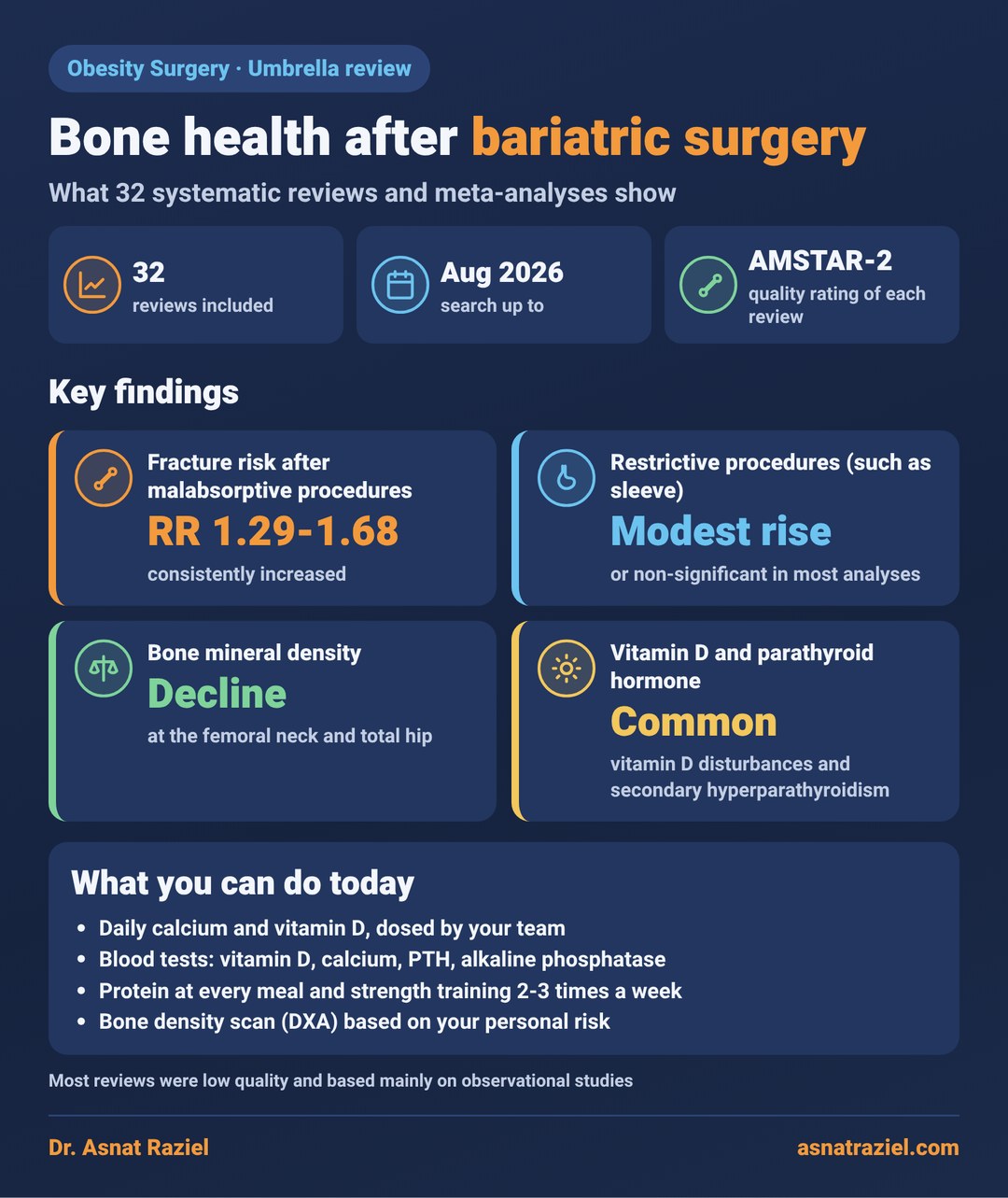
An umbrella review is a study that summarizes other reviews. Instead of looking at one study, the researchers checked whether the conclusions of many reviews agree with each other. They searched the databases up to August 2026 and rated the quality of each review with a standard tool called AMSTAR-2.
The topics included fractures, bone mineral density (BMD, a measure of bone strength), markers of bone breakdown and formation, parathyroid hormone (PTH) and vitamin D. You can find the full paper in Obesity Surgery.
Key findings on bone health after bariatric surgery
- Fractures: after procedures with a malabsorptive component, such as gastric bypass, fracture risk was consistently higher. Relative risks ranged from 1.29 to 1.68.
- Restrictive procedures: after operations such as the sleeve, most analyses showed only a modest or non-significant increase.
- Bone density: density declined at the femoral neck and the total hip.
- Bone structure: on three-dimensional scans, bone deteriorated after Roux-en-Y gastric bypass.
- Hormones and vitamin D: secondary hyperparathyroidism and vitamin D disturbances were common.
In other words, the risk is real, but it is not the same for every operation. Put simply, a relative risk of 1.29 means that for every 100 fractures expected in a similar group without surgery, there would be about 129 after surgery.
Why bones get weaker
In fact, several causes act together. First, rapid weight loss reduces the load on the skeleton, and bone responds to that. Second, after bypass, the gut absorbs less calcium and vitamin D. In addition, muscle mass sometimes drops too, and strong muscle is one of the bone’s best protectors. I wrote about this link in my article on sarcopenia and muscle loss.
A similar effect also appears with medication-based weight loss. That is why I also wrote about bone loss during weight loss in the era of new drugs.
Limitations of the review
Therefore, these findings need careful reading. Most of the included reviews were of low quality, and most rely on observational studies. In addition, some reviews share the same primary studies. On the other hand, the consistency across reviews strengthens the main message.
Bone health after bariatric surgery: what you can do today
The good news is that most of this risk can be reduced. This is how we work in our multidisciplinary center:
- Calcium and vitamin D supplements: according to the ASMBS nutritional guidelines, every patient needs regular supplements, at a dose the team tailors. After bypass, calcium citrate is usually preferred because it is absorbed better.
- Regular blood tests: vitamin D, calcium, parathyroid hormone and alkaline phosphatase, along with iron and vitamin B12.
- Protein at every meal: enough protein protects both muscle and bone. A dietitian will help you reach your personal target.
- Strength training: resistance training two to three times a week, plus walking and aerobic activity, loads the bone and strengthens it. I expanded on this in my article on preserving muscle mass.
- Bone density scan when needed: the review recommends tailoring DXA scans to each patient rather than scanning everyone. It matters most at menopause, at older age or after a fracture.
- Quit smoking and limit alcohol: both harm bone at any age.
Also, if you had surgery years ago and stopped follow-up, now is the time to return. The clinical guidelines for bariatric patients stress that teamwork, with attention to nutrition and metabolism, is the foundation. Women in menopause need special attention, as I described in my guide to obesity in menopause. Older adults can also read about bariatric surgery after 65.
Still deciding on the type of operation? Read the new comparison of the two operations.
The bottom line
Bariatric surgery saves lives and improves health for years. Still, bone health after bariatric surgery needs steady attention. Supplements, blood tests, protein and strength training are the foundation. That way you enjoy all the benefits of surgery and keep a strong skeleton for many years.
This article is general information and does not replace personal medical advice.
References
Bone Health After Bariatric Surgery: An Umbrella Review of Systematic Reviews and Meta-Analyses