By Dr. Asnat Raziel, bariatric surgeon specializing in obesity treatment, metabolic health and healthy longevity; Director of the Multidisciplinary Center for Obesity Treatment, Assia Medical, Assuta Ramat HaChayal, Tel Aviv
Retatrutide vs CagriSema: the next two obesity drugs
Retatrutide vs CagriSema is one of the comparisons my patients ask about most. Both are weekly injections, both showed large weight loss, and neither is approved yet. Still, they work in different ways, and the data on them are very different.
In this article, I answer four questions. Why does retatrutide reach the gray market? Why is there no fast approval? What happens to muscle? And which one is stronger?
Retatrutide vs CagriSema: how each one works
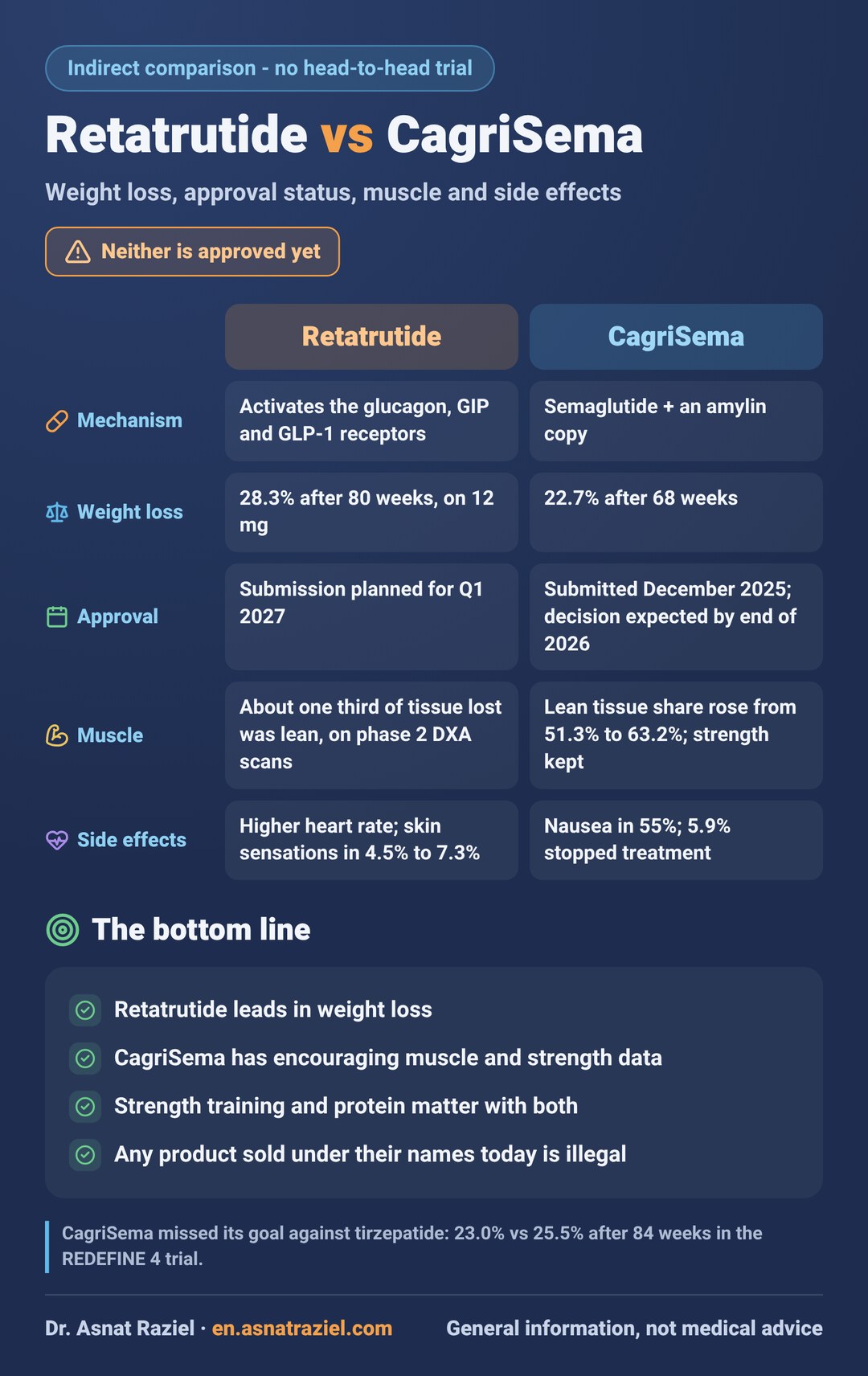
Retatrutide, made by Lilly, activates three receptors: GLP-1, GIP and glucagon. The glucagon part increases energy use and fat breakdown in the liver. That is why it is sometimes called the “triple agonist.”
CagriSema, made by Novo Nordisk, combines two compounds in one injection. The first is semaglutide, the active ingredient in Wegovy. The second is cagrilintide, a long-acting copy of the hormone amylin, which increases the feeling of fullness. I wrote in detail about amylin-based drugs.
Why retatrutide reaches the gray market
Retatrutide’s results are especially impressive. In the TRIUMPH-1 trial, participants on 12 mg lost an average of 28.3% of their body weight over 80 weeks. In the trial extension, participants with a BMI of 35 or higher reached 30.3% after 104 weeks. I wrote about this in my article on the retatrutide trials.
Results like these create huge demand long before a drug is available. A report in AJMC describes how the “trillion-dollar drug” story feeds gray market sales. Since there is no legal way to get the drug, people turn to websites and Telegram groups. I expanded on this in my article on fakes and gray market drugs.
But what people buy is not necessarily retatrutide. A study of medical records found that gray market users lost an average of only 7.2%, compared with 15.5% for trial participants. In addition, the state of Victoria in Australia reported six cases of acute liver injury in people using products labeled as retatrutide.
Retatrutide vs CagriSema: why there is no fast approval yet
Retatrutide: the data were completed only this year
Approving a drug requires a full package of data. TRIUMPH-1 results came out in May 2026, and TRIUMPH-2 and TRIUMPH-3 results in July 2026. According to Lilly’s announcement, the company plans to submit the drug to the FDA in the first quarter of 2027. In other words, the application has not been filed yet.
A legal dispute: drug or biologic?
In addition, Lilly and the FDA have been in a legal dispute since September 2024. The question is whether retatrutide is a regular drug or a biologic product. The FDA decided it is a drug, because its chain is shorter than 41 amino acids. The difference is more than technical: a biologic gets 12 years of exclusivity, compared with 5 years for a regular drug.
Safety signals that need review
The safety data also call for a careful review. Retatrutide raises heart rate in a dose-dependent way. According to a report in STAT, seven of 403 patients had heart rhythm disturbances. In the TRIUMPH-2 trial, tingling and altered skin sensation (dysesthesia) also appeared in 4.5% to 7.3% of patients, compared with 0.7% on placebo. A regulator needs to examine all of this before approval.
CagriSema: the review is under way
Novo Nordisk submitted CagriSema to the FDA on December 18, 2025. A decision is expected by the end of 2026. That is a completely normal review timeline, almost a year from submission. In other words, CagriSema is not “delayed”; it is simply going through the standard process.
Retatrutide vs CagriSema: what happens to muscle
Any large weight loss also includes loss of lean tissue. Lean tissue includes muscle, but also water, organs and bone. So the key question is the ratio between the fat and the lean tissue lost.
Retatrutide: phase 2 data only
A substudy with DXA scans looked at people with type 2 diabetes over 36 weeks. Fat mass fell by 26.1% on the 8 mg dose and by 23.2% on the 12 mg dose. In the pooled analysis, about one third of the tissue lost was lean tissue. This rate is similar to other drugs in the field. So far, I have not found published body composition data from the phase 3 trials.
CagriSema: muscle that keeps its strength
At the ECO 2026 congress, researchers presented DXA data from REDEFINE 1 on 252 participants. In people who lost 30% of their weight or more, body fat fell from 46.3% to 33.2%. At the same time, the share of lean tissue rose from 51.3% to 63.2%. What’s more, muscle strength held steady and physical function improved, even though the absolute amount of lean tissue fell.
Retatrutide vs CagriSema: which one protects muscle?
The honest answer: we cannot say. There is no head-to-head trial of retatrutide vs CagriSema, and the studies looked at different populations over different time frames. With both drugs, strength training and enough protein are the main way to protect muscle. I gathered my recommendations in preserving muscle during drug treatment.
Retatrutide vs CagriSema: which one is stronger?
For weight loss, retatrutide has the edge based on the available data. In REDEFINE 1, CagriSema led to a 22.7% weight loss after 68 weeks, compared with 28.3% for retatrutide after 80 weeks. However, these are different trials, so the comparison is only indirect.
In addition, CagriSema has already faced Mounjaro in a head-to-head trial. In REDEFINE 4, it led to a 23.0% weight loss, compared with 25.5% for tirzepatide after 84 weeks. So the trial missed its goal.
Side effects
- CagriSema – mainly digestive effects: nausea in 55%, compared with 12.6% on placebo. The rate of stopping because of side effects was 5.9%, compared with 3.5% on placebo.
- Retatrutide – dose-dependent nausea and diarrhea, a faster heart rate and unpleasant skin sensations.
Who each one may suit
For a patient who needs very large weight loss, retatrutide may become a strong option in the future. On the other hand, a patient prone to a fast heart rate or rhythm problems should consider it with caution. I wrote about the link between GLP-1 drugs and atrial fibrillation. CagriSema, by contrast, builds on semaglutide, a familiar drug with years of experience. It also has encouraging data on a low dose and on women in menopause.
The bottom line
Retatrutide vs CagriSema is not a contest with one winner. Retatrutide leads in weight loss, but it has not yet been submitted for approval and raises safety questions that need review. CagriSema should get a decision soon, and its muscle data are encouraging. Until these drugs are approved, any product sold under their names is illegal and may be dangerous. In the future, the choice will be personal, based on each patient’s goals, other conditions and tolerance.
This article is general information only and is not a substitute for personal medical advice.
References
Lilly’s triple agonist, retatrutide, delivered powerful weight loss in pivotal Phase 3 obesity trial
Coadministered Cagrilintide and Semaglutide in Adults with Overweight or Obesity
ECO 2026: REDEFINE-1 demonstrates CagriSema’s improvement in body composition
CagriSema delivers 23% weight loss but misses primary endpoint in REDEFINE 4 trial
Adults with obesity lost 22.7% of body weight with combination GLP-1/amylin analog
Lower-dose CagriSema reduces body weight vs. placebo
Lilly, FDA retatrutide biologic dispute comes to a head as submission nears
5 Things to Know About Retatrutide, the “Trillion-Dollar” Drug
Toxicity linked to unapproved peptide product labelled Retatrutide
The retatrutide and CagriSema trials were funded by Lilly and Novo Nordisk, respectively.