By Dr. Asnat Raziel, bariatric surgeon specializing in obesity treatment, metabolic health and healthy longevity; Director of the Multidisciplinary Center for Obesity Treatment, Assia Medical, Assuta Ramat HaChayal, Tel Aviv
Weight loss after 65: new data from ObesityWeek
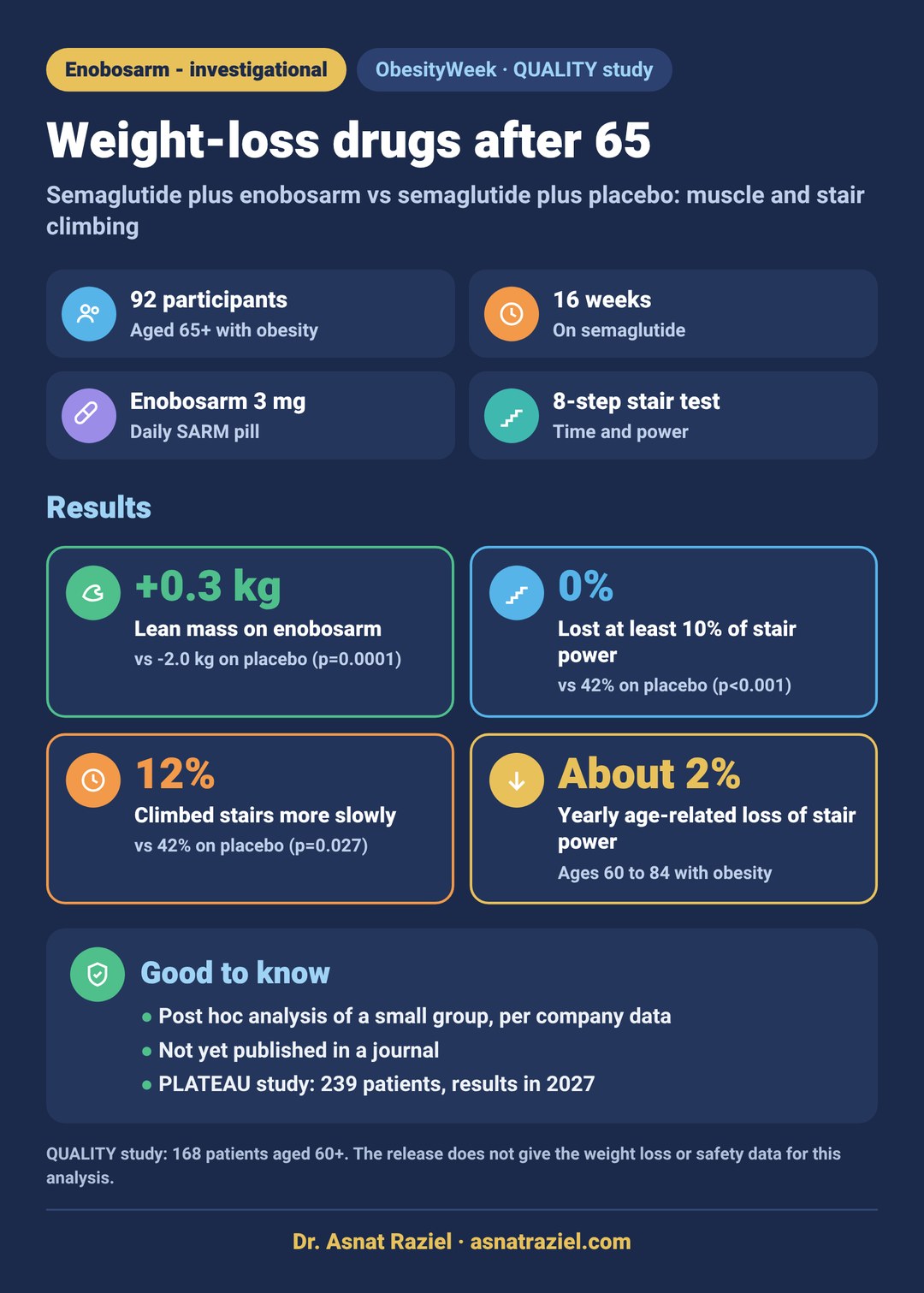
Weight loss after 65 raises an important question: what happens to muscle and everyday fitness? At ObesityWeek, the American obesity congress in Washington, Veru presented new data on this question. Among patients aged 65 and older who took semaglutide alone, 42% lost at least a tenth of their stair-climbing power. By contrast, among those who also took the experimental pill enobosarm, no one lost that much power. Enobosarm is an investigational drug and is not approved for use in Israel or the US.
Weight loss after 65 and muscle: why it matters
Losing weight improves blood sugar, blood pressure and joints. However, part of the weight that comes off is muscle. At a young age, that is less worrying. But after 65, muscle is what keeps you independent: climbing stairs, getting up from a chair and preventing falls. I wrote about this in detail in my article on the new guidelines for obesity in older adults.
What is the QUALITY study
QUALITY is a randomized, double-blind, placebo-controlled Phase 2b trial. It enrolled 168 patients aged 60 and older with obesity, and all of them received semaglutide. In addition, they took enobosarm 3 mg, enobosarm 6 mg or placebo for 16 weeks. Enobosarm is a daily pill from the SARM class, meaning it acts selectively on the male sex hormone receptor in muscle and bone.
I described the study’s overall results in my article on enobosarm for muscle preservation. At the congress, the company presented a new analysis that focuses on the older participants.
The stair test: a simple measure of function
The researchers asked participants to climb eight steps and measured time and power. In all, 164 participants completed the test at the start of the study. The test picked up a clear decline with age: among people with obesity aged 60 to 84, power dropped by about 2% per year. According to the company, this supports the test as a valid measure of real decline in function.
Weight loss after 65: what the new analysis found
The analysis included 92 participants aged 65 and older. The researchers compared enobosarm 3 mg plus semaglutide with placebo plus semaglutide after 16 weeks.
Muscle mass
A DEXA scan, a body composition test using low-dose X-rays, showed a clear difference. In the placebo group, lean mass fell by 2.0 kg. By contrast, the enobosarm group gained 0.3 kg (p=0.0001). According to the company, this means all lean mass stayed intact.
Stair climbing
- Slower stair climbing: 42% of patients on placebo vs 12% on enobosarm (p=0.027).
- A decline of at least 10% in power: 42% on placebo vs 0% on enobosarm (p<0.001).
The company says that such a decline on placebo equals seven to ten years of aging. However, the release cites no source for this comparison. Also, the release describes significant weight loss but does not give the numbers.
What to keep in mind
First, this is a post hoc analysis of a small group, not the study’s original question. Second, the data come from a company announcement and have not been published in a scientific journal. Moreover, the release does not include safety data for this analysis. Finally, the company itself notes that the FDA may not accept the stair test as a basis for approval.
What’s next: the PLATEAU study
At the same time, the company is running PLATEAU, a Phase 2b study. It enrolled 239 patients aged 65 and older with a BMI of 35 or more who are starting semaglutide. The main outcome is the change in body weight at 68 weeks. The researchers will also track muscle, fat, the stair test and bone density. An interim analysis is expected in the first quarter of 2027, with final results in the fourth quarter of 2027.
Weight loss after 65: what you can do today
Enobosarm is still far from the clinic. So the proven tools stay at the center, and it is worth starting them from the first day of treatment:
- Protein at every meal: to give muscle its building blocks.
- Regular strength training: two to three times a week. You will find practical tips in my article on strength training and muscle mass.
- Tracking body composition: not just the number on the scale.
- A simple function check: such as climbing stairs or standing up from a chair, before and during treatment.
It also helps to know the signs of muscle loss, which I describe in my article on sarcopenia and how to spot it early.
Bottom line
The new data remind us that in older age, we should judge treatment success by function, not just by kilograms. In people 65 and older, adding enobosarm preserved muscle and stair climbing. However, this was a small post hoc analysis, and we need to wait for the PLATEAU study. Meanwhile, people pursuing weight loss after 65 can protect their muscle with tools that already exist: protein and strength training.
This article is general information and does not replace personal medical advice.
References
Veru Announces Positive Topline Data from Phase 2b QUALITY Clinical Study
The study is funded by Veru, the company developing enobosarm.