By Dr. Asnat Raziel, bariatric surgeon specializing in obesity treatment, metabolic health and healthy longevity; Director of the Multidisciplinary Center for Obesity Treatment, Assia Medical, Assuta Ramat HaChayal, Tel Aviv
Switching from injection to pill: not just a matter of convenience
Switching from injection to pill is one of the most common questions in my clinic today. Many patients doing well on Wegovy or Mounjaro ask whether they can move to a daily pill. At ObesityWeek 2026, an entire session focused on this question. The speakers’ core message was clear: a request for a pill should open a conversation, not lead automatically to a prescription.
Treat the complications, not just the weight
Dr. Srivastava, who opened the session, put one principle above all others. Switching medications means choosing treatment all over again. So the first question is which complication the current treatment protects against. Convenience alone, she said, is not a sufficient reason to switch.
For example, in the US tirzepatide (Mounjaro) is approved for moderate to severe obstructive sleep apnea. In addition, injectable semaglutide (Wegovy) carries indications for reducing cardiovascular events and for fatty liver disease with fibrosis. So a patient with severe sleep apnea who switches to a pill may give up a treatment proven for their main problem.
What happens when you stop the injection
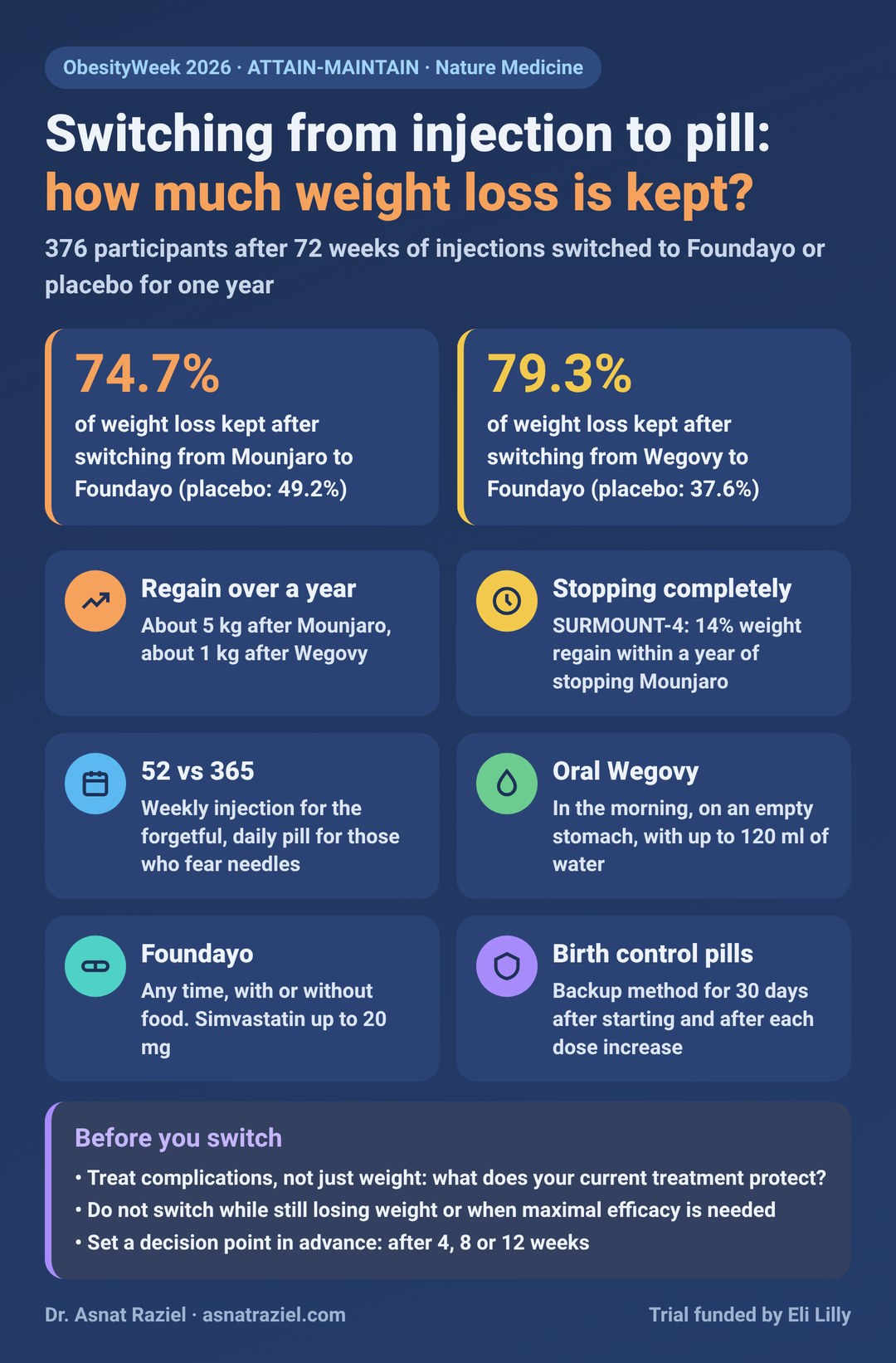
To understand the risk, it helps to know the SURMOUNT-4 trial. Participants lost an average of 20.9% of their body weight after 36 weeks of tirzepatide. After that, those who stayed on the injection lost another 5.5%. By contrast, those switched to placebo regained 14% of their weight over the following year. Moreover, the speakers described a rapid return of hunger and appetite soon after stopping.
Switching from injection to pill: what ATTAIN-MAINTAIN shows
Nature Medicine published the most important trial in this field this year. The ATTAIN-MAINTAIN trial enrolled 376 people who had completed 72 weeks of injectable treatment. Each person received Foundayo (orforglipron) or placebo, at random, for one year.
In the group switched from tirzepatide, participants kept an average of 74.7% of their weight loss on Foundayo, compared with 49.2% on placebo. Among those switched from semaglutide, maintenance reached 79.3%, compared with only 37.6% on placebo. In concrete terms, after tirzepatide participants regained about 5 kg on average over the year. After semaglutide, the average regain was only about 1 kg.
In addition, waist circumference and most cardiometabolic measures held steady. However, the trial had no group that stayed on the injection, so we cannot know exactly how much the switch "costs." The trial was also funded by the drug’s manufacturer.
Switching from injection to pill: what happens to cravings
At ObesityWeek, a new analysis of ATTAIN-MAINTAIN looked at eating control and cravings one year after switching to Foundayo. Participants completed the Control of Eating Questionnaire (CoEQ) at the start of the study and at week 52.
- People who switched from semaglutide to the pill kept all measures of eating control and cravings, with no meaningful change.
- In those who switched to placebo, control over cravings fell, and cravings for savory and sweet foods rose.
- People who switched from tirzepatide to the pill kept most of the improvement, but control over cravings fell slightly, and positive mood fell slightly.
In other words, moving from an injection to a pill preserves eating control well, especially after semaglutide. After tirzepatide, it is worth watching cravings closely in the first months. I wrote about cravings as an early warning sign in my article on keeping the weight off on Mounjaro.
A pill is mainly a maintenance tool
The speakers stressed an important practical point. Current pills are less potent than injectable tirzepatide. So anyone switching from Mounjaro to a pill should expect some weight regain. In other words, the switch fits the maintenance phase best, and the weight-loss phase less well.
For this reason, switching is not recommended for someone who is still losing weight. Anyone who needs maximal efficacy because of a related condition should also think carefully. The gap between injectable Wegovy and the new pills is smaller. Side effects after that switch tend to be more similar.
Weekly injection or daily pill: what suits you
A weekly injection means 52 decisions a year. A daily pill means 365. So the speakers advised not to ask only "what do you prefer." Instead, ask what caused missed doses. People who fear needles will benefit from a pill. On the other hand, people who tend to forget are better off staying on a weekly injection.
Other good reasons to switch include injection fatigue, trouble with refrigeration and supply, frequent travel and cost. In any case, set expectations about efficacy before the switch, not at the follow-up visit.
Oral Wegovy and Foundayo: the practical differences
Oral Wegovy (oral semaglutide)
This is a peptide, so only a small part of it is absorbed. Accordingly, you take it in the morning on an empty stomach with up to half a glass of water (about 120 ml), and wait before eating or taking other medications. It is also wise to separate it from thyroid medication. According to the guidance presented, people on 2.4 mg injectable Wegovy wait one week after the last injection and start the 25 mg pill directly.
Foundayo (orforglipron)
This is a small molecule, not a peptide. So you can take it at any time, with or without food. However, the prescribing information lists several important interactions. First, simvastatin should not exceed 20 mg a day. Second, drugs that strongly affect the CYP3A4 enzyme require adjustment. Finally, women on birth control pills need an additional method for 30 days after starting treatment and after each dose increase.
Six steps for switching from injection to pill
1. Identify the risk: which complication could worsen after leaving the current treatment?
2. Compare costs: check the price of both options over time.
3. Plan the transition: never take two GLP-1 medications at the same time.
4. Titrate according to the label: do not rush to start at a high dose.
5. Rebuild tolerance: manage digestive side effects, keep up protein and strength training, and arrange contraception.
6. Set a decision point: a review visit after 4, 8 or 12 weeks. On the day of the switch, write down when you would go back to the injection.
What if you switch to a non-GLP-1 pill?
Dr. Adam Gillman of the University of Colorado presented the limited data available. In an analysis of 40 patients who lost coverage for GLP-1 medications, average BMI fell from 36 to 27.9 during treatment. Seven months after switching to older oral medications, it stood at 27.2. The most common drug in this group was metformin.
In another study, 39 people stopped GLP-1 treatment after losing 18%. Within four months, those with no intervention regained 10.75% of their weight. By contrast, those who received a digital assistant or dietitian-planned meals regained only about 3.6%, roughly a third as much.
In his case series, three of eight patients kept most of their weight loss or kept losing. According to him, drugs such as phentermine with topiramate or Mysimba work in about half of cases. Because the mechanisms differ, this is a process of trial and error, with close follow-up. For example, with metformin we check kidney function and vitamin B12.
Further reading: switching to the Wegovy pill and choosing between a pill and an injection. See also orforglipron for weight maintenance.
Bottom line: switching from injection to pill, with good planning
Switching from injection to pill can be a good solution for the maintenance phase. ATTAIN-MAINTAIN shows that most of the weight loss is kept, especially after injectable Wegovy. However, some regain is expected after Mounjaro. So decide together with your doctor, based on your other conditions, your habits and the cost. And remember: if the pill does not work, you can always go back to the injection.
This article is general information and does not replace personal medical advice.
References
FOUNDAYO (orforglipron) tablets: Prescribing Information
Wegovy 25 mg tablets: Summary of Product Characteristics
Choosing Obesity Medication Switches: From Injectables to Oral Therapies – ObesityWeek 2026 session
The ATTAIN-MAINTAIN trial was funded by Eli Lilly, the maker of Foundayo and Mounjaro.