By Dr. Asnat Raziel, bariatric surgeon specializing in obesity treatment, metabolic health and healthy longevity; Director of the Multidisciplinary Center for Obesity Treatment, Assia Medical, Assuta Ramat HaChayal, Tel Aviv
Bone loss during weight loss: what Novo presented
Bone loss during weight loss is a well-known effect: as weight comes down, bone also loses a bit of its strength. At ObesityWeek, the American obesity congress held in Washington, Novo Nordisk presented early data on the topic. According to the company, drugs that activate the amylin and calcitonin receptors may reduce bone loss. Still, these are early signals only, not proof.
Bone loss during weight loss: why does it happen?
Bone responds to load. In other words, when the body is lighter, the bones carry less load and rebuild themselves more slowly. In addition, rapid weight loss shifts hormones that affect bone building. So a large weight loss can lower bone density a little.
This matters especially for women after menopause and for older adults, who are already at risk of osteoporosis. I’ve written about how the body changes at menopause in my article on menopause and metabolism.
Amylin and calcitonin: what’s the link to bone?
Amylin is a satiety hormone released by the pancreas together with insulin. The investigational drug cagrilintide mimics it. It also activates the receptor for calcitonin, a hormone that slows bone breakdown. CagriSema combines cagrilintide with semaglutide, the active ingredient in Wegovy.
I’ve covered this whole drug family in my article on amylin-based drugs. Keep in mind: cagrilintide, CagriSema and zenagamtide are investigational drugs that are not yet approved.
The rat study
Researchers removed the ovaries of rats, a standard model of bone loss after menopause. The rats then received treatment for eight weeks. Researchers compared them with rats that lost the same amount of weight without a drug.
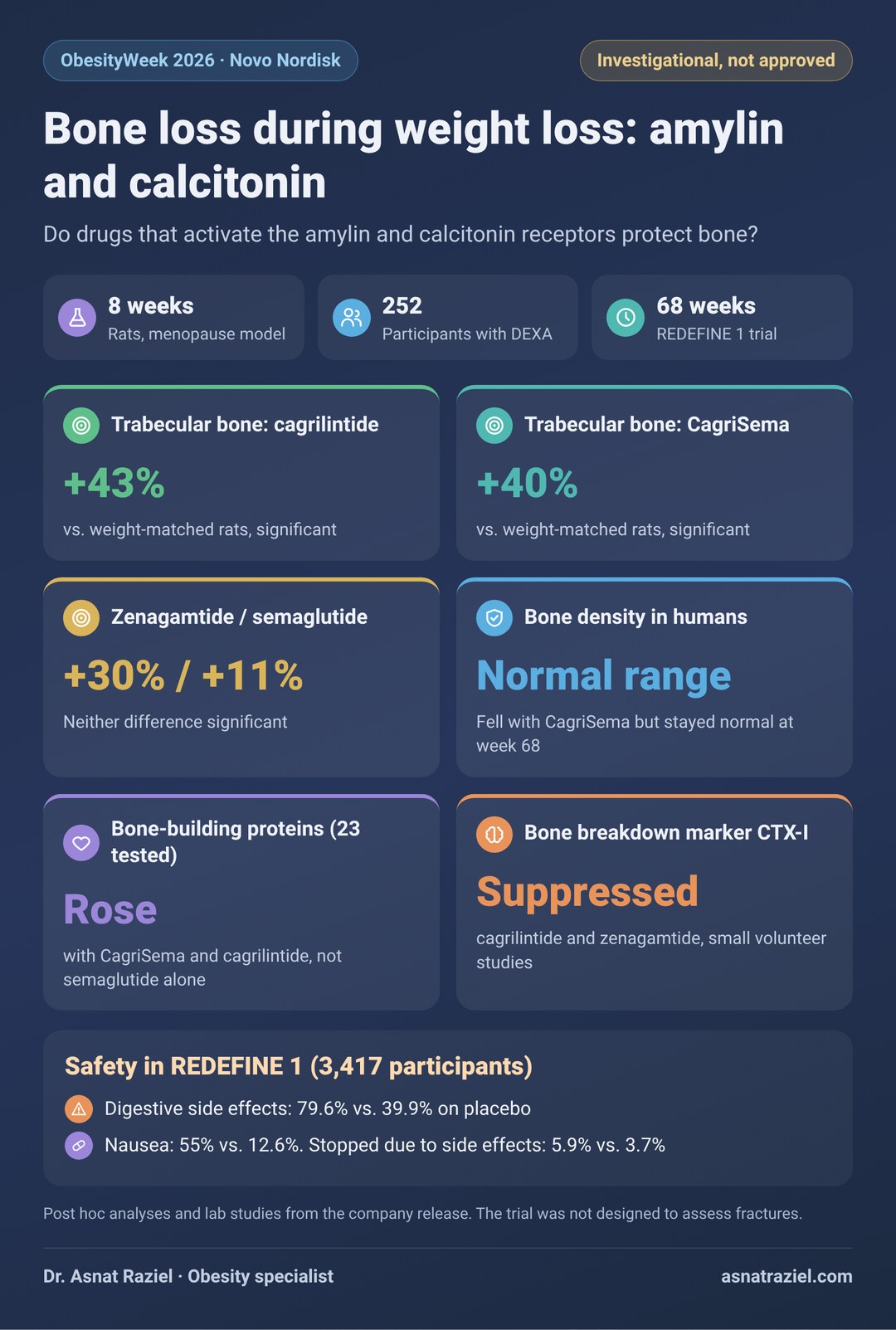
Spongy (trabecular) bone volume in the thigh bone was 43% higher with cagrilintide and 40% higher with CagriSema. Both differences were statistically significant. By contrast, the gap was 30% with zenagamtide and 11% with semaglutide, and neither was significant.
Bone loss during weight loss: what the human studies show
In small studies in healthy volunteers, cagrilintide and zenagamtide suppressed CTX-I, a blood marker of bone breakdown. On the other hand, another investigational drug that activates only the amylin receptor, without the calcitonin receptor, did not show this effect. So Novo believes calcitonin plays a role here.
What they found in REDEFINE 1
In REDEFINE 1, CagriSema’s large trial, researchers also looked back at bone. Among 252 participants who had a DEXA scan, bone density fell with CagriSema. However, at week 68 it stayed within the normal range for age and sex. The company did not publish the percentage drop.
In addition, researchers tested 23 proteins in the blood. Proteins linked to bone building rose with cagrilintide and CagriSema, but not with semaglutide alone. What’s more, the change held even after adjusting for the amount of weight lost.
The blood-protein study: signals of bone building
In a separate poster presented by Dr. Anne-Mette Bjerregaard, researchers measured thousands of proteins in blood samples from 576 participants in the phase 2 trial of cagrilintide. After 26 weeks, cagrilintide 2.4 mg raised five bone-building proteins compared with placebo: four BMP proteins (BMP4, BMP5, BMP6 and BMP7) and a protein called CHRDL2. BMP proteins stimulate the cells that build bone. The rise started by week 8 and continued through week 26.
The most interesting finding is the comparison with liraglutide, an older GLP-1 drug, at doses that produced similar weight loss. The bone-building proteins rose with cagrilintide but not with liraglutide. So the researchers suspect the effect works through the calcitonin receptor, not through weight loss itself. Still, these are blood markers only. The study did not measure bone density or fractures.
Side effects in REDEFINE 1
REDEFINE 1 followed 3,417 people for 68 weeks. Digestive side effects affected 79.6% of those on CagriSema, versus 39.9% on placebo. Nausea affected 55%, versus 12.6% on placebo. Overall, 5.9% stopped treatment because of side effects, versus 3.7% on placebo.
Bone loss during weight loss: what to keep in mind
These are post hoc analyses and lab studies, and Novo itself calls them “early signals.” In addition, REDEFINE 1 was not designed to look at fractures. Moreover, the breakdown marker CTX-I rose slightly with CagriSema compared with semaglutide. In other words, the picture is not yet clear-cut.
What this means for you
Today you can do a lot to protect your bones. First, strength training and weight-bearing activity. Second, enough protein, calcium and vitamin D. Finally, a bone density scan for those at risk. Protecting muscle goes hand in hand with protecting bone.
The bottom line
Bone health on weight loss drugs is finally getting attention. Novo’s data suggest that amylin and calcitonin may help protect bone, and the blood-protein study supports that direction. Ultimately, only dedicated trials that also track fractures will show whether this matters clinically.
This article is general information and does not replace personal medical advice.
References
Coadministered Cagrilintide and Semaglutide in Adults with Overweight or Obesity
The data were released by Novo Nordisk, the company developing the drugs.