By Dr. Asnat Raziel, bariatric surgeon specializing in obesity treatment, metabolic health and healthy longevity; Director of the Multidisciplinary Center for Obesity Treatment, Assia Medical, Assuta Ramat HaChayal, Tel Aviv
Metabolic risk in teens: not all fat is equal
Metabolic risk in teens is not determined by weight alone. Two teenagers with a similar BMI can carry very different risks of diabetes and heart disease. The difference lies in where the fat builds up, and also in family background and ancestry. That is the message of the CHARISMA study, which was the focus of a key lecture at ObesityWeek 2026.
A key lecture: looking beyond BMI
The lecture was given by Dr. Sheela N. Magge, chief of the Division of Pediatric Endocrinology and Diabetes at Johns Hopkins University School of Medicine. For many years she has studied cardiometabolic risk in children and adolescents. Her lecture asked why some children with obesity develop complications while others do not.
Her central message is clear: fat tissue is not uniform. Where fat sits matters as much as how much there is. She also urges clinicians to assess metabolic risk clustering, meaning several risk factors appearing together in the same child, rather than relying on a single definition of risk.
Visceral fat and ectopic fat: what is the difference?
Visceral fat builds up inside the abdomen, around the internal organs. Ectopic fat builds up outside normal fat tissue, inside organs such as the liver, the pancreas and muscle. Subcutaneous fat, by contrast, sits just under the skin.
According to Dr. Magge, it is the fat inside the abdomen and inside organs that is linked to complications, more than total body fat. This helps explain why adults and teens of similar weight can differ so much in their risk.
What did the CHARISMA study examine?
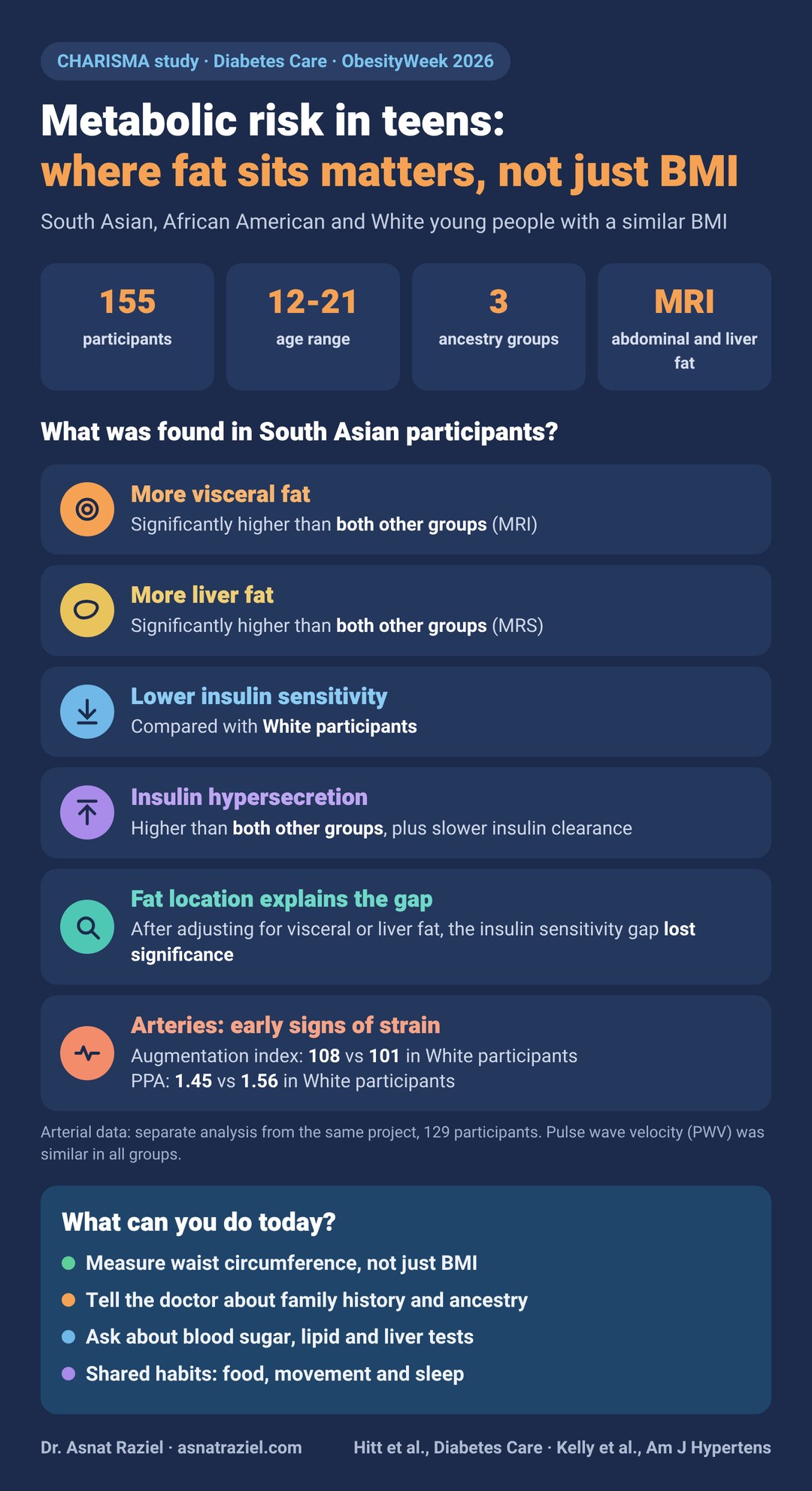
The NIH-funded study compared three groups of adolescents and young adults aged 12 to 21: South Asian Americans, African Americans and White Americans. All participants had a BMI of 23 or higher, or were above the 80th percentile for their age.
The researchers measured abdominal fat with MRI and liver fat with MRS, an imaging method that quantifies fat inside the liver. Participants also had an oral glucose tolerance test (OGTT) to measure insulin sensitivity and insulin secretion.
The analysis included 53 South Asian, 53 White and 49 African American young people. Median age was 20.3 years in the South Asian group, 19.1 in the White group and 18.8 in the African American group. The groups were similar in sex, pubertal stage and age-adjusted BMI (BMI-Z).
Metabolic risk in teens of South Asian ancestry
The results were consistent. Despite a similar BMI, South Asian participants had significantly more visceral fat than both other groups. Their liver fat was also significantly higher than in both groups.
Their insulin sensitivity was lower than in White participants. In other words, their bodies needed more insulin to keep blood sugar in check. Indeed, their pancreas secreted more insulin than in both other groups, and they also cleared insulin from the blood more slowly.
The next finding was especially striking. When the researchers accounted for visceral fat or liver fat, the gap in insulin sensitivity was no longer significant. Fat location explained much of the difference. Even so, the higher insulin secretion remained after this adjustment.
The researchers suggest that this insulin hypersecretion may come before the insulin deficiency described in South Asian adults. It is an early warning sign that already appears at a young age.
Blood vessels tell another story
In a separate analysis from the same project, the researchers examined arterial stiffness in 129 adolescents and young adults aged 12 to 21. Mean BMI was similar across the three groups: 27.1, 28.4 and 27.4. Pulse wave velocity (PWV), a common measure of arterial stiffness, was similar in all groups. Pulse wave analysis, however, revealed differences.
The augmentation index, which reflects how much the reflected pulse wave raises pressure in the central arteries, was 108 in South Asian participants versus 101 in White participants. Pulse pressure amplification (PPA) was lower in South Asian (1.45) and African American (1.48) participants than in White participants (1.56).
Lower PPA is linked to a higher likelihood of future cardiovascular events. The researchers note that these findings may reflect an early predisposition to heart disease, at an age when young people look healthy. This is also the stage at which intervention may lower the risk.
What does metabolic risk in teens mean for families?
The study was done in the United States and looked at specific ancestry groups, so its numbers cannot be applied as they are to children elsewhere. The principle, though, applies to every family: metabolic risk in teens depends on where fat is stored, on family background and on genetics, not only on weight.
Dr. Magge recommends that risk assessment consider ancestry and background, cardiovascular risk, family history and genetics. She also stresses that more pediatric research is needed. A follow-up study is already tracking the participants into adulthood to understand the differences and the mechanisms behind them.
Practical steps for parents and teens
Early detection is an opportunity, not a reason to worry. Here are steps you can take today:
Look beyond BMI. Ask the doctor to measure waist circumference too, since it predicts risk better than BMI alone.
Share your family history. Diabetes, fatty liver or early heart disease in the family is important information. Share it with the doctor, along with your family’s ancestry.
Ask about blood tests. For teens with excess weight and risk factors, the doctor may consider tests for blood sugar, lipids and liver function. Fatty liver is a silent disease, so it is worth looking for it.
Change habits as a family. Healthy eating, less ultra-processed food, physical activity and good sleep are the foundation. Fat inside organs also responds to change: in an Israeli study in adults, a green Mediterranean diet reduced pancreatic fat by 14%.
Know that effective treatments exist. When obesity persists, there are solutions for teens today. Treatment of obesity in children and teens includes multidisciplinary care and, where appropriate, medication, as the SURMOUNT-ADOLESCENTS trial showed.
Further reading: visceral fat and metabolic health and Mounjaro for teens. See also the STEP TEENS trial.
The bottom line
Metabolic risk in teens starts to develop early, sometimes without visible signs. The CHARISMA study shows that where fat sits, not only how much there is, explains much of that risk. The right approach is personal: assess each child’s full set of risk factors and act in time. The good news is that at a young age, we have time and we have tools.
This article is general information and is not a substitute for personal medical advice.
References
Diabetes and cardiometabolic risk in South Asian youth: A review
A leading clinical investigator makes the case for pediatric metabolic risk clustering
The CHARISMA study was funded by the US National Institutes of Health (NIH).