By Dr. Asnat Raziel, bariatric surgeon specializing in obesity treatment, metabolic health and healthy longevity; Director of the Multidisciplinary Center for Obesity Treatment, Assia Medical, Assuta Ramat HaChayal, Tel Aviv
Lifestyle medicine reimbursement: why most patients still can’t get it
Lifestyle medicine reimbursement was the focus of one of the most important sessions on the final day of the LM2026 Lifestyle Medicine Conference. We already know that nutrition, movement, sleep and stress management can change the course of chronic disease. Yet most patients still never receive this kind of care. So the president of the American College of Lifestyle Medicine asked a simple question: why doesn’t it reach everyone?
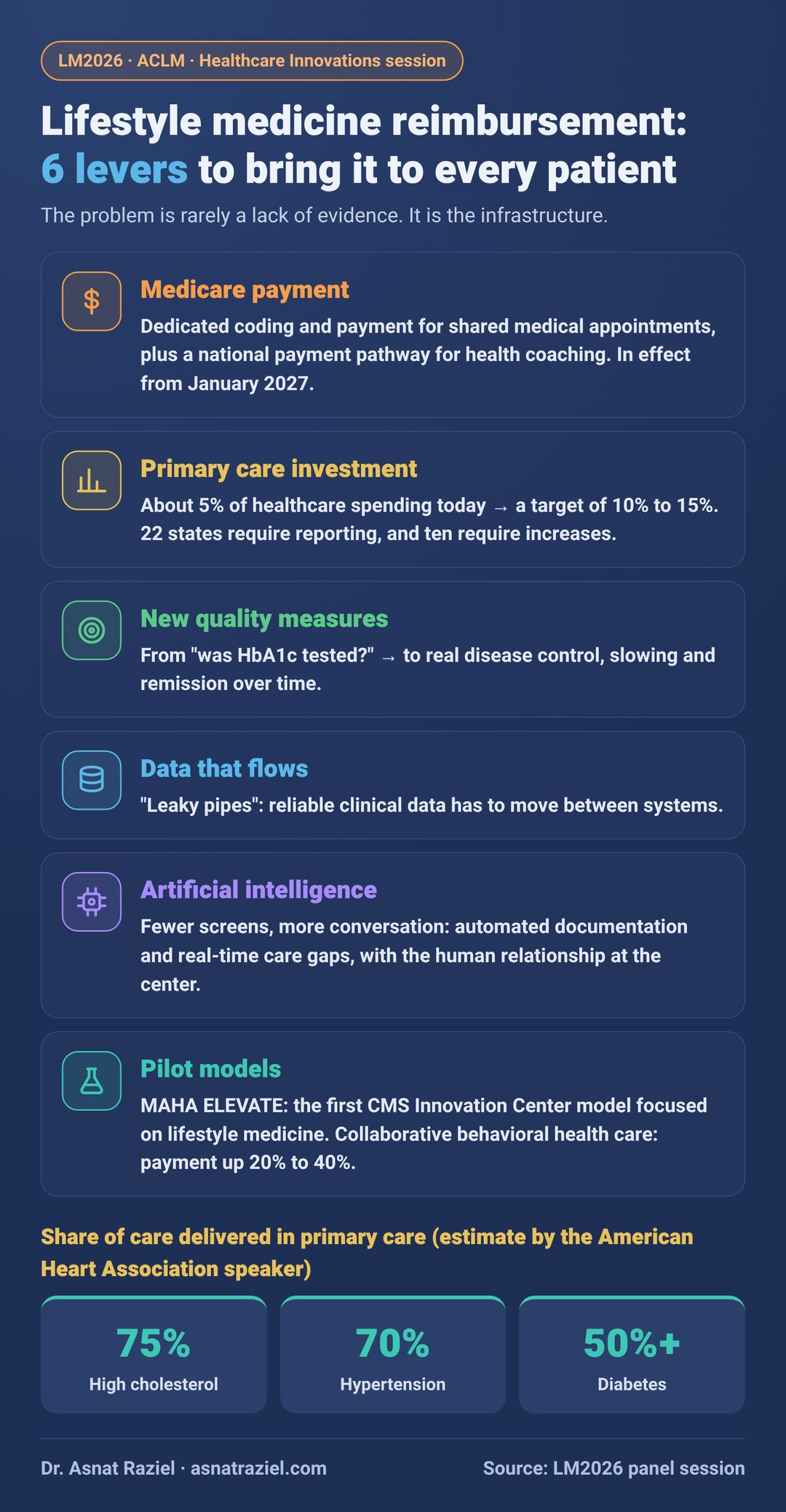
The answer from the stage was encouraging. The problem is rarely a lack of evidence. The problem is infrastructure: how we pay for care, how we measure it, how we capture data and, increasingly, how we use AI. These four levers will decide whether lifestyle medicine stays a boutique service or becomes the standard of care.
Who was on the panel
The session was moderated by Dr. Padmaja Patel, president of the American College of Lifestyle Medicine (ACLM). Four people who hold those levers joined her. Dr. Jake Quinton is chief medical officer for Medicare Parts A and B at CMS, the agency that runs Medicare. In addition, Dr. Vivek Garg leads NCQA, the organization behind the most widely used quality measures in American healthcare. Dr. Karen Johnson heads practice advancement at the American Academy of Family Physicians (AAFP). Finally, Ann Greiner leads the Primary Care Collaborative (PCC), which advocates for investment in primary care.
The opening: diabetes is not a one-way street
Just before the panel, a speaker from the American Heart Association offered an important framework. Diabetes is part of a single continuum of cardiovascular, kidney and metabolic health. That continuum starts with ideal heart health and moves through four stages to full-blown disease. However, the science shows that people can also move backward, reaching some degree of diabetes remission and returning toward health.
In his words, the order is clear: health promotion first, prevention second and treatment third. Moreover, the earlier we identify a problem and intervene, the more likely we are to bring the body back to health. By his estimate, primary care physicians provide roughly 75% of care for high cholesterol, about 70% of hypertension care and more than 50% of diabetes care. Yet their funding does not match that share of the work. The projected path of heart disease through 2050 is sobering, he said, but it can still be changed.
Lifestyle medicine reimbursement in Medicare: new codes for coaching and group visits
Dr. Patel opened with thanks. For years, clinicians delivered shared medical appointments and health coaching with no clear way to bill for them. This year, the 2027 Medicare Physician Fee Schedule created dedicated coding and payment for shared medical appointments, along with a national payment pathway for health coaching. The rules take effect in January 2027.
Dr. Quinton explained the reasoning. CMS has a three-part strategy: pay accurately for services, empower patients to make informed decisions about their health and grow accountable care organizations (ACOs). Shared medical appointments could already be billed, but the rules were gray, so CMS clarified them. Health coaching, on the other hand, used to be priced by regional contractors, and CMS set national rates instead.
The real problem: paying per visit
Dr. Johnson pointed out that whole-person care is not a new idea. Family medicine was born for exactly this purpose. She cited Barbara Starfield’s four Cs of primary care: first contact, continuous, coordinated and comprehensive. Still, the payment system is built around visits and transactions. “We are not those things,” she said. “We are whole people.” Much of care is not a pill, a procedure or a visit, but team work that supports patients even outside the office.
Dr. Garg asked why primary care is not at least 10% of healthcare spending. He noted that at least one third of Americans report having no usual source of care. Ann Greiner added that spending sits at about 5% today and needs to rise to 10% to 15%. Furthermore, 22 states require health plans to report primary care spending, and ten of them require that spending to grow.
New models for lifestyle medicine reimbursement
Greiner described a structural barrier. Under budget neutrality in the Medicare fee schedule, any increase for one group of clinicians requires a cut for another. That makes it hard to raise primary care investment there. The routes around it are legislation, state action and value-based models. For example, two bills introduced this summer propose hybrid payment: a fixed monthly amount per patient alongside fee-for-service. One of them proposes $10 billion for primary care over five years.
In addition, CMS is running the MAHA ELEVATE model, the first Innovation Center model focused on lifestyle medicine. According to Quinton, the goal is to generate direct evidence on the effectiveness and cost of this approach. At the same time, CMS is raising payment for the collaborative care model for behavioral health by 20% to 40% and revaluing tobacco cessation counseling codes. He asked practices for one thing: share the real dollars-and-cents cost of delivering evidence-based care.
Quality measures: from an HbA1c test to real disease control
One of the strongest moments of the session was about measurement. According to Dr. Garg, most quality measures were built 20 to 30 years ago from claims data, simply because it was available. But that data is superficial and captures isolated moments. Today we measure, for example, whether a patient had an HbA1c test (glycated hemoglobin, the average blood sugar over the past three months). The question that matters, however, is whether the diabetes is under control and whether the disease is slowing or even reversing.
That is why NCQA is exploring a new generation of longitudinal measures: cardiovascular risk reduction, cardiometabolic disease and chronic kidney disease. These require reliable clinical data that moves between systems. Quinton described health data exchange as “leaky pipes.” Johnson compared it to gravel roads on which every organization paves its own private route. Without good measurement, lifestyle medicine reimbursement is hard to justify.
AI: fewer screens, more conversation
On artificial intelligence, the speakers were optimistic but careful. Dr. Garg described automation that could cut manual chart review and flag care gaps in real time. That would free teams to focus on what matters: acting with patients and their families. NCQA is launching an AI learning collaborative, because these systems may give different answers to the same question.
Johnson said family physicians are excited about ambient listening tools that document the visit. The reason is simple: they can look at the patient again instead of the screen. At the same time, she stressed that relationships, data quality and professional accountability must stay at the center. Quinton noted that some patients already turn to ChatGPT first. For annual wellness visits, he said, AI can gather much of the information ahead of time, while the clinician-patient conversation remains the service Medicare pays for.
Joy returns to the practice
Johnson presented case studies of practices that adopted lifestyle medicine. They ranged from small practices to large academic centers. Most used shared medical visits, health coaches and behavior change programs, usually with existing staff and simple tools. The recurring theme was joy. Clinicians said they once again feel they are truly helping patients. That matters a great deal, because physicians and staff are leaving primary care faster than they are being replaced.
A striking example was Jamaica Hospital in New York. About 60% to 70% of its revenue comes from risk-based contracts. A trusted family physician made the business case, and the system is now building a four-story building with a culinary kitchen for underserved communities. The conference also showcased a large health system that turned prevention into strategy.
What this means for you today
The discussion was about the American system, but the message applies everywhere. Large health systems are starting to pay for what works: shared medical appointments, health coaching and long-term follow-up. In the end, though, real change happens with the patient. So you can start now:
- Ask your doctor whether your health plan offers a workshop or group program for lifestyle change, weight loss or diabetes.
- Ask for long-term follow-up, not a single test: weight, waist circumference, HbA1c, blood pressure and blood lipids.
- Lean on a team: a dietitian, psychologist, coach or physical therapist. At our center, the multidisciplinary team works together around each patient.
- Use digital tools wisely, such as a glucose sensor, and share the data with your care team.
Remember too that most chronic diseases are preventable. The new obesity and diabetes medications work best when they are combined with a healthy lifestyle.
The bottom line on lifestyle medicine reimbursement
The conference showed that lifestyle medicine reimbursement is no longer a dream. New codes, pilot models and smarter quality measures are building an infrastructure in which lifestyle medicine can be available to everyone. Even so, the speakers agreed that slow, incremental change is not enough, and that a broad movement of clinicians, patients and communities is needed.
This article provides general information and does not replace personal medical advice.
References
Calendar Year (CY) 2027 Medicare Physician Fee Schedule Final Rule
Physician advocates urge Congress to counter cuts in final 2027 Medicare Physician Fee Schedule
Session “Healthcare Innovations: Payment, Quality, Technology, Digital Transformation, and AI that Support Lifestyle Medicine in Practice,” ACLM LM2026 conference