By Dr. Asnat Raziel, bariatric surgeon specializing in obesity treatment, metabolic health and healthy longevity; Director of the Multidisciplinary Center for Obesity Treatment, Assia Medical, Assuta Ramat HaChayal, Tel Aviv
Whole person health inside a hospital system: my third morning at LM2026
Whole person health is more than a spa slogan. On the third morning of the Lifestyle Medicine conference in Orlando, I heard how a large hospital system turned it into strategy. Leadership, physicians and the community work on it together. So this session answered a question I have asked for years: how do you build prevention into medicine designed to treat disease?
The panel was moderated by Dr. Padmaja Patel, President of the American College of Lifestyle Medicine (ACLM). Three leaders from HonorHealth in Arizona joined her. Todd LaPorte is the system’s CEO. Dr. Tiffany Pankow leads caregiver wellness and patient experience. Dr. Shad Marvasti is the founding executive director of its Whole Health Institute.
Who is HonorHealth?
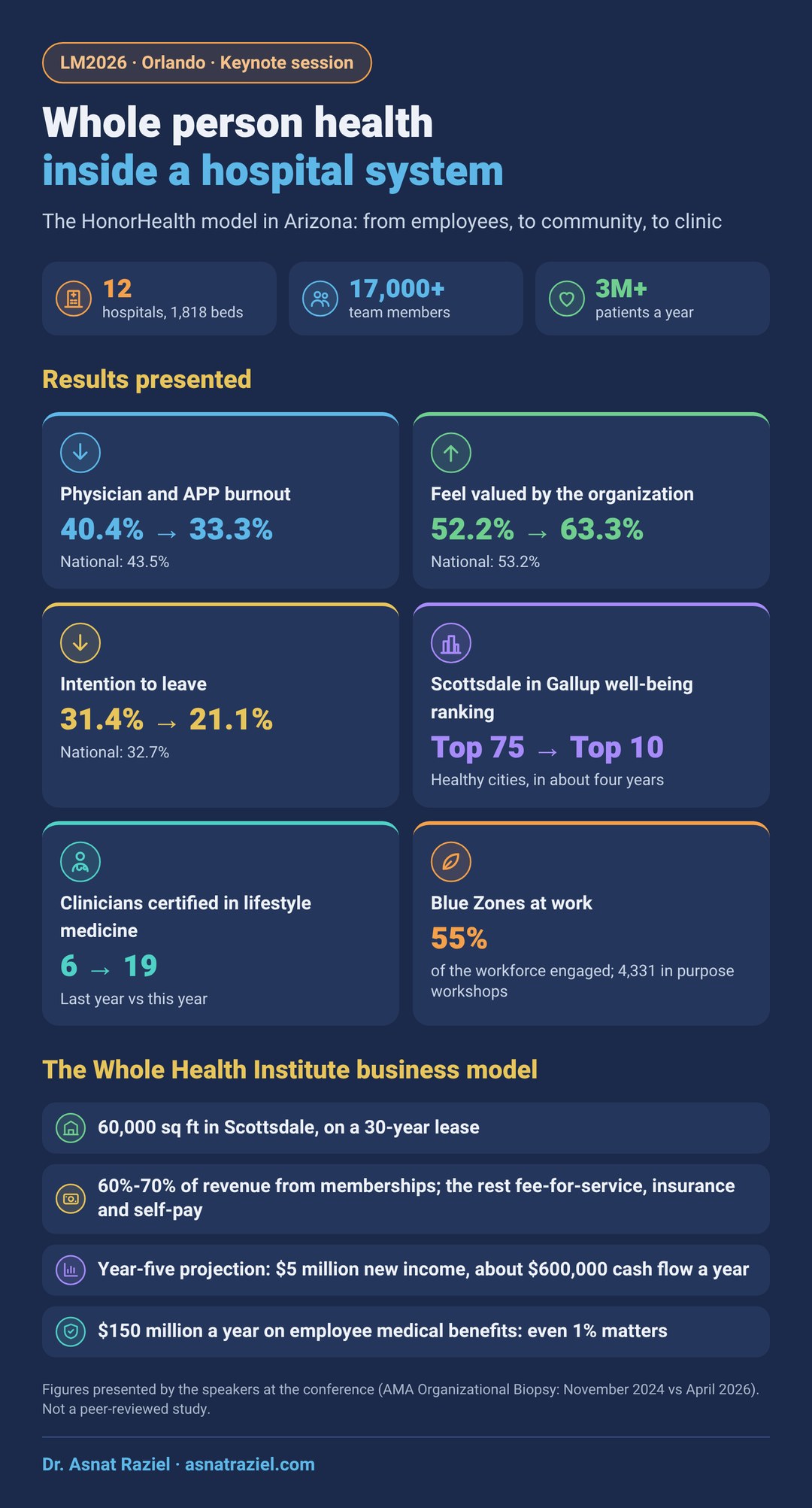
This is a very large system. According to the figures presented, it has 12 hospitals with 1,818 beds. It also employs more than 17,000 team members and serves more than 3 million patients a year. Still, size was not the main message. The message was that even a system this big can change direction.
Why whole person health pays off for a health system
LaPorte started with money. He said the system’s mission is to improve the health and well-being of the people it serves, not only to treat acute conditions. He then gave four economic arguments.
First, patients arrive sicker than before. Inactivity, processed food and obesity are raising acuity. However, reimbursement does not reflect that rise. Second, building beds is very expensive. In other words, managing demand through prevention avoids heavy capital spending. Third, there is a shortage of physicians, nurses and allied health professionals. Finally, a system that invests in community health builds trust. And when people get sick, they go to the people they trust.
The workforce as a test case
LaPorte also pointed to his own employees. HonorHealth spends 150 million dollars a year on medical benefits for 20,000 employees and dependents. Even a 1% improvement, he said, is real money. He added that depression and anxiety are the two most medicated conditions in that plan. A 25% reduction would free millions to reinvest.
How do you win over physicians?
Dr. Pankow said six clinicians earned lifestyle medicine certification last year. This year, 19 are going through it. The response surprised her. Many physicians feel the current approach is not delivering the results they want. After all, clinical guidelines already list lifestyle as the first tier of treatment.
What convinced them? Patient stories of changed outcomes, research evidence, and certified colleagues describing changes in their own health. Today there are trained physicians in neurology, cardiology, bariatrics, emergency medicine and hospital medicine. As a result, a referral network is forming among doctors who speak the same language.
Two tips for leaders
First, fund the training so clinicians do not pay out of pocket. At HonorHealth, philanthropy and the CEO’s personal backing made this possible. Second, partner with ACLM for education and data that help win executive support. Also, not everyone needs full board certification. Shorter courses for the whole team spread the load.
LaPorte added a lesson learned. Give people time to build relationships across service lines. Only then do they redesign clinical pathways together.
A whole person health institute: the business model
At the heart of the plan is the Whole Health Institute in Scottsdale. It will serve the entire Phoenix metro area, home to about 5.5 million people. It addresses five dimensions: physical, mental, emotional, spiritual and social health.
The building will house a teaching kitchen, a spa and meditation area, and a medically supervised fitness floor. It will also have a pool, a basketball court, yoga, acupuncture, a sleep lab and support groups. More importantly, bariatrics, sports medicine, orthopedics, cardiology, women’s health and the integrative and lifestyle medicine clinic will all work under one roof.
The numbers
The facility covers 60,000 square feet on a 30-year lease. About 60% to 70% of revenue is expected to come from memberships. Fee-for-service, insurance and self-pay will make up the rest. By year five, the institute is projected to bring 5 million dollars of new income to the system, with cash flow of about 600,000 dollars a year. In addition, the HonorHealth Foundation raises 50 to 60 million dollars a year, and has set a goal of one million dollars a year for this work.
Whole person health for caregivers: systems first, then the individual
Can you ask an exhausted team to work on wellness too? Dr. Pankow said you fix the system first: teamwork, efficiency and removing barriers. Research shows that spending even 20% of work time on purpose-aligned work helps reduce burnout. Even so, she stressed that people also need personal tools. Lifestyle medicine offers them through its six pillars.
Results were tracked with the AMA Organizational Biopsy. Between the first and third surveys, burnout among physicians and advanced practice providers fell from 40.4% to 33.3%. By comparison, the national figure was 43.5%. Meanwhile, the share who feel valued by the organization rose from 52.2% to 63.3%. Intention to leave dropped from 31.4% to 21.1%.
Blue Zones at work and in the community
HonorHealth also adopted Blue Zones. The program draws on the places in the world where people live the longest healthy lives. At work, it acts on three levels: people, places and policy. For example, cafeterias moved to plant-forward menus, and managers learn how to support their teams emotionally.
By the end of year two, 55% of the workforce had taken part. In addition, 4,331 people joined purpose workshops and 3,537 joined Moais, small standing social groups. Overall, employees logged more than 12,700 Blue Zones experiences. Voluntary turnover stood at 16%.
From the top 75 to the top 10
In the community, HonorHealth helped launch a citywide project in Scottsdale with the city, Cigna and Goodwill. LaPorte said it was roughly the 75th Blue Zones community project and only the second in a large urban area. At baseline, the Gallup well-being assessment ranked Scottsdale among the top 75 healthy cities. Now, about four years later, it ranks in the top 10. LaPorte himself walks with neighbors every two weeks.
How to measure whole person health
Dr. Pankow supports ACLM’s effort to standardize quality and cost measures. Still, she believes we should also measure patient loyalty, patient experience, and caregiver engagement and meaning. Patients at their lifestyle medicine clinics rate their experience very highly, she said. At a time of confusion and low trust in health information, that is an asset.
Finally, LaPorte shared that he will step down as CEO in March. He will stay on as a strategic advisor to his successor, who asked him to keep this work alive. In his view, the approach is now part of the culture and bigger than any single leader.
What this means for us in Israel
As the director of a multidisciplinary obesity center, I heard confirmation of the path we are on. Obesity care is no longer just a drug or an operation. It needs a team for nutrition, movement, sleep and emotional eating. It also needs an organization built to deliver all of that.
I took away three practical lessons. First, prevention is a financial decision, not only a medical one. Second, investing in staff health is the natural place to start. Third, train physicians across specialties so referrals flow. Similar ideas came up in another LM2026 talk on the four dimensions of sleep.
The bottom line
Whole person health can move from vision to action inside a health system. The conditions are clear: leadership commitment, a business model, physician training and consistent measurement. At HonorHealth it began with employees, moved into the community and is now reaching the clinic. It is a map worth reading closely, because most chronic disease is preventable.
This article is based on a conference discussion and on data the speakers presented. It is general information, not personal medical advice.
References
LM2026 Agenda – American College of Lifestyle Medicine
HonorHealth launches Whole Health Institute focused on prevention and whole-person care
HonorHealth Blue Zones Project – Scottsdale, AZ
Burnout high where you practice? AMA “biopsy” helps find out why
Texas Health Resources becomes nation’s largest employer to become Blue Zones Project Approved