By Dr. Asnat Raziel, bariatric surgeon specializing in obesity treatment, metabolic health and healthy longevity; Director of the Multidisciplinary Center for Obesity Treatment, Assia Medical, Assuta Ramat HaChayal, Tel Aviv
Staying healthy in wartime: why it matters right now
Staying healthy in wartime may not be the first thing on your mind, but it matters more than ever. A siren in the middle of the day, constant news updates, worry about your children and your parents. Through all of this, we still have to keep living, working, caring for others and running a home. That is exactly why we need to talk about health now. Not as an escape from reality, but as a way to face it with strength and clarity.
The body reacts to the security situation right away. The nervous system shifts into high alert, cortisol levels rise, sleep changes and appetite swings. Some people lose their appetite, while others feel a strong urge for sweets and carbohydrates. This is not weakness; it is biology. The body is looking for comfort and calm, and the question is how to manage that wisely.
What war does to the mind: the data from Israel
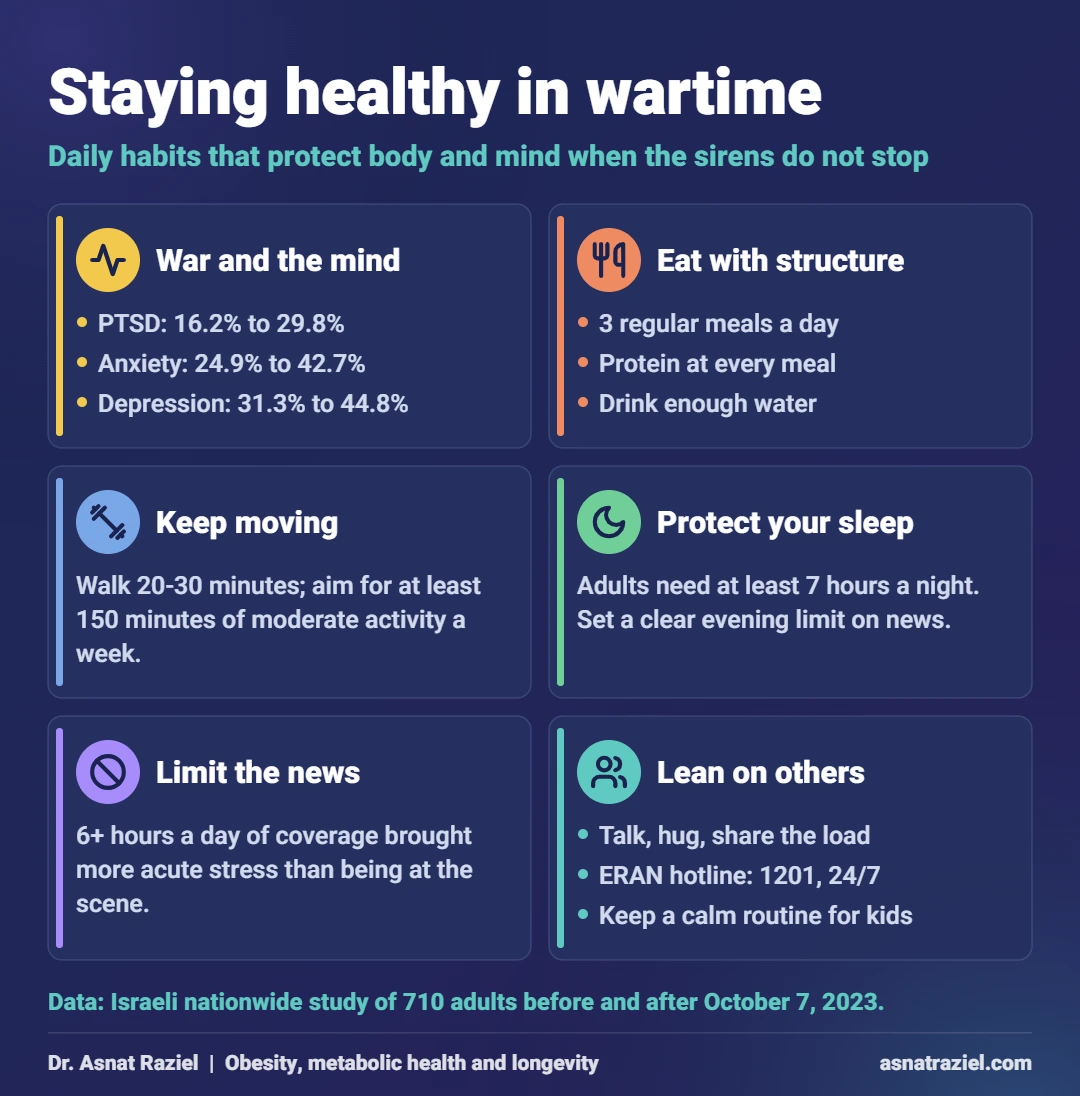
Israeli research shows how heavy the burden is. In a nationwide study, researchers followed 710 Israelis before and after October 7, 2023. The estimated rate of PTSD (post-traumatic stress disorder) nearly doubled, from 16.2% to 29.8%. At the same time, the rate of generalized anxiety rose from 24.9% to 42.7%, and the rate of depression rose from 31.3% to 44.8%.
These numbers are not a reason for despair. Instead, they remind us that a stress response is a natural response, and that it is okay to ask for help. Once we understand this, guilt fades, and we can act with awareness.
What happens to the body under ongoing stress
When stress lasts for weeks, the body switches into survival mode. The heart rate rises slightly, the muscles stay tense and the digestive system changes its rhythm. Over time, high cortisol affects blood sugar balance, sleep quality and mood. That is why fatigue and brain fog are so common in a period like this. I have written at length about the link between stress, metabolism and weight in my article on stress and weight gain. For related reading, see my article on whether the body really adapts to war.
Eating under stress: a structure that calms
The foundation is a simple, clear eating routine. Three regular meals a day create a sense of stability. At each meal, include a source of protein, such as eggs, yogurt, fish, chicken or legumes. Alongside the protein, add vegetables and a moderate portion of whole-grain carbohydrates. Protein steadies blood sugar and helps you stay full for longer.
When a craving for something sweet comes up, it is better to choose a small, defined portion. A square of dark chocolate after a meal is not the same as eating on autopilot in front of the late-night news. Drinking enough water is also essential. Even mild dehydration can cause headaches and fatigue, and these symptoms are easy to mistake for stress.
The key is awareness and gentleness: not fighting ourselves, but managing ourselves. If you recognize emotional eating in yourself, you will find practical tools in my article on emotional eating in wartime.
Staying healthy in wartime starts with movement
The body needs a physical outlet for stress. There is no need for extreme workouts. A 20- to 30-minute walk, stretching, gentle yoga or deep-breathing exercises all help reduce stress. According to the World Health Organization, physical activity reduces symptoms of depression and anxiety in adults. The general recommendation is at least 150 minutes of moderate activity a week.
Beyond that, movement restores a sense of control over your body when the world outside is beyond your control. Even a short walk near home, close to your safe room, is an important step. To choose the right type of activity for you, you can read about aerobic versus strength training.
Sleep: the anchor of staying healthy in wartime
There is no resilience without sleep. The American Academy of Sleep Medicine recommends that adults regularly sleep at least seven hours a night. During a war, however, many of us stay glued to the news until late. So it is worth setting a clear limit on news in the evening hours.
A warm shower, dim lighting and a regular bedtime routine signal to the nervous system that it can relax. Even if your sleep is not perfect, every small improvement in its quality helps your immune system and your ability to make sound decisions. You will find more ideas in my article on sleep, tiredness and appetite.
Staying healthy in wartime means setting limits on the news
Nonstop news consumption is not just tiring. In an American study after the Boston Marathon bombing, people who watched six or more hours of coverage a day reported higher acute stress than people who were at the scene itself. In other words, the screen itself can deepen distress.
That is why it helps to pick two or three set times a day to catch up on the news and to turn off nonessential alerts. Of course, alerts from the Home Front Command (the IDF’s civil-defense authority) must stay on.
Mental health: strength is not suppression
Being strong does not mean not feeling. An open conversation with a partner, a friend or a colleague eases the emotional load. A hug, a kind word and a sense of togetherness reduce stress in a way no supplement can. The World Health Organization has published an illustrated guide to coping with stress, with short exercises that take a few minutes a day. Here on the site, too, you will find simple stress-relief techniques.
And for anyone who feels overwhelmed: ERAN, Israel’s emotional first aid hotline, is available at 1201 around the clock, anonymously and free of charge. Community is medicine, and mutual responsibility is resilience.
Children and family: stability amid uncertainty
Children sense the atmosphere, even when they do not hear all the details. A simple daily routine, shared meals and calm, eye-level conversation give them a sense of security. UNICEF recommends first finding out what your child knows and how they feel, and then explaining calmly and in an age-appropriate way. In addition, it recommends limiting the flow of news for children, too. When parents breathe calmly and convey a steady message, children learn from them how to regulate themselves.
Don’t put life on hold
It is tempting to stop everything until things are quiet again. But life does not wait. Keep cooking, laughing, planning ahead and taking short walks. This is not ignoring reality; it is a declaration of life. The body and mind need moments of routine to stay resilient.
The bottom line on staying healthy in wartime
The war is fought outside, but stability is built inside. A balanced body supports a steady mind, and a steady mind allows for sound decisions and calm dialogue. Therefore, staying healthy in wartime is not a luxury but a mission. When we strengthen body and mind, we also strengthen the society around us. Ultimately, even in a hard reality, we can choose not only to survive but also to grow stronger.
The information in this article is general and does not replace personal medical advice.
References
Media’s role in broadcasting acute stress following the Boston Marathon bombings
Doing What Matters in Times of Stress: An Illustrated Guide
How to talk to your children about conflict and war
ERAN: emotional first aid by phone and online (Kol Zchut, in Hebrew)