By Dr. Asnat Raziel, bariatric surgeon specializing in obesity treatment, metabolic health and healthy longevity; Director of the Multidisciplinary Center for Obesity Treatment, Assia Medical, Assuta Ramat HaChayal, Tel Aviv
The Book of Esther in days of missiles
This year, we read the Book of Esther in the middle of a military campaign. The operation against Iran began on February 28, 2026, and Purim fell on March 3, four days later. Purim is the Jewish holiday that celebrates the story told in the Book of Esther. The skies thundered, and public debate was tense. Amid all this noise came a holiday born in the Persian Empire, and it invited us to look deeper.
My goal was not to draw a simplistic comparison between ancient Persia and today’s Iran. Instead, I wanted to understand what power is, what sovereignty is, and which values are born precisely when the fire flares up. Those days were not just another string of headlines. They were a chapter.
Purim is a holiday of reversal
Purim is not a holiday of denial. It is a holiday of reversal, and that reversal is not only diplomatic or military. It is a reversal of consciousness. That is why we read the scroll differently this year. History did not repeat itself, but we are no longer the same people. We have a state, we have responsibility, and we have a chance to choose who we will be in the middle of the storm.
The king’s ring in the Book of Esther
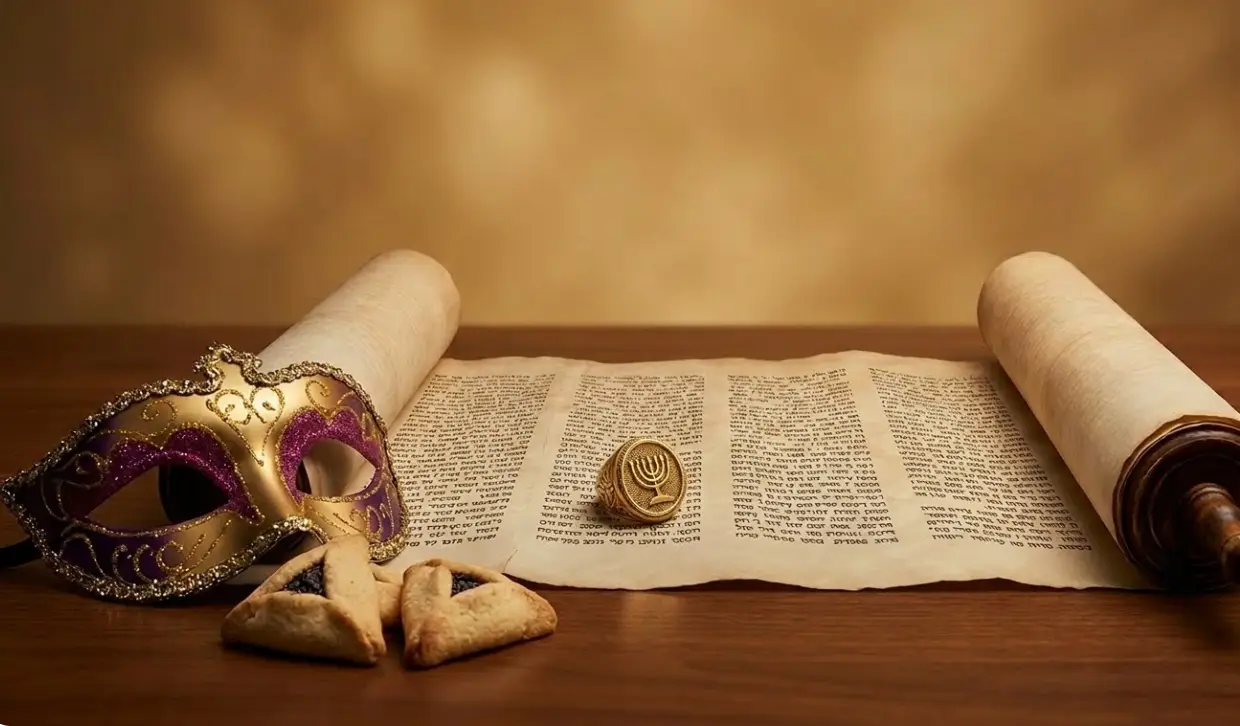
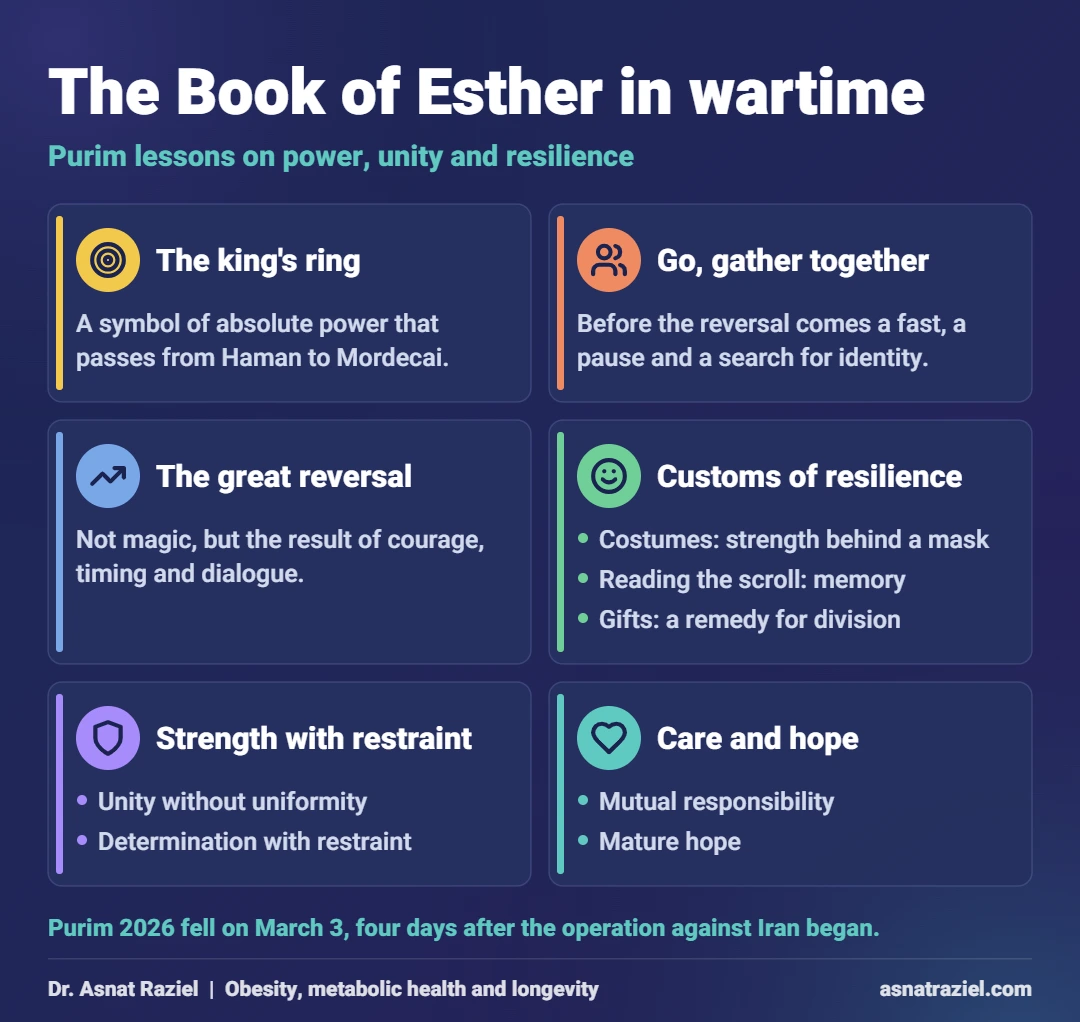
The Book of Esther includes a detail that seems minor but is dramatic: the king’s signet ring. King Ahasuerus takes off his ring and gives it to Haman. With it, he hands Haman the authority to sign in his name. One signature, one seal, and the decree becomes a law that cannot be revoked. In other words, the ring symbolizes absolute concentration of power. Power like this decides the lives of many without ever meeting them face to face.
The ring is also a symbol of vulnerability. The Jews of Shushan, the Persian capital, had no ring, no army and no sovereignty. Their fate depended on the will of a foreign ruler. One person, in one moment, was enough to sketch a dark future for them.
Today, reality is completely different. We are not a people waiting to see who will hold the ring. We have sovereignty, an army and democratic institutions. Yet precisely because we have power, we must ask how we use it. Sovereignty is not only the right to act. It is also the responsibility to act with morality, restraint and clarity.
The story in the Book of Esther: not a battle, but a process
The scroll does not describe a glorious battlefield. There are no heroes in armor. Instead, there are people, political intrigue, mistakes and blindness. Above all, there is a coming together.
“Go, gather together all the Jews.” This is a decisive moment. Before the turnaround, before the feasts and before the joy, there is a fast. There is a pause and a search for identity. Haman described the Jews as a people “scattered abroad and dispersed,” because he saw weakness in division. Mordecai and Esther understood that the response was not only political. It was communal, and it was a matter of consciousness.
The reversal, “it was turned to the contrary,” is not magic. It is the result of courage, timing and dialogue. Esther goes in to the king without a sword, but with responsibility. She understands that true power is not only outward strength. It is the ability to speak, to influence and to change direction.
At the end of the story, the same ring passes from Haman to Mordecai. The symbol of the decree becomes a symbol of rescue. This story still echoes today. We are not in exile, but even in a sovereign reality, the challenge is not only military. It is also a challenge of values.
Holiday customs as a language of resilience
Purim is full of customs that look lighthearted but carry deep meaning. First, the costumes remind us that reality is not always what it seems. Esther hides her identity. We, too, learn that real strength sometimes grows quietly, behind a mask of everyday life.
Second, reading the scroll is an exercise in memory. It is a memory of danger, but also of a process and of a reversal. It teaches us not to panic at a dramatic moment and to see the bigger picture.
Third, sending gifts of food to friends and giving gifts to the poor are a remedy for division. They make a social statement: we are not scattered, and we see one another. Even in tense times, we strengthen the social fabric.
Finally, the feast and the joy are not an escape from reality. They are a declaration. We do not let the threat shrink our lives. We choose full lives, even when the skies are thundering. As a physician, I also see this as a lesson in coping with stress: connection, giving and joy protect both mind and body.
A scroll for today: a new text in an ancient spirit
And in the midst of the intensifying campaign, another scroll was written, not on parchment but on hearts.
And it came to pass in those days, and in these days, when the skies trembled and hearts sought an anchor, that many voices went out at the city gates. Some said: this is no time to talk, only to act. And some said: this is no time to act, only to wait. Meanwhile the people, in the midst of the tension, searched for a word that would gather them together.
And the sages said: no nation stands on the strength of its arm alone, but also on the strength of its spirit. For the arm protects the body, and the spirit protects the house from within. There is a house that falls from noise outside, and there is a house that falls from shouting within.
And a woman arose and said: it is not enough for us to be saved; we must also remain ourselves. It is not enough for us to win; we must also keep our character. For if we give up on dialogue, on moderation and on standing by one another, we will find ourselves strong on the outside and empty on the inside.
Many asked: but how can one speak of moderation when there is fire? And she answered: precisely then. For fire outside demands water within. Water of patience, of precision and of listening. Not to weaken resolve, but to keep it clean.
The sign of the reversal
And what will be the sign? The sign is that we will keep sending portions from the heart, and keep giving to those in need. We will keep talking to one another like brothers and sisters, even when we disagree. For the great threat is not only the missile in the sky, but the rift between one person and another.
And it came to pass, when they gathered together, that the spirit grew stronger. As the spirit grew stronger, so did their resolve. Then room opened up for a joy that is not easy. A mature joy, one that says: we are here to live, not only to survive.
Therefore these days were called days of reversal. The reversal is not only in what happens outside, but in what happens in the heart. The heart, instead of shrinking, expands. Dialogue, instead of breaking, grows more refined. And values, instead of weakening, become clearer.
The campaign as a test of values
The missiles were real, and the escalation was real. There is no room for naivety. Still, alongside physical defense there is also a defense of values. A military campaign can end in an agreement or in renewed deterrence. By contrast, the inner campaign goes on every day. It is the campaign between extremism and moderation, and between division and solidarity.
Right now, certain values come into sharper focus:
- Unity without uniformity: being together even when we do not think alike.
- Determination with restraint: knowing how to defend ourselves without losing our moral compass.
- Mutual responsibility: leaving no one alone, neither on the home front nor in the heart.
- Mature hope: not the kind that ignores hardship, but the kind that knows we are capable.
These values are also tools for health. Ongoing stress affects sleep, appetite and metabolism. I wrote about this in my article on stress and weight gain. In addition, if you find yourself turning to food for comfort, you will find tools in my article on emotional eating during war. For related reading, see my article on how the body copes with an ongoing threat.
The Book of Esther and reversal as a choice
Purim does not promise quiet. Rather, it offers movement. The reversal in the Book of Esther is not only a historical miracle but a human possibility. It is the ability to take a hard reality and respond to it from a place of depth rather than panic. Even a moment to pause and breathe is a small step in that direction.
We are not Shushan. We are a sovereign state, with a backbone, historical experience and responsibility. But we, too, need our own “go, gather together.” We, too, need a moment of clarity: who are we in the middle of the fire?
What the Book of Esther teaches us this year
If we choose to combine strength with humility, security with moderation and determination with dialogue, we will come out of this period safe, but also deeper. Ultimately, that is the message of the Book of Esther this year. Missiles can light up the sky. But the true reversal happens in the heart.
The information in this article is general and does not replace personal medical advice.
References
Over 2,000 taken to hospitals since beginning of Iran war – Health Ministry