By Dr. Asnat Raziel, bariatric surgeon specializing in obesity treatment, metabolic health and healthy longevity; Director of the Multidisciplinary Center for Obesity Treatment, Assia Medical, Assuta Ramat HaChayal, Tel Aviv
Being one of the women in surgery: my choice
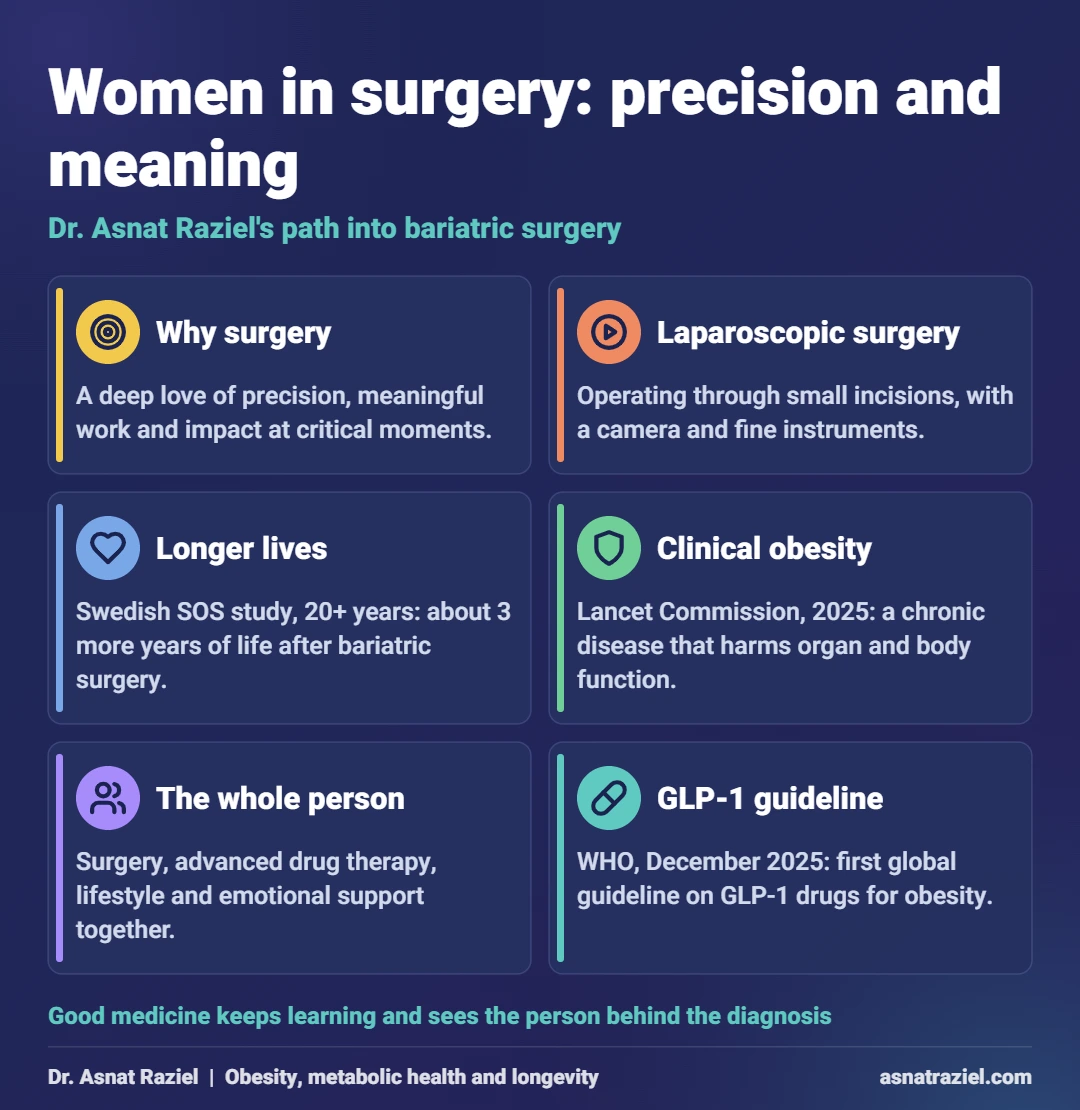
Being one of the women in surgery means working in a demanding, hierarchical and sometimes very male-dominated field. My choice of this field did not come from a wish to fight or to break glass ceilings. It came from a deep love of precision, of meaningful work and of the ability to make a difference at critical moments.
From the very beginning, professionalism, innovation and constant learning attracted me. This field demands responsibility, sharp thinking and nonstop growth. That is why it spoke to me so naturally.
Growing with the technological revolution
Surgery allowed me to grow into the world of advanced laparoscopic surgery. In this kind of operation, the surgeon works through small incisions, using a camera and fine instruments. In this way, I was part of the technological revolution of modern medicine, and I always kept moving forward professionally.
Learn, improve, stay up to date, never stand still. That was, and still is, a way of life for me. Even today, technology keeps advancing, for example with artificial intelligence in obesity surgery.
Women in surgery: often the only one in the room
Being a woman in this space was not always simple. More than once, I was the only woman in the room, with no clear female role model to identify with. It took especially precise work, quiet confidence and the ability to stay true to myself. And I had to do that even in a setting that did not always speak the same language.
The numbers still reflect this. According to a Knesset report covered by Ynetnews, women are a majority in Israeli medical schools, yet they make up only 20% of general surgery specialists.
Over the years, I realized that I did not need to adopt a style that was not mine. You can be highly professional and assertive when needed. At the same time, you can also be attentive, humane and calm in your presence.
Why bariatric surgery: surgery that changes life itself
Choosing bariatric surgery, meaning operations to treat obesity, was a deep choice for me, not a technical one. This field combines advanced surgical innovation with a direct effect on people’s quality of life. That effect also shows over the long term. The Swedish SOS study followed patients for more than 20 years. It found that people who had bariatric surgery lived, on average, about 3 years longer than the control group.
Over the years, I have seen how the right medical intervention lets patients fulfill wishes that once seemed impossible. They can move freely, breathe easily, return to activity and feel at home in their own bodies. Bariatric surgery is not only about the number on the scale. Rather, it is about the ability to live a full life.
Surgery is only part of the journey
Over time, I came to understand more clearly that surgery is only part of the journey. Obesity is a complex, multilayered disease that calls for a broad view. In 2025, the Lancet Commission on Clinical Obesity also defined clinical obesity as a chronic disease that harms the function of organs and the body, not just a number on the scale.
That opened up a whole professional world for me. It connects surgery, advanced drug therapy, lifestyle and emotional support. This field allows not only treatment of the body, but real work with the whole person. I wrote about the importance of a full team in my article on why you cannot treat obesity alone. You can also find a comparison of the options in my article on obesity drugs versus bariatric surgery.
Medicine that learns, medicine that grows
One thing that continues to fascinate me is that the field never stands still. New drugs, advanced technologies and a deeper understanding of how obesity works now make precise, personalized and humane treatment possible. For example, in December 2025, the World Health Organization published its first global guideline on GLP-1 drugs for treating obesity. You will find more about non-surgical options in my guide to alternatives to bariatric surgery.
For me, good medicine is medicine that keeps learning. It is willing to change, to ask questions, and to combine science, clinical experience and genuine listening. This blend of professionalism, innovation and personal growth is what makes this path so meaningful.
Looking ahead: a message to women in surgery
To young women considering a surgical career, my message is simple. You can be excellent and love technology and innovation. In addition, you can keep your own voice and clear values. There is no single right way, and all women in surgery can find their own path.
This is part of a wider story, which I explore in my article on Israeli women and the gaps still to close.
In the end, medicine needs skilled hands. However, it needs no less a broad view, curiosity and the ability to see the person behind the diagnosis.
The information in this article is general and does not replace personal medical advice.
References
Life Expectancy after Bariatric Surgery in the Swedish Obese Subjects Study
Definition and diagnostic criteria of clinical obesity
WHO issues global guideline on the use of GLP-1 medicines in treating obesity