By Dr. Asnat Raziel, bariatric surgeon specializing in obesity treatment, metabolic health and healthy longevity; Director of the Multidisciplinary Center for Obesity Treatment, Assia Medical, Assuta Ramat HaChayal, Tel Aviv
Israeli women are writing the story
Israeli women stopped being just part of the story long ago. Today, they are the ones writing it. In some countries, women still struggle to be heard. Here in Israel, by contrast, women lead almost every area of life.
Every morning, millions of women get up here, and each of them changes reality in her own way. They operate in operating rooms and develop groundbreaking technologies. In addition, they lead research, found startups and command military units. They also teach, create, manage organizations and raise families. Quite often, they do all of this at once.
That is why the Israeli woman has become a symbol of resilience, initiative, creativity and responsibility. Above all, she is the driving force of Israeli society.
An inspiring journey
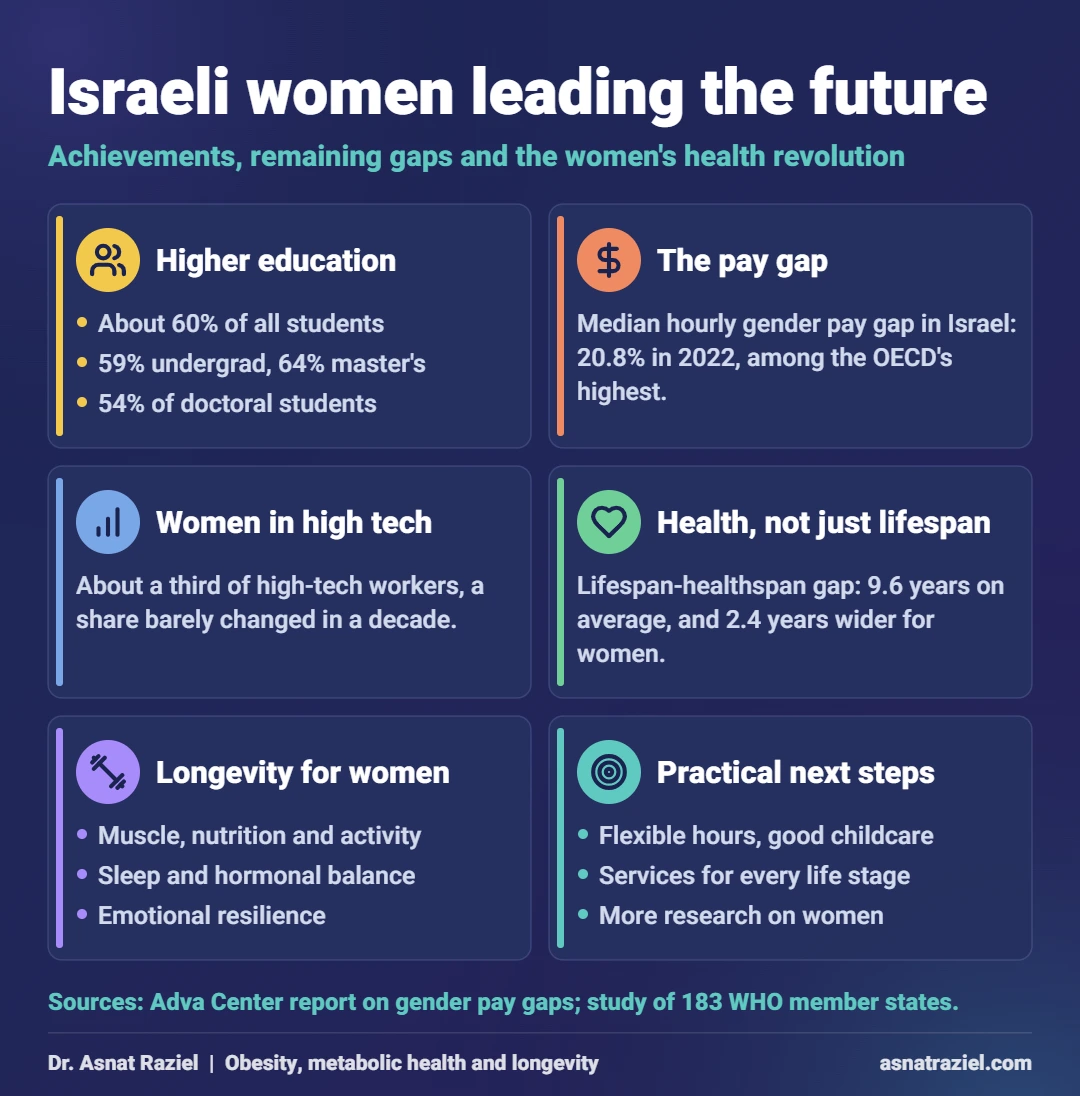
A few decades ago, the options open to women were far narrower. Today the picture is completely different. According to data released at the opening of the 2025-26 academic year, women make up about 60% of students in Israeli higher education. They are 59% of undergraduate students, 64% of master’s students and 54% of doctoral students.
Today, women are leaders in medicine, law, research, education and psychology. Their numbers are also growing steadily in engineering, high tech and entrepreneurship. In hospitals, they head departments and medical centers. For example, the operating room itself has changed dramatically, as I described in my article on women in surgery. In academia, they lead research with global impact. And in the defense establishment, they hold command roles that were once closed to them.
These are not just personal achievements. This is a social revolution.
The road was paved by women who dared to dream
This progress did not happen by chance. Women who refused to give up built it over decades. Women’s organizations, equality legislation and wider access to education created a new reality. In addition, the fight against discrimination and the push for women on corporate boards made a big difference. Support for female entrepreneurship and a stronger standing for women in science and defense changed the picture, too.
Technology is another area where women are driving change, as I describe in femtech and the future of women’s health.
Today, hundreds of organizations and initiatives in Israel promote women. They nurture young leadership and integrate women in Israel’s outlying regions, in Arab society and in the ultra-Orthodox (Haredi) community. They also mentor female entrepreneurs, help survivors of violence and train women for leadership roles. The message is clear: when you invest in women, the whole of society moves forward.
The next challenge for Israeli women
This next stage of the revolution is not only about whether women can reach any role. On that, there is hardly any debate. However, gaps still exist. According to the Adva Center report on gender pay gaps, the median hourly gender pay gap in Israel stood at 20.8% in 2022. That is one of the highest gaps among OECD countries, the organization of developed economies. The report also notes that women make up about a third of high-tech workers, and this share has barely changed over the past decade.
An international comparison is also available in the OECD gender wage gap indicator. So the new question is a little broader. How do we build a society that lets women succeed without paying for it with their health, their relationships or their families?
A woman should not have to choose between a career and children. Nor should she have to choose between success and health. And she certainly should not have to apologize for her ambitions. For that to happen, we need a deep change in work culture, in how responsibility is shared within the family, and in how we define success.
Israeli women and the women’s health revolution
One of the most exciting developments in recent years is the understanding that women’s health is about more than treating disease. The World Health Organization stresses that women’s health includes body and mind throughout life. The organization also notes that heart disease and mental health conditions in women are often underdiagnosed and undertreated.
Moreover, women live many years longer than men on average, but not always in good health. A study of 183 countries found that the gap between life expectancy and healthy life expectancy reached 9.6 years on average. For women, this gap is 2.4 years wider on average than for men. I have also written about this gap in my article on why women live longer than men.
This is where longevity medicine comes in. It offers a new way of thinking: a strong body, a sharp mind and a high quality of life for decades. Preserving muscle mass, eating well and staying physically active are all part of women’s empowerment. So are good sleep, hormonal balance and emotional resilience. For example, during menopause there is great value in a lifestyle that eases the symptoms, and alongside it, in creatine for women over 40.
A healthy woman does not just live longer. She influences, creates, leads and gives far more to the people around her. For more on this, see my related article on metabolic health in women.
A vision for the next decade
Imagine Israel in 2036. In that country, women and men earn equal pay for the same work. Many women head universities, hospitals, public companies, startups and government ministries.
In that country, mothers do not have to choose between family and career. Every girl, in every town and every community, knows that the sky is not the limit. In addition, health, prevention and healthy longevity become national values. And women are leading this revolution, too.
This vision starts with small, practical steps. For example, workplaces can offer flexible hours and good childcare. The health system can also build services tailored to women at every stage of life, from adolescence to old age. Likewise, we can strengthen research on women, so that treatment is based on data that were also collected from women. That way, every woman will be able to fulfill her potential without giving up her health.
A call to the next generation
What we have achieved is not the finish line. It is the starting line. We must keep encouraging girls to dream big and to study science and technology. Likewise, we must encourage them to start businesses, enter public leadership and lead research, medicine and innovation.
We also need to build networks of mentoring and mutual support among women. One woman’s success does not come at another’s expense. On the contrary, it opens the door for many more. Israel’s future depends to a great extent on the women who will lead it: in labs, classrooms, operating rooms, R&D centers, government and the community.
The bottom line: Israeli women and the future
Israeli women have already proven that they can meet any challenge. Now it is time not only to recognize their achievements, but also to create the conditions for them to soar even higher. When women thrive, families grow stronger and the economy grows. At the same time, the health system improves and society becomes more equal. In the end, the whole country becomes stronger, more innovative and more humane. This is not just a hope. It is a vision we must choose to make real, together.
The information in this article is general and does not replace personal medical advice.
References
Gender pay gaps in Israel 2025 (Adva Center)
Global Healthspan-Lifespan Gaps Among 183 World Health Organization Member States