By Dr. Asnat Raziel, bariatric surgeon specializing in obesity treatment, metabolic health and healthy longevity; Director of the Multidisciplinary Center for Obesity Treatment, Assia Medical, Assuta Ramat HaChayal, Tel Aviv
The Putin longevity project: the Kremlin declares war on aging
The war on aging is no longer just a slogan of Silicon Valley labs. Life expectancy around the world keeps rising, and many countries invest in longevity research. Yet no leader seems to state this ambition as openly as Russian President Vladimir Putin. In recent years, the Putin longevity project has turned the fight against aging into a national mission. The investment covers regenerative medicine, genetic engineering, growing organs and other new technologies.
Is this science fiction? Or are we really approaching an era in which we replace organs like spare parts in a car? In this article, I look at what we know today, and at what is still far from the clinic.
Inside the Putin longevity project
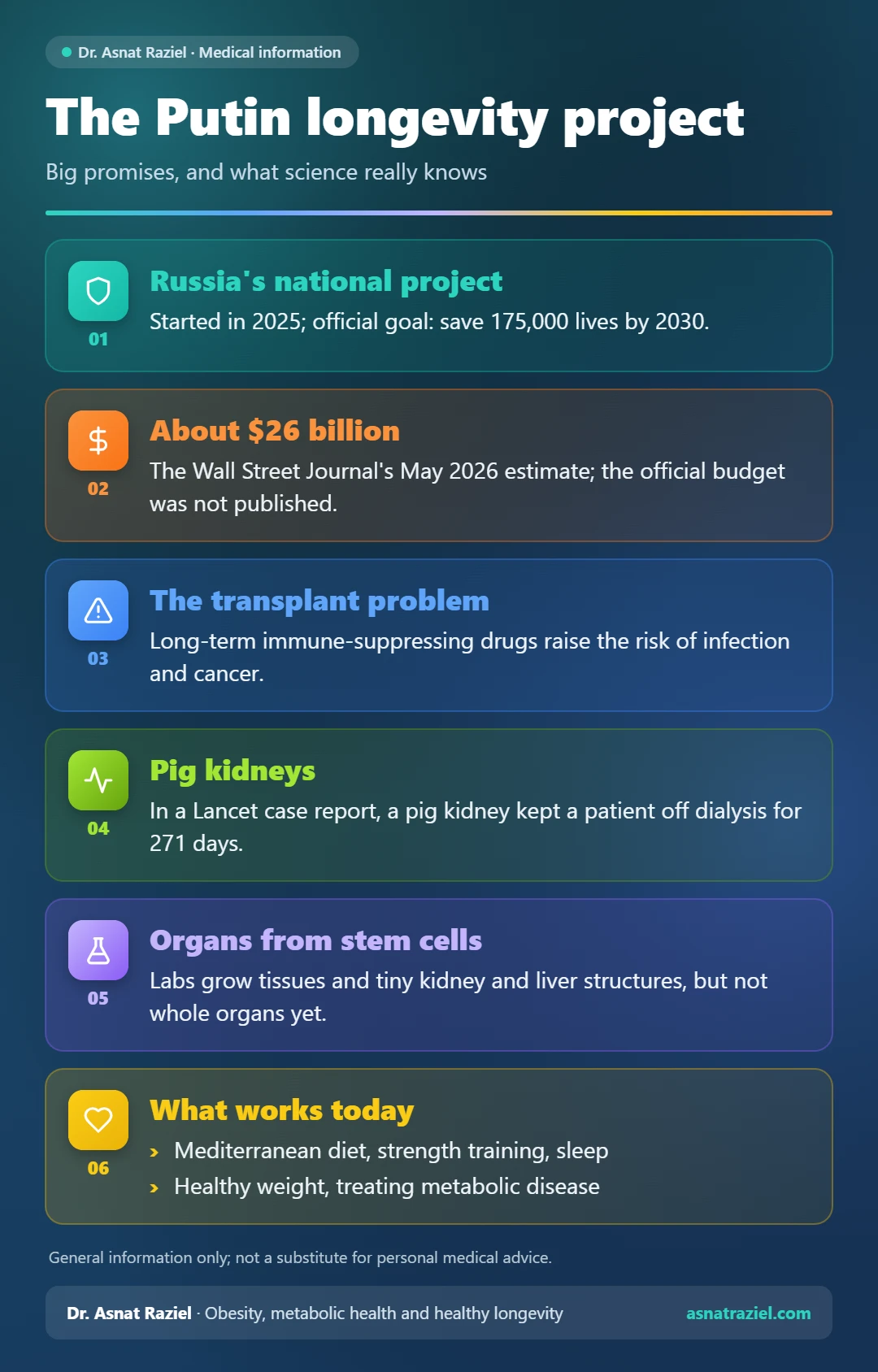
In February 2024, Putin announced a new national project called “New Health-Saving Technologies.” The project started in 2025. According to an investigation by Radio Free Europe/Radio Liberty, the official goal is to save 175,000 lives by 2030. Its areas include slowing cellular aging, neurotechnologies, directing the immune system against aging and bioprinting of tissues. The official budget has not been published. However, a Wall Street Journal investigation from May 2026 estimated it at about $26 billion. According to that report, researchers are also working on growing human organs inside mini-pigs and on a gene therapy that slows cellular aging.
The vision has also reached the world stage. In September 2025, at a military parade in Beijing, an open microphone caught Putin and Chinese President Xi Jinping in conversation. According to the report, Putin’s interpreter said that organs could be transplanted again and again. Xi replied that some predict people will live to 150. Later, Putin confirmed the exchange and said that organ transplants offer hope for long, active lives.
Can we simply replace organs?
Biologically, the idea sounds logical. Most organs gradually lose function. The kidneys filter less well, the heart loses efficiency, the liver regenerates slowly and the lungs lose elasticity. So replacing a worn-out organ with a healthy one could, in theory, delay some of the effects of age.
This is where the problems begin. Even today, after a life-saving transplant, patients take drugs that suppress the immune system for a long time. These drugs prevent rejection of the graft, but they raise the risk of infection, cancer and other complications. In other words, they are not suitable for a healthy person who just wants to “stay young.”
Gene-edited pigs: the future of transplants?
One intriguing direction is transplanting organs from genetically engineered pigs. Pig organs are similar in size and structure to human organs. In recent years, researchers have edited the pig genome and removed genes that trigger rejection.
Progress has been fast. In February 2025, the FDA, the U.S. Food and Drug Administration, cleared the first clinical trials of pig kidney transplants. In September 2026, The Lancet published the case of a patient who lived for 271 days with a pig kidney, without dialysis. Afterwards, he received a kidney from a human donor. Still, the pig kidney was eventually damaged by rejection and inflammation. So for now, this is a bridge to a human transplant, not a permanent solution.
Growing organs from stem cells
Another fast-moving field is regenerative medicine. Instead of a donor organ, researchers try to grow new organs from stem cells. Labs can already produce various tissues and tiny kidney and liver structures. On the other hand, no one can yet grow a whole human organ for routine transplantation. The big advantage of this approach is that it uses the patient’s own cells, so the risk of rejection is very small.
In Russia, too, bioprinting is at the center. According to the Wall Street Journal report, Russian researchers claim they have printed human cartilage and a mouse thyroid gland. However, these claims have not yet gone through full publication and peer review. So it is important to tell a political statement apart from a proven scientific result. Moreover, even in the world’s leading labs, many years separate printed tissue from an organ that works inside the human body. Along the way, there are questions of blood vessels, nerves, long-term durability and cost. There is also an ethical question: who will benefit from these technologies, and who will be left behind?
And what about the brain?
Even if one day we replace the heart, liver, kidneys and lungs, the biggest question remains: the brain. Memory, personality and consciousness cannot be swapped out. Science is moving forward, though. For example, in a trial published in Nature in 2025, researchers transplanted nerve cells made from stem cells into 12 people with Parkinson’s disease, and the treatment was safe. Yet there is still no way to renew an aging brain or to prevent cognitive decline. So keeping the brain young will remain the central challenge. Meanwhile, one of the best tools we have is good sleep for brain health.
Beating aging is not just about replacing organs
The Putin longevity vision is intriguing. But today’s longevity medicine works in a much broader direction. The goal is to extend healthspan, the years in which we are independent, active and clear-minded. To do this, we focus on factors with a proven effect on aging:
- A Mediterranean diet with quality protein.
- Physical activity, especially strength training for preserving muscle mass.
- Good sleep and stress management.
- Keeping a healthy weight and reducing chronic inflammation.
- Treating metabolic diseases, and in suitable patients, GLP-1 drugs as well.
In addition, treating these risk factors lowers the risk of heart disease, diabetes, fatty liver and even some neurodegenerative diseases. If you want to dig deeper, read about longevity drugs and about epigenetic clocks that measure biological age.
Will we live forever?
The answer is probably no. But it is quite possible that we will live many years in good health. Organ replacement, regenerative medicine, gene editing and stem cells will change medicine in the coming decades. Still, the road to eternal life is long and full of scientific, medical and ethical challenges.
The bottom line on the Putin longevity project
The great revolution may not be living to 150. Instead, it may be the ability to reach 90 or 100 with a working body, a clear mind and a good quality of life. In the end, we win the war on aging not only in Kremlin labs, but through daily habits and smart medical follow-up. And that is no longer a fantasy. It is exactly the goal of modern longevity medicine, as I described in my article on healthy longevity and healthspan.
This article is general information and does not replace personal medical advice.
References
Bridges, Roads, Education — Immortality! Russia’s Newest National Project
Inside Putin’s $26 Billion Quest for Longevity
Putin and Xi caught on hot mic talking about living to 150
FDA greenlights first clinical trials for genetically modified pig kidney transplants in humans
Porcine kidney xenotransplantation as a bridge to allotransplantation: a first-in-human study
Phase I trial of hES cell-derived dopaminergic neurons for Parkinson’s disease