By Dr. Asnat Raziel, bariatric surgeon specializing in obesity treatment, metabolic health and healthy longevity; Director of the Multidisciplinary Center for Obesity Treatment, Assia Medical, Assuta Ramat HaChayal, Tel Aviv
Do GLP-1 drugs cause cancer? It is one of the questions my patients ask most often, usually because of the warning about thyroid tumors on the package. In this article, I separate myths from facts, tumor by tumor, based on a major 2026 review and the latest meta-analyses of randomized trials.
Do GLP-1 drugs cause cancer? What we really know today
The link between satiety-hormone drugs and cancer is one of the most important questions in obesity medicine. Over the past decade, GLP-1 drugs have revolutionized the treatment of obesity and type 2 diabetes. Semaglutide, tirzepatide and similar drugs lower weight, improve metabolic control and protect the heart. But do they raise the risk of cancer, have no effect on it, or perhaps even protect against it? The 2026 answer is reassuring: the evidence does not show an increase in overall risk, and some of it hints at protection.
In a comprehensive review in the journal Nature Cancer from January 2026, two researchers from Toronto brought order to the subject. Prof. Daniel Drucker is one of the world’s leading researchers on incretins, and he wrote the review with Dr. Julian Yabut. They reviewed clinical data, registry data and laboratory studies.
Obesity, diabetes and cancer: a link that is not in dispute
The starting point is the well-established link between obesity and many types of cancer. These include breast cancer after menopause and cancers of the colon, pancreas, liver, uterus, kidney and esophagus. Type 2 diabetes itself also raises the risk of cancer and of dying from it. You can read more in my article on the cancers linked to obesity.
The mechanisms are complex. First, chronic excess insulin activates growth pathways in cells. In addition, the growth hormone IGF-1, chronic inflammation and changes in the hormones released by fat tissue all play a role. Together, they create an environment that helps malignant cells survive and grow. By contrast, substantial weight loss, for example after bariatric surgery, is accompanied by a drop in obesity-related cancer. Therefore, the assumption is that drugs that cause major weight loss may also have an effect.
What makes GLP-1 drugs unique
GLP-1 is a hormone that the small intestine releases after eating. It increases insulin release, suppresses glucagon, slows stomach emptying and reduces appetite. The drugs were first developed for diabetes, and later also for obesity. Newer drugs, such as tirzepatide, combine activation of GLP-1 and of the hormone GIP. Beyond their metabolic effect, they also have anti-inflammatory and immune effects. You can find a full explanation in my article on how obesity drugs work.
The old fear: GLP-1 drugs and thyroid cancer
The first suspicion arose during drug development. In rodents, the drugs caused growth of C cells in the thyroid gland and even tumors of the medullary thyroid cancer type, MTC. As a result, a prominent boxed warning (black box warning) was added to the drug labels. Even then, however, it was clear that there is a fundamental difference. In human C cells, the GLP-1 receptor is very low and sometimes undetectable.
So do GLP-1 drugs cause thyroid cancer in people? Population studies since then are not clear-cut, but most are reassuring. A French study found a higher risk of thyroid cancer after one to three years of use. On the other hand, a large Scandinavian study of 145,410 users found no increase in risk. According to Drucker and Yabut, the French study did not correct for detection bias: patients under close follow-up undergo more tests, so small tumors are diagnosed in them. Nevertheless, the drugs are still not allowed for people with a personal or family history of MTC or with MEN2 syndrome.
What randomized trials show about GLP-1 drugs and cancer
On the question of satiety-hormone drugs and cancer, randomized trials give the cleanest picture. A meta-analysis in the Annals of Internal Medicine from December 2025 included 48 trials with 94,245 participants. The researchers concluded that the drugs probably have little or no effect on cancers of the thyroid, pancreas, breast and kidney. Another meta-analysis of 50 trials found no change in overall cancer risk. It did show a drop in uterine cancer in the obesity trials, along with a weak signal for thyroid cancer that needs further study.
It is important to understand one limitation. These trials were not designed to test cancer, and their follow-up was relatively short. Cancer develops over years, so the full picture will become clear only later. So far, however, these trials do not show that GLP-1 drugs cause cancer.
Beyond weight: a direct effect on tumors?
One of the fascinating questions is whether the effect comes only from weight loss. In cell cultures and animals, the drugs slowed the division of cancer cells under certain conditions. For example, in colorectal cancer cells they triggered programmed cell death through the cAMP-PKA signaling pathway. In addition, the researchers saw changes in the tumor environment: less inflammation and changes in immune cells, including T cells.
Even so, Drucker and Yabut warn against hasty conclusions. It is very hard to detect the GLP-1 receptor in human cancer cells. Some studies used nonspecific antibodies. Therefore, the proof of a direct effect is still not conclusive, and in their view weight loss probably explains much of the benefit.
Satiety-hormone drugs and cancer by tumor type
In pancreatic cancer, a sensitive area because of the history of these drugs, the data do not show a higher risk. Some studies even show a decrease, but the number of cases is small. More information on the pancreas appears in my article on weight-loss drugs and pancreatitis.
In colorectal cancer, a U.S. registry study found fewer cases among GLP-1 users than among insulin users. A drop was also seen in uterine cancer compared with insulin, although the number of events was low. By contrast, in breast cancer the randomized trials showed no difference. In other words, the promise is there, but it has not yet been proven. At the same time, none of these tumor-specific data show that GLP-1 drugs cause cancer.
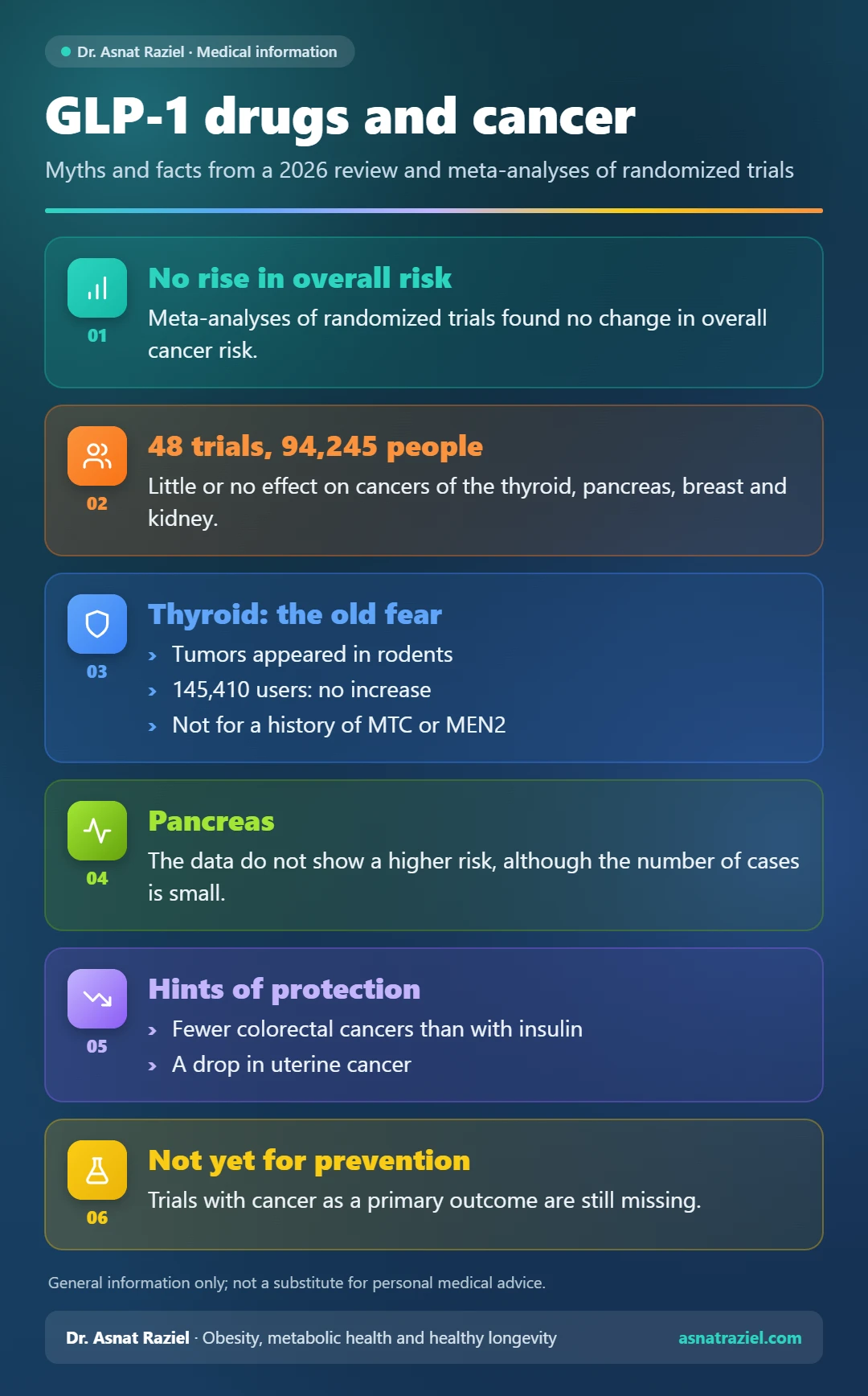
Do GLP-1 drugs cause cancer? Myths and facts in brief
- Myth: the drugs raise overall cancer risk. Fact: meta-analyses of randomized trials found no change in overall cancer risk.
- Myth: the thyroid risk has been proven in humans. Fact: the tumors appeared in rodents. In human C cells, the receptor is very low, and a Scandinavian study of 145,410 users found no increase. Even so, people with a history of MTC or with MEN2 should not take these drugs.
- Myth: the drugs raise the risk of pancreatic cancer. Fact: the data do not show a higher risk, although the number of cases is small.
- Myth: the drugs already prevent cancer. Fact: the data are not sufficient to recommend them for cancer prevention.
Limits of current knowledge and future research
Despite the optimism, Drucker and Yabut state clearly that the data are not sufficient to recommend these drugs for cancer prevention. Randomized trials with cancer as a primary outcome are missing. In addition, we need to better understand the effects that do not depend on weight. Trials are already under way in women with uterine cancer and with breast cancer, and also in men before surgery for prostate cancer. The goal is to test whether weight loss with these drugs improves treatment outcomes. I discuss the long-term safety of these drugs in a separate article.
Summary: do GLP-1 drugs cause cancer?
The main conclusion is clear. The evidence does not support a higher overall cancer risk from satiety-hormone drugs, and their safety profile is reassuring. In the future, they may also turn out to play a protective role, but getting there requires careful, long-term research. At a time when obesity is one of the great epidemics, these drugs may also open a window of opportunity for prevention. The opposite question, whether these drugs might actually prevent cancer, and why observational studies and trials disagree on it, is the focus of my article on GLP-1 drugs and cancer prevention. The decision about treatment is always personal and is made together with your doctor.
The information in this article is general and does not replace personal medical advice.
References
Glucagon-like peptide-1 medicines and cancer
GLP-1 receptor agonists and the risk for cancer: A meta-analysis of randomized controlled trials
Glucagon-like peptide 1 receptor agonist use and risk of thyroid cancer: Scandinavian cohort study