By Dr. Asnat Raziel, bariatric surgeon specializing in obesity treatment, metabolic health and healthy longevity; Director of the Multidisciplinary Center for Obesity Treatment, Assia Medical, Assuta Ramat HaChayal, Tel Aviv
AI and metabolic health: what are we talking about?
AI and metabolic health now meet everywhere: in your smartwatch, in your glucose sensor and in nutrition apps. Metabolic health is the body’s ability to keep blood sugar, fats, blood pressure and weight in a healthy range. When it goes off track, the risk of type 2 diabetes, fatty liver and heart disease rises. So the important question is which of the new technologies truly help patients, and which are still just a promise.
In this article, I explain what artificial intelligence can already do today, which studies support it, and where caution is needed.
What is artificial intelligence in medicine?
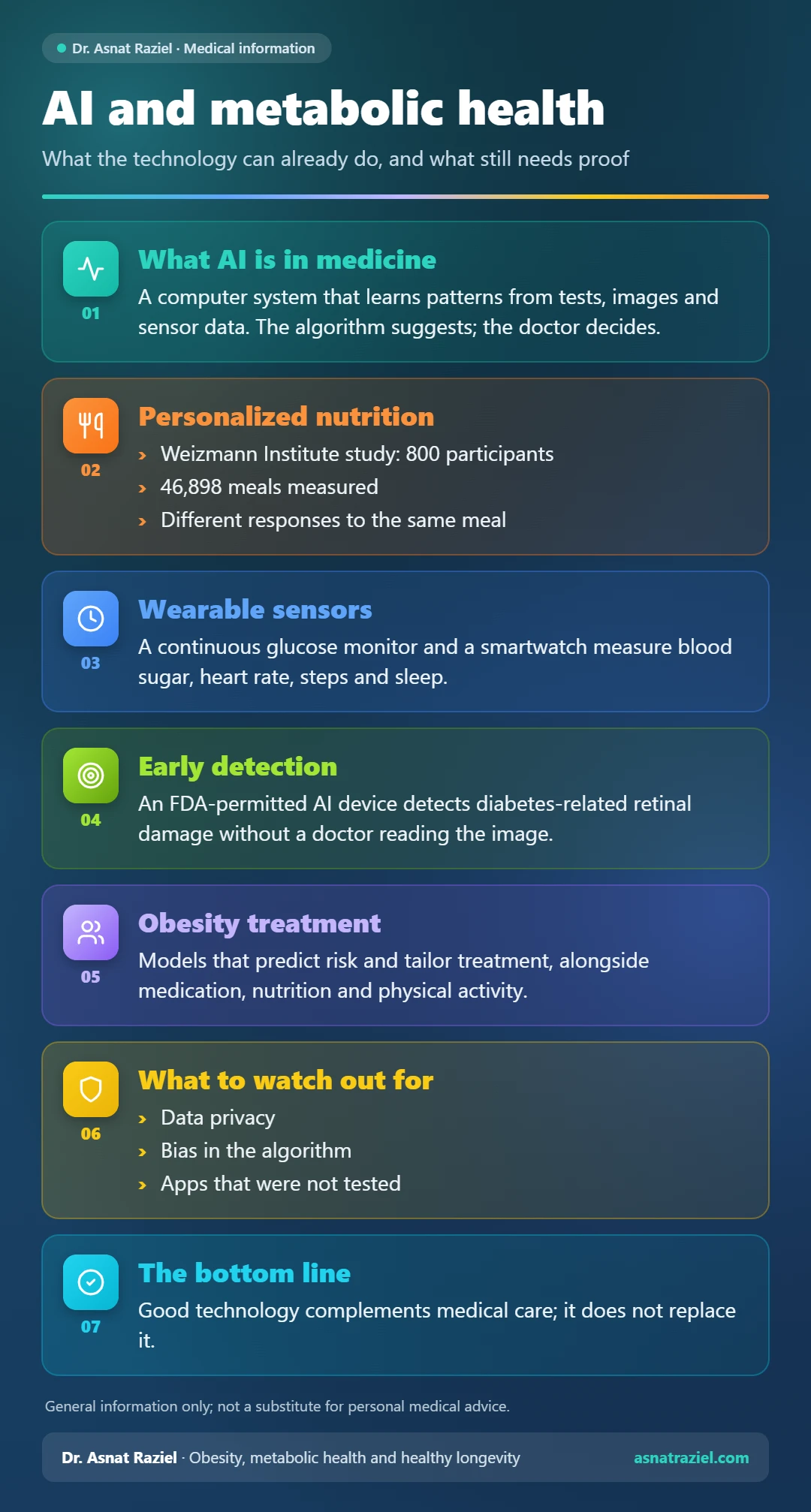
Artificial intelligence (AI) is a computer system that learns patterns from large amounts of data. In medicine, it analyzes blood tests, images, sensor data and medical records. In this way, it finds connections that are hard for the human eye to see. A general overview of how AI is used in health care shows how wide the field is: from diagnosis to drug development.
However, it is important to understand the difference between a tool that helps the doctor and a tool that replaces the doctor. In most cases today, the algorithm suggests, and the doctor decides. I wrote about the human side of medicine in this era in my article on the human skills that medicine needs.
AI and metabolic health: personalized nutrition
One of the strongest examples comes from Israel. Researchers at the Weizmann Institute fitted 800 participants with continuous glucose sensors for a week and measured their responses to 46,898 meals. Their study in the journal Cell found that different people respond in completely different ways to the exact same meal.
That is why the researchers built a machine-learning algorithm. It combined blood tests, eating habits, body measurements, physical activity and gut bacteria. Next, the algorithm predicted blood sugar responses to meals, and the researchers tested its accuracy in another group of 100 people. Finally, a menu built by the algorithm lowered blood sugar spikes after meals. The conclusion: one recommendation for everyone does not always fit each person.
AI and metabolic health: wearable sensors
A continuous glucose monitor (CGM) is a small patch worn on the arm. It measures blood sugar every few minutes and sends the data to your phone. For people with diabetes, it is already a key tool. Even people without diabetes use it to understand how food, sleep and exercise affect them.
In addition, smartwatches measure steps, heart rate and sleep quality. Sleep directly affects blood sugar and appetite, as I explained in my article on sleep and brain health. On the other hand, data alone does not change behavior. It helps when a professional helps you interpret it and turn it into practical steps.
AI and metabolic health: early detection
Over time, diabetes damages small blood vessels, including those in the retina of the eye. In 2018, the FDA for the first time permitted the marketing of an AI-based device that detects diabetes-related eye damage without a doctor to read the image. In a test of 900 people with diabetes, the device correctly identified 87.4% of the cases of significant retinal damage. It also correctly ruled out the disease in 89.5% of those without it.
Moreover, algorithms are learning to detect risk from heart tracings, routine blood tests and scans. The goal is to find people at risk before the disease breaks out. I wrote about this direction in detail in my article on preventive medicine and artificial intelligence.
AI and metabolic health in obesity treatment
Obesity is a disease with many causes, and each person has a different mix of them. A broad review of artificial intelligence in obesity care describes models that predict risk, detect problems early and tailor treatment to the individual. Still, the authors note that the models vary in how well they work, and that there are challenges of data quality and ethics.
This is exactly where data tools can help. I cover a concrete example in my article on AI and predicting response to obesity treatment.
In practice, these tools work alongside what already works: medication for obesity and metabolic disease, nutrition, physical activity and follow-up. They can help identify who will benefit from a particular treatment and track progress between visits. In addition, digital questionnaires now also measure feelings such as food noise, the constant thoughts about food. You can read more about apps and digital monitoring in my article on how AI is already used in obesity care.
More technologies on the way
Beyond sensors, there are new directions that are still being researched. For example, virtual reality is being tested as a tool for changing habits in obesity treatment. In addition, companies such as Openwater are developing noninvasive ultrasound technologies. At the same time, AI models are learning to recognize signs of biological aging.
The overall direction is a personal health system that connects all the data into one picture. However, most of these technologies have not yet shown that they improve health outcomes over time.
AI and metabolic health: what to watch out for
Alongside the promise, there are some risks worth knowing about:
- Privacy: health data is sensitive information. Check who holds it and who the company shares it with.
- Bias: an algorithm that learned from one population may be wrong in another.
- Too much information: checking your data too closely can create anxiety around food and weight.
- Apps without oversight: many tools on the market have not been tested in clinical studies.
So the rule is simple: good technology complements medical care; it does not replace it.
The bottom line
The link between AI and metabolic health is already felt in practice. Real studies already support sensors, personalized nutrition and early detection. On the other hand, some tools still need proof, and they work best alongside a professional who knows you. In our clinic, we combine this data into a personal treatment plan. If you would like to learn more about my approach, you can read about me.
The information in this article is general information and does not replace personal medical advice.
Questions and answers
Should I use a continuous glucose monitor if I don’t have diabetes?
It can help you understand how certain foods affect you. However, it is best to interpret the results with a professional, so you don’t draw the wrong conclusions.
Can an app replace a dietitian or a doctor?
No. A good app helps with tracking and reminders, but it doesn’t know your full medical picture.
Does artificial intelligence already diagnose diseases?
In some cases, yes. For example, a device that the FDA permitted for marketing detects retinal damage in people with diabetes. In most fields, though, it still serves as a support tool for the doctor.
How do I keep my data private?
Read the terms of use, check where the company stores the information, and prefer tools from well-known medical organizations.
Sources
Personalized Nutrition by Prediction of Glycemic Responses
Harnessing Artificial Intelligence in Obesity Research and Management: A Comprehensive Review