By Dr. Asnat Raziel, bariatric surgeon specializing in obesity treatment, metabolic health and healthy longevity; Director of the Multidisciplinary Center for Obesity Treatment, Assia Medical, Assuta Ramat HaChayal, Tel Aviv
Predicting weight loss response: from your genes to your smartwatch
Why does one person lose a lot of weight on a given treatment while another barely changes? Predicting weight loss response is exactly what artificial intelligence (AI) may soon help us do. The future of obesity care and AI was one of the most fascinating topics at the European Congress on Obesity, ECO 2026. Over the past decade, the field has gone through a revolution: new drugs, a deeper biological understanding of the disease, and research on the brain, muscle and microbiome. In addition, our view of obesity has changed. Today, we see it as a chronic disease, not a failure of willpower.
In a special plenary lecture, speakers showed how AI may change the way we diagnose, predict and treat obesity. Instead of one treatment for everyone, the vision is deeply personalized care. The system would combine genetic data, the microbiome, sleep, exercise, nutrition and blood tests. In this way, it would build a precise plan for each person.
In this article, I focus on one question: can AI predict who will respond to which treatment? For a broader look at apps, digital monitoring and smartwatches in daily care, see my article on how AI apps, digital monitoring and smartwatches support everyday obesity care.
Your body produces enormous amounts of data
Prof. Uğur Sezerman, an expert in bioinformatics and medical AI, explained that medicine is entering the era of Big Data, meaning huge collections of information. The cost of genetic sequencing has dropped dramatically. Today, advanced genetic testing is available at a relatively low price. Alongside genomics, the study of all our genes and how they interact with the environment, many other layers of data have been added:
- Transcriptomics: the study of all the RNA molecules active in a cell or tissue at a given time.
- Proteomics: the study of all the proteins in the body, their structure and their function.
- Epigenetics: changes in gene expression driven by environment and lifestyle, without any change in the DNA itself.
- The microbiome: the population of bacteria living in the body, mainly in the gut.
- Metabolomics: the study of the products of metabolism in the body.
- Wearables: smartwatches and sensors that track sleep, heart rate, activity and stress.
- Smartphone data: information from your phone used to monitor health and behavior.
- Electronic health records: a system that brings together all of a patient’s medical information.
According to Prof. Sezerman, no doctor can analyze all of these layers at once. This is where AI comes in. AI systems find links among thousands of variables and estimate disease risk. Moreover, they try to predict who will respond to a particular drug, who will have side effects and who needs a different treatment.
Why does one patient respond so well to Wegovy and another barely at all?
One of the most interesting questions today is why the response to drugs such as Wegovy, Ozempic or Mounjaro varies so much from person to person. I have written about the reasons in my article on why the same weight loss injection works differently for different people. At the congress, speakers explained that AI may be able to identify subgroups: strong responders, partial responders and people who barely respond.
Averages alone cannot answer this. For example, Ynetnews reported on the first head-to-head trial of Mounjaro versus Wegovy, where average weight loss was 20.2% and 13.7%, respectively. Still, an average does not tell us how a specific patient will respond.
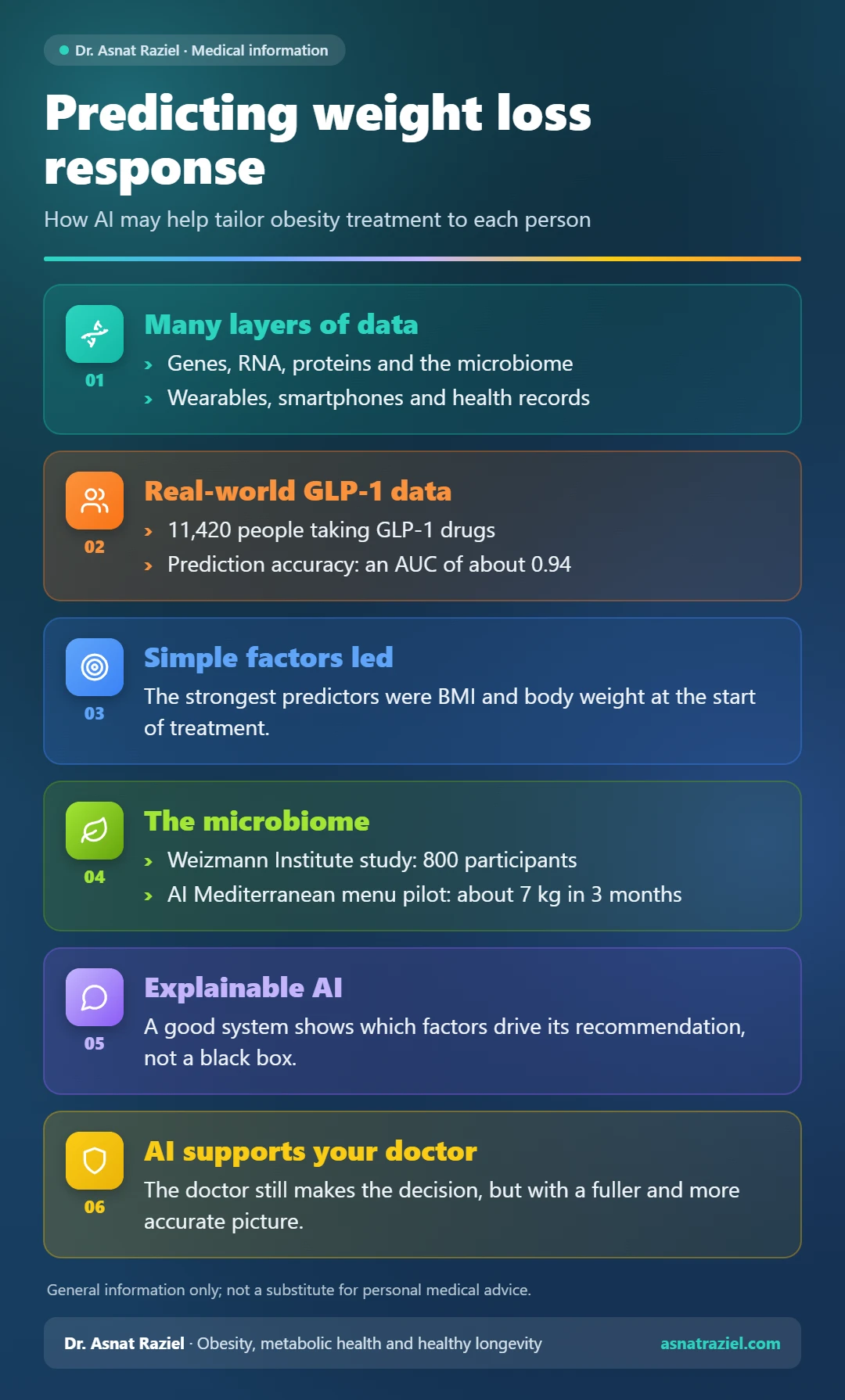
This idea has already been tested on real-world data. In a study published in July 2026, researchers built machine learning models using data from 11,420 people taking GLP-1 drugs. The best models predicted weight loss outcomes with high accuracy (an AUC of about 0.94). However, the most influential factors were simple ones: BMI and body weight at the start of treatment.
The congress also put a strong emphasis on Explainable AI, that is, AI whose reasoning we can understand. The researchers warned against a black box that gives a recommendation without an explanation. Therefore, the goal is for the system to show which factors drive its decision: genetics, diet, smoking, sleep, physical activity or the microbiome.
Can the microbiome help in predicting weight loss response?
Part of the lecture dealt with the microbiome and whether it can help us tailor treatment to the individual. The idea is not new. In an Israeli study from the Weizmann Institute, researchers followed 800 participants. Their algorithm combined blood tests, eating habits, physical activity and gut bacteria. As a result, it could predict each person’s blood sugar response to every meal.
In a pilot study presented at the congress, AI built a personal Mediterranean menu for each participant, designed to change the makeup of their gut bacteria. In addition, participants received lifestyle support and coaching. According to the data presented, after three months they lost about 7 kg on average, with improvements in BMI and waist circumference. Similarly, another small European study showed that a six-week AI-based nutrition program increased the diversity of gut bacteria.
The researchers also described a link between certain bacteria and weight loss. Some bacteria produce short-chain fatty acids. A laboratory study showed that these acids stimulate the release of GLP-1, the satiety hormone. The vision is to combine medication, a personal diet, tailored exercise, sleep monitoring and continuous support through an app and a smartwatch.
Predicting weight loss response today: what it means for you
So, what can patients take from all this right now? First, the most powerful predictors in the 2026 study were not exotic tests. Instead, they were baseline BMI and body weight, measurements every clinic already takes. Second, the microbiome studies are promising, but they are still small or early. For that reason, personalization today starts with a careful medical assessment, not with an algorithm. This is also the idea behind tests that help match obesity treatment to the individual. Finally, when an AI tool does give advice, ask what it is based on. A good system should explain which factors shaped its recommendation, just as your doctor should.
From treating disease to preventing it
A key message at the congress was that medicine is moving from a reactive approach to one of prediction and prevention. Rather than waiting for diabetes or heart disease, AI systems will try to spot early who is at risk. That way, doctors could step in early and in a personal way.
In the future, data on sleep, heart rate, activity, eating habits and genetics may reveal a metabolic shift even before disease appears. AI is already used in the operating room too, as I described in my article on AI in bariatric surgery. In addition, companies are using it to develop new obesity drugs.
The challenges ahead
Alongside the excitement, the researchers also stressed the challenges. First, there is the privacy of medical data. Second, there is legal responsibility when a mistake happens. Finally, there is the quality of the data used to train these systems. Incorrect medical coding or incomplete data could lead to dangerous conclusions. Accordingly, the World Health Organization has published principles for the ethics and governance of AI in health, including transparency, accountability and privacy protection.
AI does not replace your doctor
Despite the big headlines, the message at the congress was clear: AI does not replace doctors. It is a decision-support tool that helps us understand how complex obesity is. In other words, the doctor still makes the decision, but with a far fuller and more accurate picture.
The bottom line on predicting weight loss response
The future of obesity medicine will probably be far more personal. Instead of one diet for everyone, care will combine biology, genetics, the microbiome, lifestyle and technology. Thanks to AI, treatment may become continuous support rather than a one-time clinic visit. Such a system would learn about the patient in real time and help them maintain metabolic health for years. You can read more about the trends in the field in my article on the future of obesity medicine.
The information in this article is general and does not replace personal medical advice.