By Dr. Asnat Raziel, bariatric surgeon specializing in obesity treatment, metabolic health and healthy longevity; Director of the Multidisciplinary Center for Obesity Treatment, Assia Medical, Assuta Ramat HaChayal, Tel Aviv
GLP-1 after pancreatitis: can you start obesity medication?
People who have had pancreatitis in the past usually ask me one question: is it safe for me to start GLP-1 injections for obesity after pancreatitis? The question is understandable. Pancreatitis, or inflammation of the pancreas, can be a serious condition. So any mention of it next to the name of a drug triggers instant concern. However, the answer is not a blanket “yes” or “no.” It depends on what caused the previous episode, on testing and on follow-up.
In this guide, I explain what we know today, as of October 2026. I also describe what is worth checking before treatment, and which signs call for immediate medical attention.
What pancreatitis is and what causes it
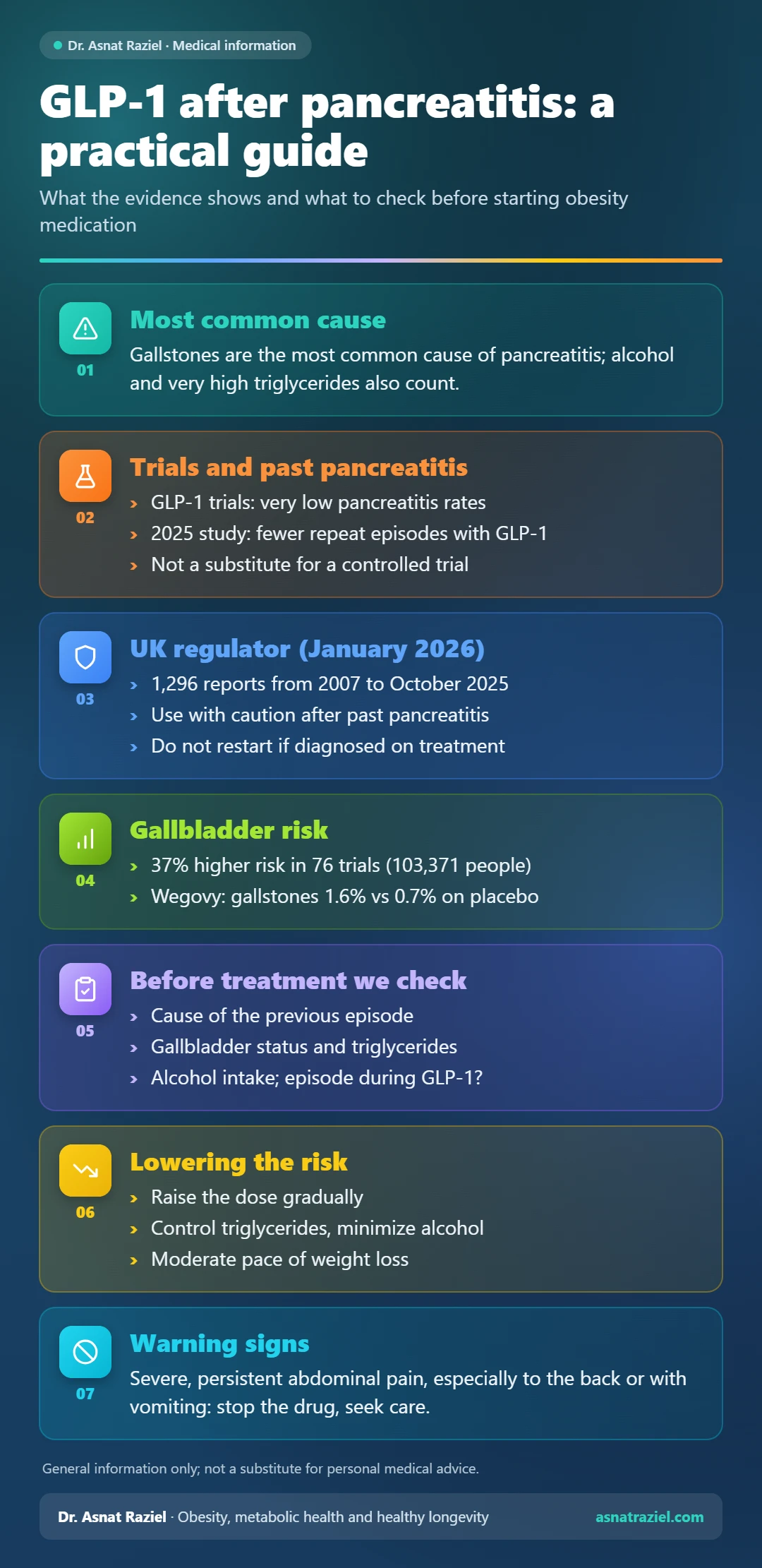
Acute pancreatitis usually shows up as severe pain in the upper abdomen. The pain may radiate to the back and is sometimes accompanied by nausea and vomiting. Blood tests show raised pancreatic enzymes. According to the US National Institute of Diabetes and Digestive and Kidney Diseases, the most common cause is gallstones. A small stone leaves the gallbladder, gets stuck in the common duct and blocks the drainage of the pancreas.
Other causes include heavy alcohol use, certain medications and genetic factors. In addition, very high levels of triglycerides, a type of fat in the blood, are a known trigger. Poorly controlled diabetes and various metabolic conditions also add to the risk.
Obesity as an independent risk factor
There is a key point to understand. Obesity itself raises the risk of pancreatitis, even without any medication. The reason is the high rate of gallstones, high triglycerides and insulin resistance. What’s more, rapid weight loss, for any reason, increases the formation of gallstones.
Therefore, when pancreatitis appears in a person with obesity, we first look at the existing risk factors. Only then do we ask whether the drug played a role. You can read about the role of blood fats in my article on Mounjaro and the lipid profile.
What studies show about GLP-1 after pancreatitis
Large clinical trials of drugs in the GLP-1 family found a very low rate of pancreatitis. The rate was similar to that in the control groups. You will find a detailed review of these data in my separate article on the overall pancreatitis risk with weight-loss drugs, which looks at everyone who takes these drugs rather than at people with a past episode.
But what about people who have already had pancreatitis? Here, the information is more limited. A large retrospective study from 2025 looked at people with type 2 diabetes and a history of pancreatitis. The researchers compared GLP-1 users with users of other diabetes drugs. Surprisingly, the risk of a recurrent episode was lower with GLP-1 drugs, over one year and up to five years. Still, the researchers themselves stressed that a study like this does not replace a controlled trial.
Much of the fear comes from how the data are read. I explain this in my article on the GLP-1 pancreatitis myth.
Regulators, on the other hand, are taking a stricter line. In January 2026, the UK medicines regulator, the MHRA, strengthened the warning for all GLP-1 drugs and for tirzepatide. The agency had received 1,296 reports of pancreatitis between 2007 and October 2025, including 19 deaths. It stated that the drugs should be used with caution in people with a history of pancreatitis. In addition, if pancreatitis is diagnosed during treatment, the drug should not be restarted. Keep in mind that spontaneous reports do not prove a causal link.
Weight loss, the gallbladder and gallstones
Weight loss itself is a central issue. A meta-analysis of 76 trials with 103,371 participants found a 37% higher risk of gallbladder disease with GLP-1 drugs. The risk was especially high at higher doses and when the drugs were used for obesity. The Wegovy prescribing information also reports gallstones in 1.6% of patients on the injection, compared with 0.7% on placebo.
In other words, sometimes the event does not come from the drug directly but from the rapid metabolic change. The good news is that the risk can be reduced. A moderate pace of weight loss, a balanced diet and medical follow-up help a lot. There is more on this in my article on gallstones during treatment with Wegovy and Mounjaro.
Starting GLP-1 after pancreatitis: what we check first
Anyone who has had pancreatitis needs a careful assessment before starting treatment. This is not necessarily an outright ban. Rather, it calls for a personalized approach, monitoring and a detailed explanation. These are the questions I go through in my clinic:
- What caused the previous episode: gallstones, alcohol, high blood fats or an unknown cause?
- If the cause was gallstones, has the gallbladder been removed?
- What are the triglyceride levels today, and are they under control?
- Did the episode happen during treatment with a GLP-1 drug?
- How much alcohol does the patient drink today?
The answers change the picture. For example, according to the American College of Gastroenterology guidelines, gallstone pancreatitis usually calls for surgery to remove the gallbladder. The operation prevents a repeat episode from the same cause. By contrast, if pancreatitis appeared during GLP-1 treatment and the diagnosis was confirmed, the UK guidance says the drug must not be restarted. In that case, we look at a different option.
How to lower the risk during treatment
First, we increase the dose gradually and do not rush. Second, we bring triglycerides under control and keep alcohol to a minimum. Third, we keep weight loss at a reasonable pace, without extreme diets. You can read about the dangers of losing weight too fast in my article on the risks of rapid weight loss.
In addition, for patients at high risk of gallstones, the doctor may consider a preventive medication. A meta-analysis of 13 trials found that ursodeoxycholic acid reduced gallstones during weight loss. The researchers also found that a diet slightly higher in fat reduced stones. This is a personal decision, made together with your doctor.
What to do if symptoms appear
Severe, persistent abdominal pain requires immediate medical evaluation, especially if it radiates to the back or comes with vomiting. In that situation, stop the drug right away and go to the emergency room or see a doctor. It is important to tell the medical team about the injection, because a drug bought privately does not always appear in your medical record.
After the evaluation, the decision depends on the findings. If pancreatitis was not diagnosed, you can usually go back to treatment. If it was diagnosed, you switch to a safe alternative. Broader information on the safety of obesity medication will help you see the full picture.
A balanced view: between fear and evidence
The fear of pancreatitis is understandable, but it should not drive the decisions. When you look at the data in the right context, the risk with obesity medication is low. It is close to the baseline risk of people with obesity. On the other hand, untreated obesity raises the risk of diabetes, heart disease, fatty liver disease and various cancers. That risk is high, proven and ongoing.
The bottom line on GLP-1 after pancreatitis
A history of pancreatitis is a reason for caution, not necessarily a reason to give up on treatment. Responsible medicine is based on data and on clinical context. That is why we check what caused the episode, treat the risk factors and choose a drug and dose tailored to the individual. Ultimately, when treatment is given with guidance and follow-up, the benefit outweighs the rare risk in most cases. This is not medicine that ignores risk; it is precision medicine.
The information in this article is general and does not replace personal medical advice.
References
WEGOVY (semaglutide) – Prescribing Information
American College of Gastroenterology Guidelines: Management of Acute Pancreatitis