By Dr. Asnat Raziel, bariatric surgeon specializing in obesity treatment, metabolic health and healthy longevity; Director of the Multidisciplinary Center for Obesity Treatment, Assia Medical, Assuta Ramat HaChayal, Tel Aviv
Rapid weight loss: why the pace matters
The dangers of rapid weight loss are not obvious, because the urge to lose weight fast is only natural. Quick results boost motivation, improve self-image and create a sense of success. However, not all weight loss is a health achievement. When the pace is too fast and there is no medical guidance, the price may be paid in muscle, bone and gallstones. That is why modern medicine focuses not only on how much weight you lose, but also on what you lose and how.
When is the pace too fast?
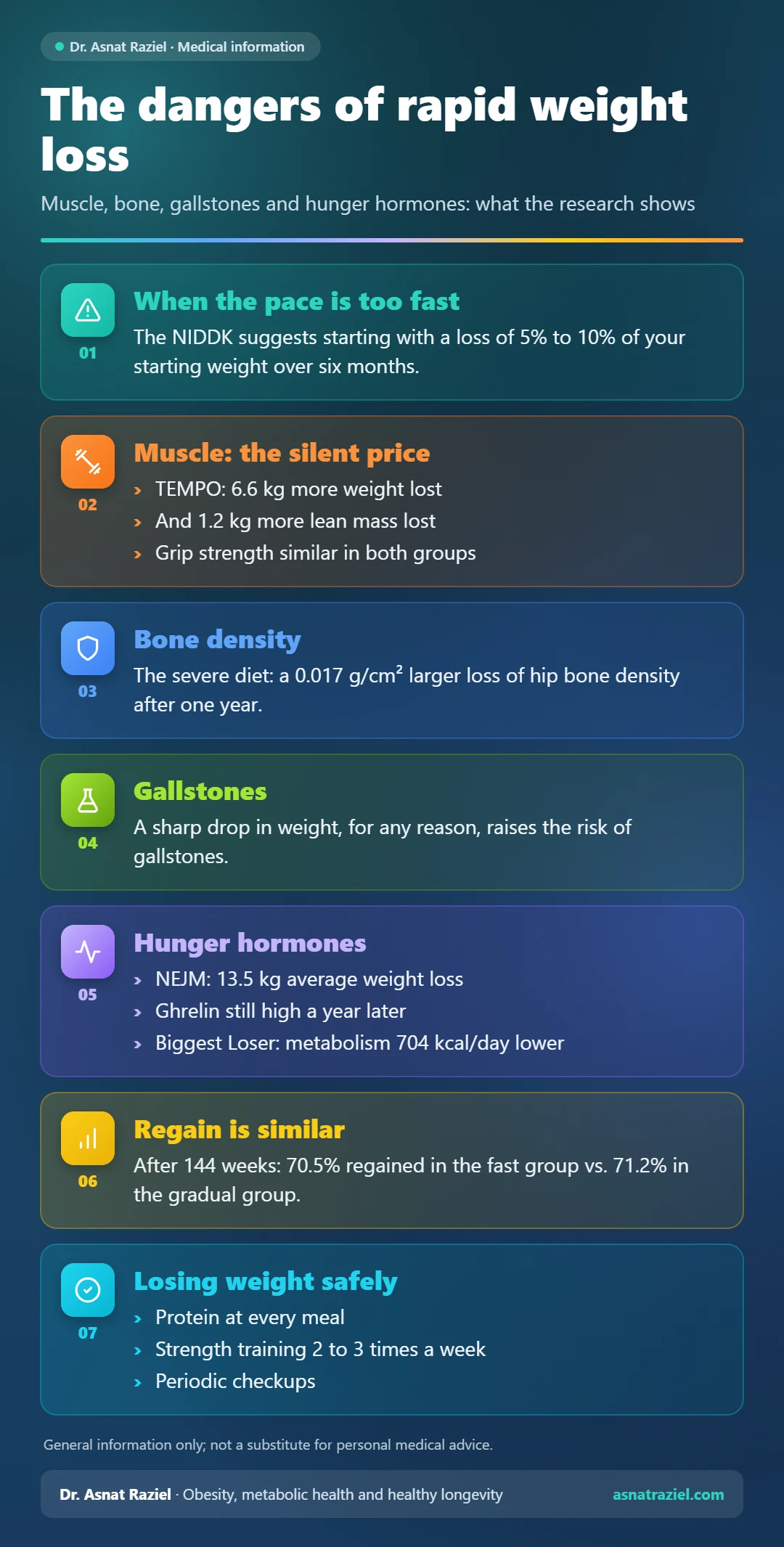
There is no single number that fits everyone. Still, a sharp, sustained drop in weight without a tailored nutrition and exercise plan increases risk. The U.S. National Institute of Diabetes and Digestive and Kidney Diseases (NIDDK) recommends starting with a loss of 5% to 10% of your starting weight over six months. The key question is where the kilograms come from: fat, muscle or both.
Muscle loss: the silent price of rapid weight loss
One of the main concerns with rapid weight loss is the loss of muscle mass. Muscle is metabolically active tissue. It burns glucose, keeps you steady and gives you the strength for daily function. When weight loss “takes muscle with it,” the body burns less energy at rest, fitness declines, and the risk of falls and fractures rises. This risk is especially pronounced in older age.
That said, the picture is not simple. The TEMPO study included 101 postmenopausal women with obesity. One group followed a severe meal-replacement diet, and the other followed a moderate diet. After one year, the severe-diet group had lost an additional 6.6 kg of weight and an additional 1.2 kg of lean mass. However, the muscle loss was in proportion to the overall weight loss, and grip strength remained similar in both groups. In other words, the key is protein and strength training, not just the pace. You will find a practical guide in my article on how to prevent muscle loss while losing weight.
Rapid weight loss and your bones
Losing weight quickly, especially without enough protein and weight-bearing activity, can reduce bone density. In the same TEMPO study, the severe diet caused a much greater loss of bone density at the hip. The difference between the groups was 0.017 g/cm² after one year, even though the severe-diet group also lost much more abdominal fat. The researchers advised special caution in postmenopausal women, particularly those with osteopenia or osteoporosis (bone thinning). For these groups, it is therefore important to combine a diet rich in calcium and vitamin D, enough protein and strength training.
The gallbladder and digestive system
A sharp drop in weight, for any reason, raises the risk of gallstones. This rule applies to extreme diets, to surgery and to drug treatment without follow-up. According to the NIDDK, very rapid weight loss increases the chance that stones will form. The cause is not the treatment itself, but the rapid change in fat balance and bile flow. Managing the pace of weight loss, eating the right foods and staying under medical follow-up all reduce the risk. You can read more in my article on gallstones during drug treatment.
Who needs to be especially careful?
In some groups, the dangers of losing weight fast are especially pronounced. First, people over 65, who lose muscle and bone easily. Second, postmenopausal women, because of the risk of bone thinning. In addition, people with a history of gallstones, eating disorders or chronic diseases. For them, it is worth building a personal plan with a doctor and a dietitian before starting. This way, they can enjoy the benefits of weight loss while reducing its cost.
Metabolism and hunger hormones
When the body loses weight, it switches on compensation mechanisms. Hunger hormones rise, satiety hormones fall and metabolism slows down. In a study published in the NEJM, 50 participants lost an average of 13.5 kg on a very-low-calorie diet. Even a year later, levels of the hunger hormone ghrelin remained high, and levels of satiety hormones remained low. Moreover, the feeling of hunger stayed strong.
An extreme example comes from a follow-up of contestants on “The Biggest Loser”. The contestants lost an average of 58.3 kg on the reality show. Six years later, they had regained an average of 41.0 kg. What’s more, their resting metabolic rate was still 704 calories a day below where it started.
Does rapid weight loss come back faster?
The common belief is that what comes off fast comes back fast. However, a randomized trial from Australia tested exactly this question. In total, 200 participants lost weight either quickly over 12 weeks or gradually over 36 weeks. After 144 weeks of weight maintenance, both groups had regained a similar share of what they had lost: 70.5% in the fast group and 71.2% in the gradual group, among those who completed the study. In other words, the problem is not the pace itself. The problem is that the body fights weight loss at any pace, so long-term treatment is needed.
Medication also requires managing the pace
Even when effective medications drive the weight loss, it is important to manage it carefully. The doctor increases the dose gradually, according to the guidelines and to each patient’s response. At the same time, the patient sticks to a protein-rich diet and physical activity with an emphasis on strength. Close medical follow-up completes the picture. In addition, the medications counteract some of the hunger mechanisms, so stopping them suddenly brings those mechanisms back. I wrote about this in my article on what happens after stopping GLP-1 medications.
How to reduce the risks of rapid weight loss
The goal is not to slow down at any cost, but to control the pace and the quality of weight loss. Losing weight at a controlled pace allows for:
- Reducing fat while preserving muscle.
- Improving metabolic markers without hurting function.
- Protecting your bones and gallbladder.
- Healthy biological adaptation and keeping your results over time.
In practice, this means protein at every meal, strength training two to three times a week and periodic checkups. How much protein you need is explained in my article on protein intake during weight loss.
A balanced view of rapid weight loss
Weight loss is a tool, not a goal in itself. Health is measured by function, strength, metabolic markers and quality of life. When weight loss is fast but not smart, its dangers can take us further away from that goal. On the other hand, when it is managed well, it becomes a stable foundation for long-term health.
The information in this article is general and does not replace personal medical advice.
Sources
Long-term persistence of hormonal adaptations to weight loss
Persistent metabolic adaptation 6 years after “The Biggest Loser” competition
The effect of rate of weight loss on long-term weight management: a randomised controlled trial




