By Dr. Asnat Raziel, bariatric surgeon specializing in obesity treatment, metabolic health and healthy longevity; Director of the Multidisciplinary Center for Obesity Treatment, Assia Medical, Assuta Ramat HaChayal, Tel Aviv
Emotional eating warning signs: where the line is
Emotional eating warning signs help you tell the difference between eating out of emotion, which almost everyone knows, and a pattern that already needs treatment. All of us sometimes eat out of fatigue, boredom, stress or a need for comfort. Food is not just fuel for the body; it is also a source of pleasure, memories and a sense of security. That is why emotional eating in itself is neither a problem nor a disorder.
It becomes a problem when it turns into the main, or the only, way to cope with emotions. It also needs attention when it harms your health, your sense of control or your quality of life. In this article, I explain how to recognize that line and what to do when you cross it. If you are looking for day-to-day tools to change the habit, see my practical guide to overcoming emotional eating.
Emotional hunger vs physical hunger
Physical hunger builds up gradually. It appears a few hours after a meal and settles down once you eat. In contrast, emotional hunger arrives all at once, usually after a strong emotion. It is typically aimed at a specific food, sweet or fatty. Moreover, it does not settle even after a full meal, because the need is emotional rather than physical.
A simple question can help in the moment: “What am I feeling right now?” If the answer is anger, loneliness or fatigue, your body may not be hungry at all. It is also worth watching for patterns over a week or two. A short note of the moment, the emotion and the food sometimes reveals signs of emotional eating you had not noticed. In addition, lack of sleep increases the urge to eat, as I explain in my article on tiredness, sleep and appetite.
Emotional eating warning signs: when the line is crossed
The shift from ordinary emotional eating to a problematic pattern happens when food stops being a choice and becomes an automatic response. A few signs are worth noticing. For example, every unpleasant emotion leads to eating. Or you feel a loss of control while eating. Guilt, shame or a need to “make up for it” after eating are also warning signs. In such situations, the pattern already calls for professional attention.
The brain, stress and food
Emotional eating is closely tied to the brain’s stress system. A model published in Physiology & Behavior describes how stressful situations activate the hormonal stress axis. This axis increases the release of cortisol, the stress hormone, which affects appetite and the preference for rich food. At the same time, this food activates the brain’s reward system and brings temporary relief from tension.
In some people, this mechanism grows stronger over time. This happens mainly in those with an early biological or emotional vulnerability. Eventually, food becomes a regular way to regulate emotions. We have seen a similar phenomenon in hard times, such as emotional eating during wartime.
The link to obesity and eating disorders
Long-term emotional eating can lead to weight gain. A 2023 meta-analysis found that emotional eating is much more common in people with obesity than in people with a healthy weight. On the other hand, the researchers found no difference between people with overweight, without obesity, and people with a healthy weight.
Just as important, emotional eating can develop into a true eating disorder. For example, binge eating disorder often starts as untreated emotional eating. Repeated diets also make the pattern worse, because they increase stress and a sense of deprivation. However, not everyone who eats out of emotion has an eating disorder. When the pattern is constant, recurring and accompanied by emotional distress, it is worth getting an assessment.
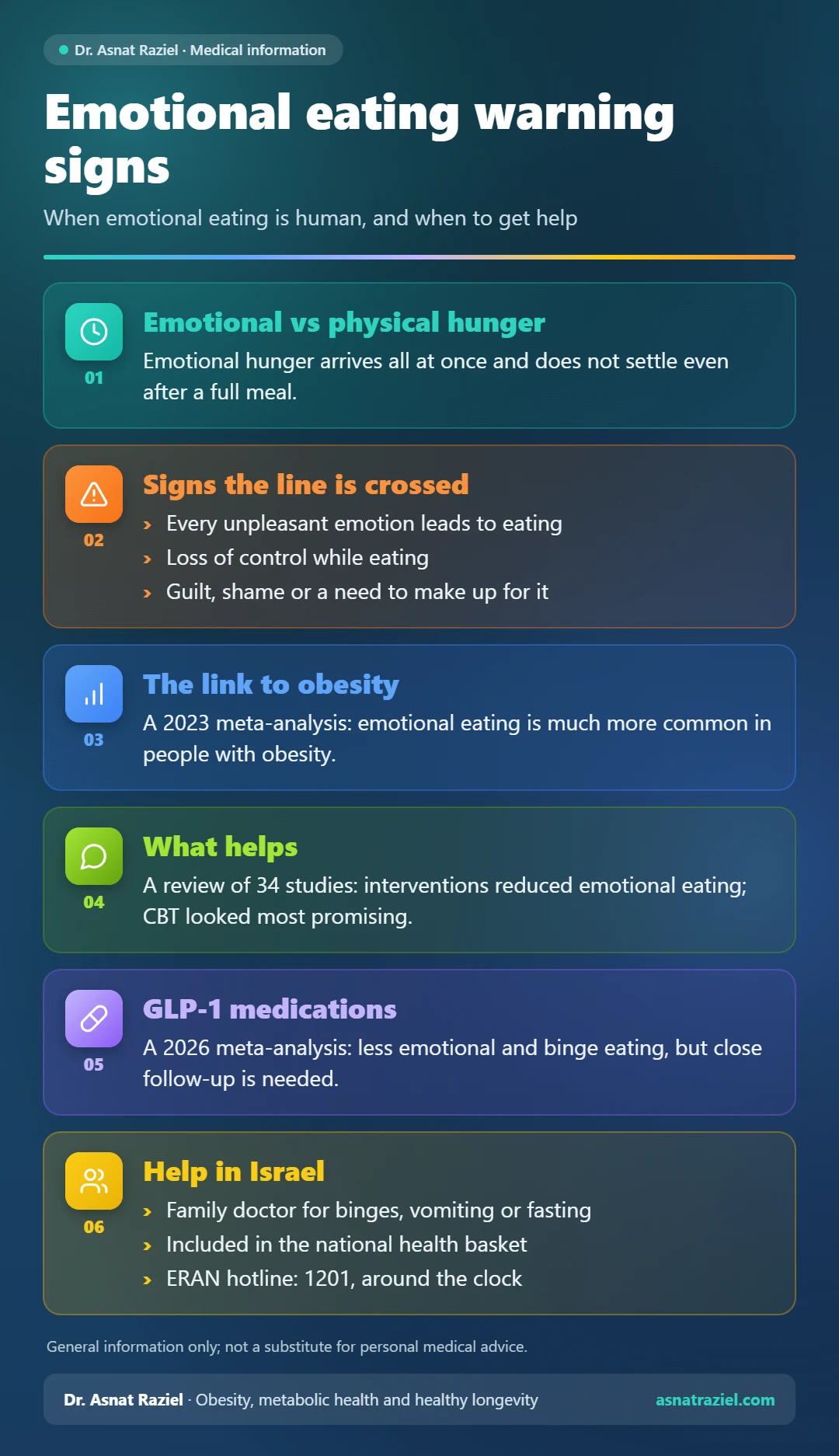
A checklist of emotional eating warning signs
To sum up the emotional eating warning signs above, ask yourself a few questions. Does almost every unpleasant emotion lead you to food? Do you feel a loss of control while eating? Do guilt, shame or a need to “make up for it” follow? Is the pattern constant and recurring, and does it come with emotional distress? If the answer to some of these is yes, it is worth getting an assessment. And if there are binges, vomiting or fasting, see your family doctor without delay.
Why willpower does not solve emotional eating
Trying to solve emotional eating with strict discipline or bans usually makes the problem worse. When you define food as the enemy, the emotion grows stronger and eating becomes charged. That is why effective treatment does not focus on prohibition. Instead, it expands the person’s emotional toolbox. The ability to recognize an emotion, stay with it and find other ways to cope is at the heart of the process.
How to treat emotional eating warning signs
Treatment for emotional eating relies on a multidisciplinary approach. A systematic review of 34 studies found that interventions targeting emotional eating reduced it. Among the approaches, cognitive behavioral therapy (CBT) showed the most promising results. A recent 2025 review also found benefit in mindfulness-based approaches, which means awareness of the present moment without judgment. However, the researchers note that the studies showed this benefit mainly in the short term.
Alongside the emotional work, nutritional guidance restores trust in the body and in its hunger and fullness signals. When there is overlap with an eating disorder or with ADHD, medication is sometimes considered as well. For example, a 2026 meta-analysis found that GLP-1 medications reduced emotional and binge eating. However, they also increased dietary restraint, so close follow-up is needed. The goal is not to stop eating out of emotion. The goal is to stop depending on food as your only way of coping.
Where to get help in Israel
If emotional eating warning signs come with binges, vomiting or fasting, see your family doctor. Israel’s basic national health basket covers treatment for eating disorders. For example, at Maccabi, one of Israel’s health funds (HMOs), members aged 12 and over are entitled to an assessment and a series of treatments. In addition, the Israeli Association for the Prevention, Treatment and Research of Eating Disorders publishes a directory of treatment centers. In emotional distress, you can contact ERAN, Israel’s emotional first aid hotline, at 1201, around the clock.
Bottom line: emotional eating warning signs are a call to listen
Emotional eating is not a failure. It is a signal of an emotional need that is not being met. When you approach it with curiosity rather than judgment, it can become a starting point for deep change. That change touches both your relationship with food and your relationship with yourself. For further reading, see my articles on emotional coping with obesity, on what modern medicine knows about eating disorders and on orthorexia, when healthy eating becomes dangerous.
The information in this article is general and does not replace personal medical advice.
References
Stress, eating and the reward system
Emotional Eating and Obesity: An Update and New Insights
Israeli Association for the Prevention, Treatment and Research of Eating Disorders (in Hebrew)
ERAN: emotional first aid by phone and online (Kol Zchut, in Hebrew)