By Dr. Asnat Raziel, bariatric surgeon specializing in obesity treatment, metabolic health and healthy longevity; Director of the Multidisciplinary Center for Obesity Treatment, Assia Medical, Assuta Ramat HaChayal, Tel Aviv
Preventive medicine and AI: from a system that treats disease to one that protects health
Preventive medicine and artificial intelligence may be the most promising combination in medicine in the coming years. Most of us meet the health system only when something has already gone wrong. A pain appears, a blood test comes back abnormal or blood pressure rises, and only then does the workup begin. The longevity world offers the opposite approach: collect information over time, spot small changes early and step in before they become a problem.
Max Marchione, co-founder and CEO of the company Superpower, presented this vision in a conversation published in August 2026 on Longevity.Technology. It is worth noting that this is sponsored content. According to him, the health system of the future will be preventive, continuous, personal and data-driven. Artificial intelligence (AI) will connect thousands of pieces of information that are scattered across different places today.
No more snapshots of your health
One of the problems with traditional medicine is that it measures at isolated points in time. We usually have a blood test once every few months or years. The doctor checks our blood pressure during an office visit. The doctor asks about sleep, exercise and diet, but usually has no continuous picture of our lives.
The body, on the other hand, changes all the time. Blood sugar rises and falls throughout the day. Heart rate, sleep, weight and body composition change too. So do physical fitness, breathing rate and recovery. A system that combines blood tests, genetic information, wearable devices, medications and medical history turns health from a “snapshot” into an ongoing “movie.” You can read about these tools in my article on smart rings and health tracking.
When artificial intelligence connects the dots
Marchione describes a personal example. He connected his Oura ring to the system, and over time the algorithm found a link between his breathing rate and his sleep quality. The system raised the possibility of an allergy and suggested an appropriate test.
In other words, the AI did not diagnose a disease. Its advantage was different: it went through months of data and found a pattern that a doctor can hardly spot in a ten-minute visit. Doctors excel at understanding context, at clinical judgment and at communicating with the patient. The computer, by contrast, scans millions of data points quickly and finds connections. Together, the two are stronger than either one alone. Examples from the world of obesity appear in my article on the future of obesity treatment in the age of AI. I also summarize three key directions in obesity medicine from the ECO congress.
Preventive medicine and AI: will AI replace the doctor?
That is probably the wrong question. Even in Marchione’s vision, AI does not make important medical decisions on its own. For example, when the question of hormone therapy comes up, the decision stays with the doctor. So the interesting model is not “AI instead of the doctor,” but “AI alongside the doctor.”
The algorithm scans the information, identifies trends, flags changes and raises hypotheses. The doctor decides whether a finding matters, whether further workup is necessary and whether any intervention is needed at all. Similarly, the World Health Organization’s guidance on the ethics of AI in health emphasizes human control over decisions. I discuss which human skills in medicine will matter most in a separate article.
Moreover, more information does not necessarily mean better health. The Apple Heart Study included 419,297 people. Only 0.52% received an irregular pulse notification. Among those who returned an ECG patch with data that could be analyzed, 34% turned out to have atrial fibrillation. In other words, a wearable device can detect a first sign, but only a medical workup can confirm it.
Does “within the normal range” mean we are healthy?
Another point in the interview concerns normal ranges in lab tests. Medicine uses reference ranges to decide whether a value is abnormal. But a value within the range is not necessarily the optimal value for a particular person.
Here we need to be careful. Not every “suboptimal” value is a disease, and not every small deviation justifies treatment. Stretching the boundaries of medicine can lead to unnecessary tests, anxiety and overtreatment. On the other hand, when we follow the same person for years, a trend matters even when each test on its own is normal. For example, a consistent change in blood pressure, blood sugar, blood lipids or body composition tells us more than a single value. In this context, it is also worth reading about a normal weight that is not always healthy.
That is why good preventive medicine asks not only “Is the test normal?” but also “Where is this person heading?”
Preventive medicine and AI in the world of longevity
The goal of longevity medicine is to extend healthspan: the number of years we live with good physical and cognitive function and with independence. A study of 183 countries found that the gap between life expectancy and healthy life expectancy averaged 9.6 years, and reached 12.4 years in the United States.
Obesity, muscle loss, high blood pressure, prediabetes and abnormal blood lipids do not appear overnight. Likewise, declining fitness, sleep disorders and loss of function develop over years. In preventive medicine, a system that tracks trends makes it possible, at least in principle, to act in time: through nutrition, physical activity, sleep, quitting smoking, obesity treatment and sometimes medication. Such monitoring also includes blood tests to estimate biological age, which are still at the research stage.
The information already exists, but it is fragmented
The problem is not unique to one commercial company. A discussion paper from the U.S. National Academy of Medicine, from March 2026, describes health systems that generate enormous amounts of information. However, much of it remains siloed in each separate system. In a follow-up article from August 2026, the authors wrote that hospitals generate about 50 petabytes of data a year. Yet they use only about 3% of it for analysis or care coordination.
Lab results sit in one place, imaging in another, and wearable data stays with the patient. Information on diet, activity and sleep usually never reaches the medical record at all. Truly effective preventive medicine will need a system that connects all of these.
What about peptides and new longevity treatments?
The interview also covers peptides. Marchione expects them to have a major impact on medicine in the next five years. He cites GLP-1 drugs as an example of a treatment that affects many areas of health.
But we need caution here. “Innovative” does not necessarily mean “proven.” There is a big gap between a drug that has gone through large clinical trials and received regulatory approval, and an interesting molecule in early-stage research. I expanded on this difference in my article on peptides in modern medicine. Good longevity medicine does not choose between innovation and evidence. Instead, it adopts innovation when the evidence justifies it, and not before.
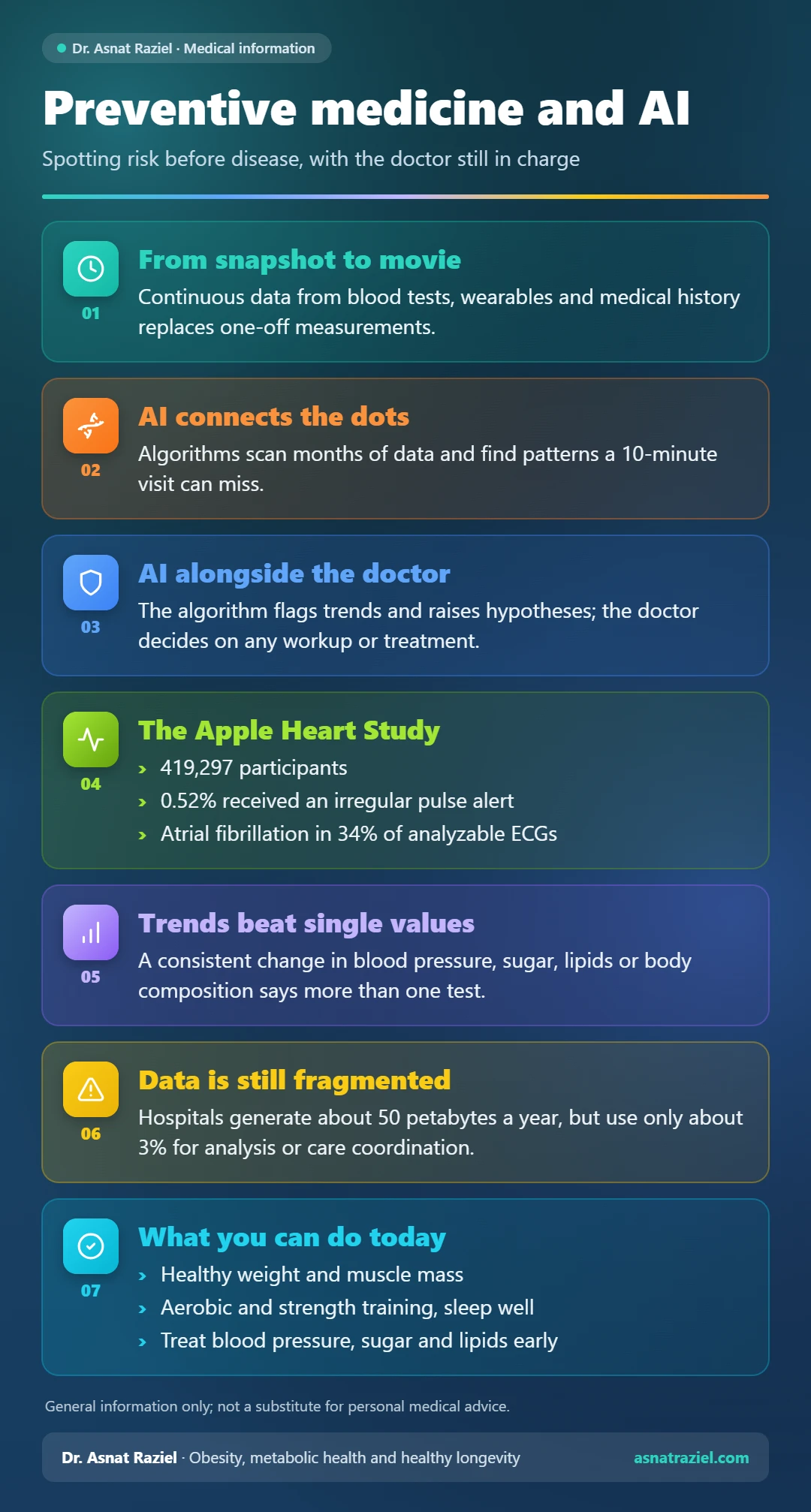
Preventive medicine and AI: the future is continuous care
Perhaps the big change is not a new test or a new drug, but a change in mindset. Instead of a system that waits for a diagnosis, we need a system that identifies risk. Rather than a single test, we look at a trend over years. In place of fragmented information, we get an integrated picture. And instead of a visit every few months, continuous monitoring when it truly helps.
Ultimately, combining preventive medicine and AI is not a competition between the machine and the doctor. Rather, it links the computing power of the computer with the judgment, experience and humanity of the doctor. The goal is not only to treat disease well, but to help us get there less often. You can read more about this direction in my article on healthy longevity.
The information in this article is general and does not replace personal medical advice.
Questions and answers
Do you need dozens of tests to practice preventive medicine?
No. More tests do not necessarily mean better medicine. We choose tests based on age, health status, family history and personal risk factors.
Can a smartwatch or smart ring diagnose a disease?
In most cases, no. They provide useful information and identify trends. However, an abnormal finding requires medical interpretation, and sometimes confirmation with a standard medical test.
Can AI recommend medical treatment?
It helps analyze information and support decisions. Even so, important medical decisions should rely on evidence, and doctors should make them in an appropriate medical setting.
What can we already do today?
A great deal. It is worth maintaining a healthy weight and body composition and building muscle mass. In addition, it is important to combine aerobic activity and strength training, eat a high-quality diet, sleep well and not smoke. Finally, it is worth treating high blood pressure, diabetes, obesity and blood lipids in time. These are still the foundation for extending healthy life expectancy.
References
Building a health system that puts prevention first
The Missing Foundation: Why Digital Architecture Must Be Health Care’s Next Priority
Large-Scale Assessment of a Smartwatch to Identify Atrial Fibrillation
Global Healthspan-Lifespan Gaps Among 183 World Health Organization Member States
Ethics and governance of artificial intelligence for health
The Longevity.Technology article is sponsored content. Apple funded the smartwatch study.




