By Dr. Asnat Raziel, bariatric surgeon specializing in obesity treatment, metabolic health and healthy longevity; Director of the Multidisciplinary Center for Obesity Treatment, Assia Medical, Assuta Ramat HaChayal, Tel Aviv
Human skills in medicine: why now?
Human skills in medicine are becoming more important than ever, precisely in an age of smart machines. Artificial intelligence (AI) already writes, creates images and analyzes medical tests. It also identifies complex patterns and offers solutions within seconds. So a question that many people are asking comes up: what will remain the human role?
To me, the more interesting question is a different one. Which human qualities will become especially important, precisely because machines are so smart? The future is not a contest between people and machines. It belongs to those who know how to combine the speed and accuracy of technology with judgment, creativity, compassion and responsibility. That way, we can see the whole person.
When information is available everywhere
In the past, knowledge was a scarce resource. People studied for years to accumulate information, remember it and use it at the right moment. Today, AI systems scan enormous amounts of information, summarize it and present an answer almost instantly.
This change does not diminish the value of knowledge. However, it changes the way we use it. The ability to remember every detail is making room for an even more important ability: asking the right question. We need to understand what really matters and to tell the difference between well-founded information and an answer that is convincing but wrong. In addition, we need to spot what is missing and check whether a recommendation fits the specific person and their life. In a world flooded with information, judgment, one of the core human skills in medicine, becomes the key asset.
What AI can already do in medicine
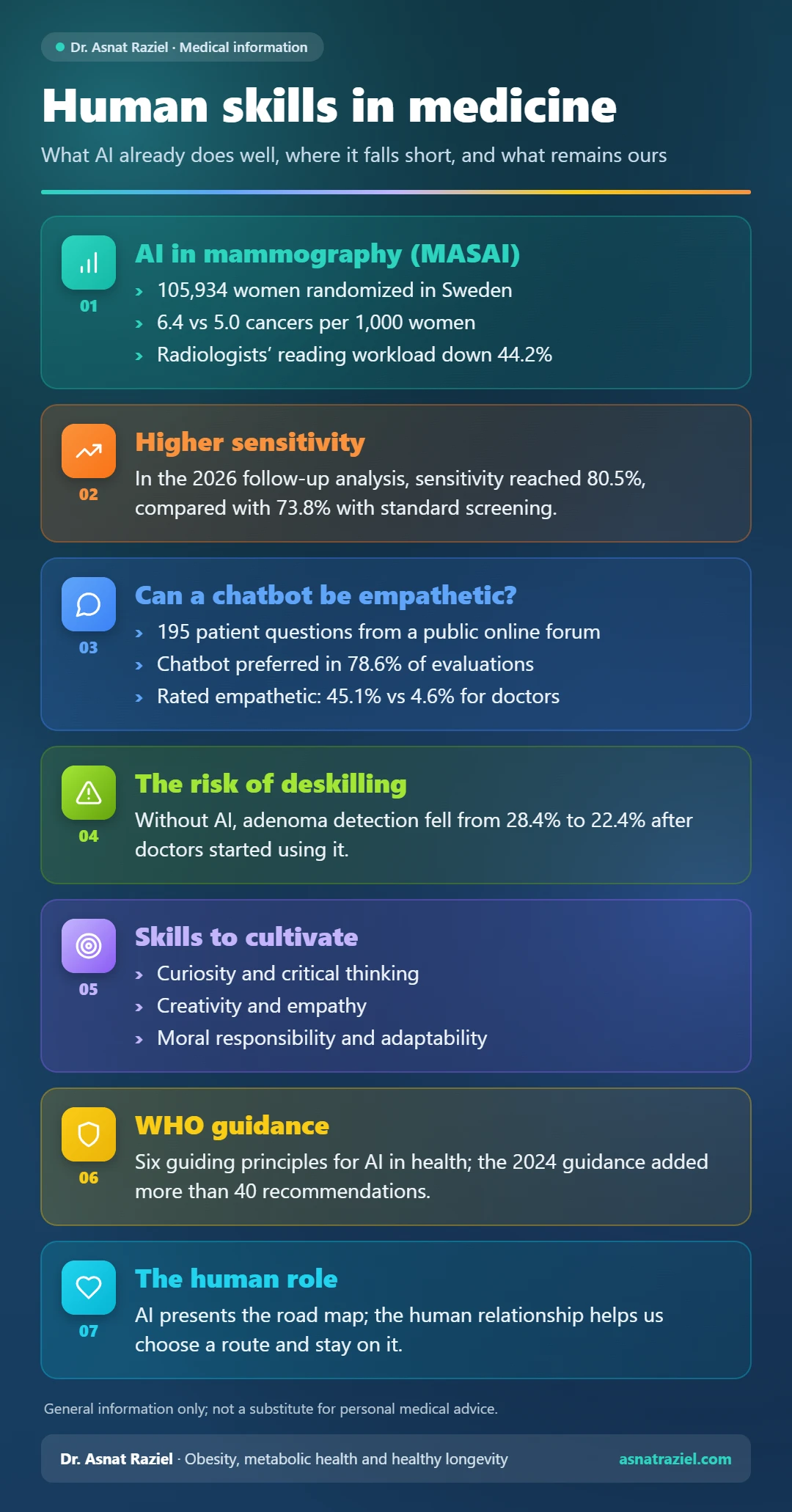
Medicine is a good illustration of how powerful this change is. For example, the MASAI trial in Sweden randomly assigned 105,934 women undergoing mammography to two groups. In the group where AI assisted the radiologists, screening detected 6.4 cancers per 1,000 women, compared with 5.0 with standard screening. At the same time, the radiologists’ reading workload dropped by 44.2%. In the follow-up analysis of the trial, published in early 2026, sensitivity reached 80.5%, compared with 73.8% with standard screening.
It is important to remember that the radiologists stayed in the picture. The AI sorted the scans and flagged suspicious findings, but the final decision remained a human one. In other words, it was the combination of person and machine that produced the result. In addition, the FDA, the US Food and Drug Administration, publishes an updated list of AI-enabled medical devices that have been authorized for marketing.
From general prediction to personalized medicine
In the near future, we will be able to combine information from blood tests, imaging and genetics. We will add data from smartwatches, sleep habits, nutrition, physical activity and metabolic markers. The system will detect trends even before symptoms appear and suggest a personal prevention plan. As a result, medicine may gradually shift from treating a disease that has already developed to actively protecting health. I have also written about this direction in my article on preventing disease with AI.
This is also one of the most fascinating connections to the world of longevity medicine. The goal is not only to add years to life. We want to add healthy, independent and meaningful life to our years. For example, in obesity treatment too, AI-based tools are starting to help to tailor treatment to each patient.
Human skills in medicine: technology measures, people give meaning
A smart system can calculate the risk of diabetes, heart disease or functional decline. It can also suggest a treatment target, identify a sleep deficit and recommend physical activity. But the person receiving the recommendation comes with a whole life story. They have worries, habits, a family and limitations. Sometimes they also have past attempts that left them disappointed.
This is where human skills in medicine come in: good medicine connects the data with this reality. The doctor explains the options and listens to what matters to the patient. Over time, the doctor builds trust and translates a scientific recommendation into a path the person wants to follow and is able to follow. Put simply, AI presents the road map. The human relationship helps us choose a route and stay on it over time.
Human skills in medicine: can a machine be empathetic?
Researchers have already looked into this question. In a study in JAMA Internal Medicine, health professionals compared 195 answers from doctors and from a chatbot to patient questions on a public online forum. The evaluators preferred the chatbot’s answer in 78.6% of evaluations. Moreover, they rated 45.1% of the chatbot’s answers as empathetic or very empathetic, compared with 4.6% of the doctors’ answers.
Even so, it is important to read this result correctly. The doctors’ answers were much shorter, and the study did not look at patients in a clinic. So, in my view, the conclusion is not that the machine will replace the doctor. The conclusion is that time, listening and warm wording, all human skills in medicine, are part of care. When AI saves us technical work, we will be able to devote the time we gain to the conversation itself.
The danger: forgetting how to do it on our own
Technology also has a less shiny side. A multicenter study from Poland looked at doctors who perform colonoscopy, an examination of the large bowel. After the doctors started working with AI, the researchers examined the procedures they performed without it. In those procedures, the detection rate of adenomas, polyps that can turn into cancer, fell from 28.4% to 22.4%. That is, constant reliance on the machine may erode human skill.
This is an observational study, so it does not prove cause and effect. Still, it highlights an important message. In its guidance on large multi-modal models, the World Health Organization warns about automation bias. This is the tendency of doctors and patients to overlook a system’s errors, or to hand difficult decisions over to it. Therefore, the doctor must keep thinking, checking and questioning.
Human skills in medicine for a new era
The better machines get at computing, the more we will need to cultivate the abilities that give that computing direction and meaning. First, curiosity will allow us to ask new questions. Second, critical thinking will help us check the answers. In addition, creativity will connect ideas in ways the system has not yet seen. Empathy will let us understand needs that do not show up in the data. Finally, moral responsibility will steer technology toward the good of people and society.
The ability to adapt will also become a core skill. Professions will change, work methods will be renewed and knowledge will keep updating quickly. That is why the person of the future will keep learning throughout life. Learning itself is part of human resilience.
Longevity starts in everyday life
Enthusiasm for new technologies is understandable. Advanced tests, biological clocks, sensors and algorithms promise a glimpse into our health future. But their real value begins when information turns into action.
Long-term health still starts with regular movement and preserving muscle mass. It also requires proper nutrition, good sleep, metabolic balance, social connections and a sense of meaning. Technology helps us measure, fine-tune and stay consistent. For example, a smartwatch can encourage movement throughout the day. I have also written about moving from data to habits in my article on longevity in everyday life. The encouraging message is that we build much of our future health through the small decisions we make today.
The responsibility remains in our hands
AI brings enormous opportunities. Alongside them come important questions about privacy, bias, equity and access. In its document on the ethics of AI for health, the World Health Organization set out six guiding principles. They include protecting human autonomy, transparency, accountability and equity. The 2024 guidance added more than 40 recommendations for governments, developers and health systems.
Medical, educational and social decisions affect human beings. That is why they need accountability, oversight and transparency. Our role is to decide which goals technology will serve and what limits we will set for it. In addition, we must make sure that progress is accessible and beneficial to everyone.
The bottom line
In the end, the machine helps us know. Our humanity decides what we do with that knowledge. That is why human skills in medicine, such as judgment, listening and responsibility, will determine the quality of care in the future. The important question is not whether machines will be smarter than we are. The question is what kind of human beings we want to be alongside them.
And if machines will think faster than we do, recognize patterns better than we do and predict parts of the future, which skills do we want to cultivate starting today? That way, the future will be both advanced and human.
The information in this article is general and is not a substitute for personal medical advice.
References
Artificial Intelligence-Enabled Medical Devices
Ethics and governance of artificial intelligence for health
WHO releases AI ethics and governance guidance for large multi-modal models




