By Dr. Asnat Raziel, bariatric surgeon specializing in obesity treatment, metabolic health and healthy longevity; Director of the Multidisciplinary Center for Obesity Treatment, Assia Medical, Assuta Ramat HaChayal, Tel Aviv
Obesity medication approval: what you need to know
Getting obesity medication approval through your Israeli health fund (HMO) can cut the monthly cost by hundreds of shekels. Even so, many people are confused. Who qualifies? What does the national health basket cover, and what does supplementary insurance cover? In this guide, I explain the process step by step, based on the health funds’ official information.
One thing to know up front: the terms, prices and covered drugs change from time to time. So at every stage, check the latest information on your health fund’s website.
Who qualifies for obesity medication approval?
The medical criteria are similar in Israel and abroad. According to the U.S. National Institute of Diabetes and Digestive and Kidney Diseases (NIDDK), adults are candidates for treatment when:
- their body mass index (BMI) is 30 or higher, or
- their BMI is 27 or higher and they also have a weight-related condition, such as high blood pressure or type 2 diabetes.
To find your number, use a BMI calculator. Still, BMI is only a starting point. Your doctor also looks at other medical conditions, other medications and factors that affect the choice of drug. For a general overview of the available drugs, see this review of anti-obesity medications, or my page on medications for obesity.
Obesity medication approval: health basket or supplementary insurance?
This is the point many people miss. The basket committee added Wegovy to the national health basket, but only for teens aged 12 to 18. For adults, by contrast, Wegovy and Mounjaro were not included, mainly because of their high cost. For the newest pill, I explain what Foundayo’s approval means for patients separately.
As a result, adults get the discount through their health fund’s supplementary insurance plan. In other words, you need to be a member of the supplementary plan and meet its conditions. I have summarized each fund’s arrangements, and how they compare with other countries, in my article on insurance coverage for obesity drugs.
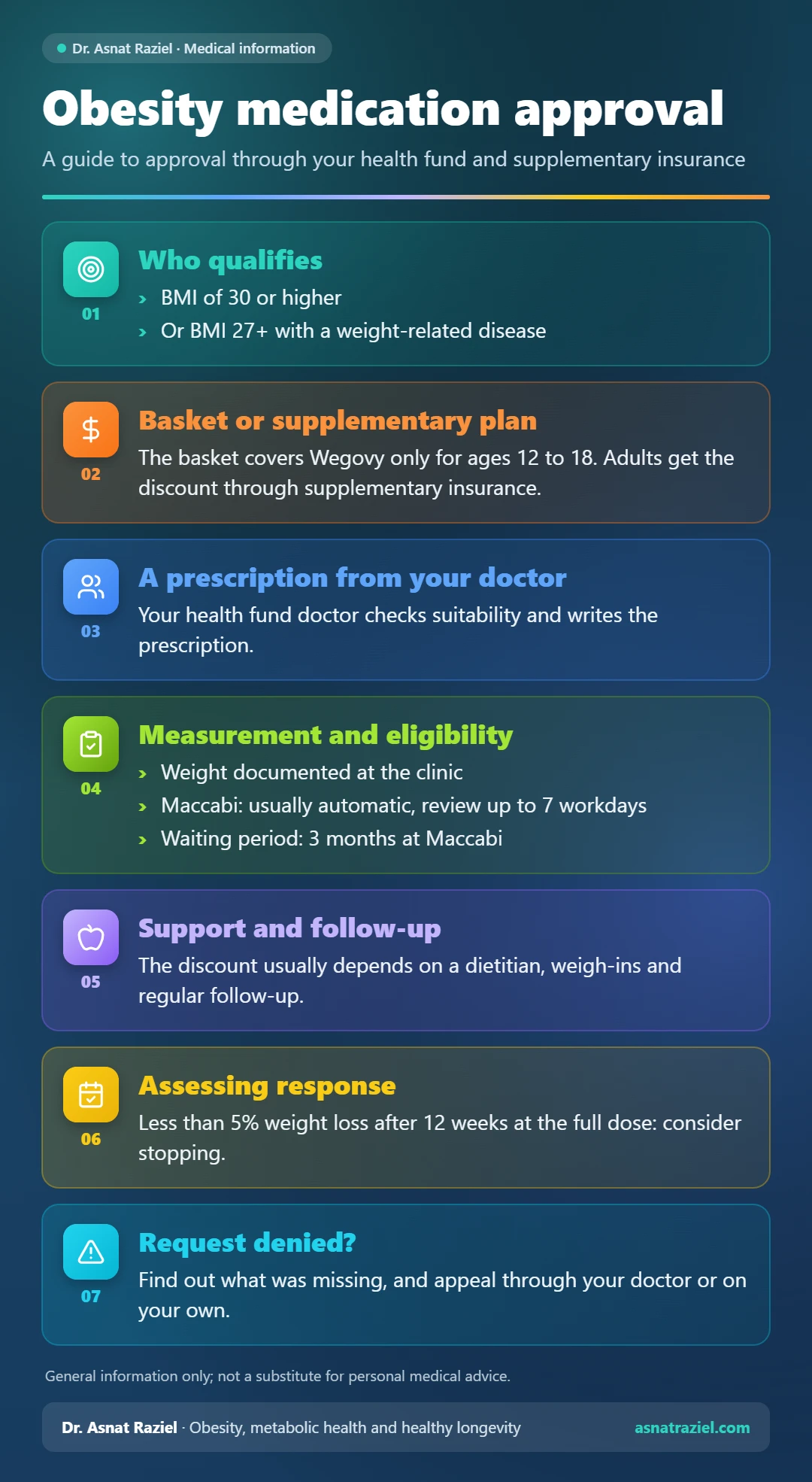
The obesity medication approval process, step by step
Step 1: A visit with your doctor
It all starts with a visit to your health fund doctor. The doctor checks whether the drug is medically right for you and writes a prescription. At Maccabi, for example, the referral comes from your treating doctor, and the prescription is issued during the visit. I have written about the medical side of getting a prescription in my guide to starting weight loss medication, and about how to pick the right physician in how to choose an obesity doctor.
Step 2: A documented measurement
Most health funds require a weight and height actually measured at the clinic. A self-reported weight is usually not enough. That’s why it is worth booking a weigh-in with a nurse or dietitian ahead of time, before you see the doctor. For a full checklist to bring to that visit, see my article on getting a prescription for weight loss injections.
Step 3: The health fund checks eligibility
Next, the health fund checks whether you meet the supplementary plan’s conditions. According to Maccabi’s eligibility page, in the Maccabi Zahav (Gold) and Maccabi Sheli plans, Maccabi usually approves Wegovy automatically when the doctor issues the prescription. You can see the answer on the website and in the app. If the conditions are not met, your doctor is notified, and reviewing a request usually takes up to 7 working days.
Step 4: The waiting period
Watch out for the waiting period. At Maccabi, for example, Wegovy eligibility under the supplementary plan starts only 3 months after you join the plan. Also, people who transfer from another health fund usually keep the seniority they have built up, under certain conditions.
Step 5: Nutrition support and follow-up
Approval often depends on taking part in a support program. At Leumit, for example, the discount on Mounjaro in the Leumit Zahav plan requires a documented clinic weigh-in, sessions with a dietitian and regular follow-up. Similarly, at Maccabi, Mounjaro treatment is combined with lifestyle change, including dietitian support and physical activity.
What does each health fund offer?
The arrangements change, so here is what I found on the health funds’ websites and in recent reports. Before you apply, confirm the details with your fund:
- Maccabi (Zahav and Sheli): Wegovy with a co-payment of 51% of the drug’s price, and Mounjaro with a co-payment of 442 to 927 shekels, depending on the dose.
- Clalit, Leumit and Meuhedet: Wegovy and Mounjaro at a discount of about 50% under the supplementary plan. The health funds publish current prices on their websites.
After approval: follow-up and next steps
Approval is only the beginning. According to the NIDDK, if you have not lost at least 5% of your starting weight after 12 weeks on the full dose, your doctor will consider stopping the drug. In addition, for teens, Maccabi approves treatment for 12 months at a time and then reassesses it based on up-to-date measurements.
So keep a record of your weigh-ins and dietitian sessions. What’s more, GLP-1 drugs also reduce food noise, but the best results come only with a change in habits. The medication is part of obesity treatment, not a substitute for it.
What if your obesity medication approval is denied?
First, ask your doctor to explain which condition was not met. Sometimes all that is missing is a documented weigh-in or a diagnosis of a related condition. Second, you can file an appeal. At Maccabi, for example, the doctor submits the appeal with reasons or new information. If the doctor does not, you can apply yourself through the website or the app. Finally, if you do not meet the criteria, it is worth discussing other treatment options with your doctor.
The bottom line
Today, adults get obesity medication approval through supplementary insurance, not through the national health basket. The process includes a prescription from your treating doctor, a documented measurement, meeting the BMI criteria, a waiting period and nutrition support. Preparing ahead saves you rejections and delays. Also, remember that approval is not the end of the road. Rather, it is the start of a process of follow-up. If you would like to find out whether treatment is right for you, you can read more about me and my clinic.
This article is general information and is not a substitute for personal medical advice.
Questions and answers
Are Wegovy and Mounjaro in the health basket?
The basket includes Wegovy only for teens aged 12 to 18. For adults, the discount comes through the health fund’s supplementary insurance.
How long does obesity medication approval take?
At Maccabi, approval for Wegovy is usually granted as soon as the prescription is issued. When a review is needed, it usually takes up to 7 working days.
Can I get the medication without supplementary insurance?
Yes. With a doctor’s prescription, you can buy the drug at full price. The health fund’s discount is available only to supplementary plan members who meet the conditions.
What happens if I don’t lose weight?
If you have lost less than 5% after 12 weeks on the full dose, your doctor will consider stopping the drug or switching treatment.
Sources
Prescription Medications to Treat Overweight & Obesity
Additional sources (in Hebrew): Maccabi Healthcare Services eligibility page for obesity and diabetes injections; reports in Ynet and Israel Hayom on Mounjaro discounts at Leumit and Clalit.