By Dr. Asnat Raziel, bariatric surgeon specializing in obesity treatment, metabolic health and healthy longevity; Director of the Multidisciplinary Center for Obesity Treatment, Assia Medical, Assuta Ramat HaChayal, Tel Aviv
Japanese wisdom meets the science of longevity
Japanese wisdom offers a different way of looking at health, time and meaning. It includes concepts such as ikigai, wabi-sabi and shinrin-yoku. Some are ancient, while others are fairly modern. Today, several of them also meet findings from neuroscience, lifestyle medicine and longevity research.
Picture a quiet morning in a small Japanese village. An older woman opens her door, tends her potted plants and makes green tea. Then she goes out for a short walk and meets her friends. She is not trying to get everything done. She simply lives, and she has good reasons to get up every morning.
Over hundreds of years, Japanese culture developed concepts that describe a special attitude toward life. They deal with finding meaning, building habits and accepting change. In addition, they emphasize the beauty of simplicity, the connection with nature and being present in the moment.
The most famous of them is ikigai, but it is only one part of a rich world of ideas. Some come from Buddhism and Zen. Others come from artistic traditions, social customs and Japanese work culture. However, not all of them are philosophies of life in the formal sense. Nor are all of them as ancient as social media makes them out to be.
In this article, I have gathered 25 such principles. For each one, you will find what science says about it, whether there is research, and how to apply it in daily life. In this way, we can connect ancient wisdom with healthy longevity, meaning many years of life with good health, function and independence.
Japanese wisdom, part one: meaning, habits and nature
1. Ikigai: the heart of Japanese wisdom
Ikigai is perhaps the reason to get up in the morning. It is one of the most beautiful concepts in Japanese culture. Roughly, it means whatever gives life value, flavor and purpose. It can be meaningful work. But it can just as well be raising grandchildren, tending a garden, playing music, cooking, volunteering, friendship or a morning walk.
In the West, ikigai is sometimes described as the overlap of four circles: what I love, what I am good at, what the world needs and what I can be paid for. However, according to an explanation from the Government of Japan, an American entrepreneur created that diagram. In other words, it is a modern Western adaptation, not the traditional Japanese definition. So ikigai does not require professional success or income.
What does science say about ikigai?
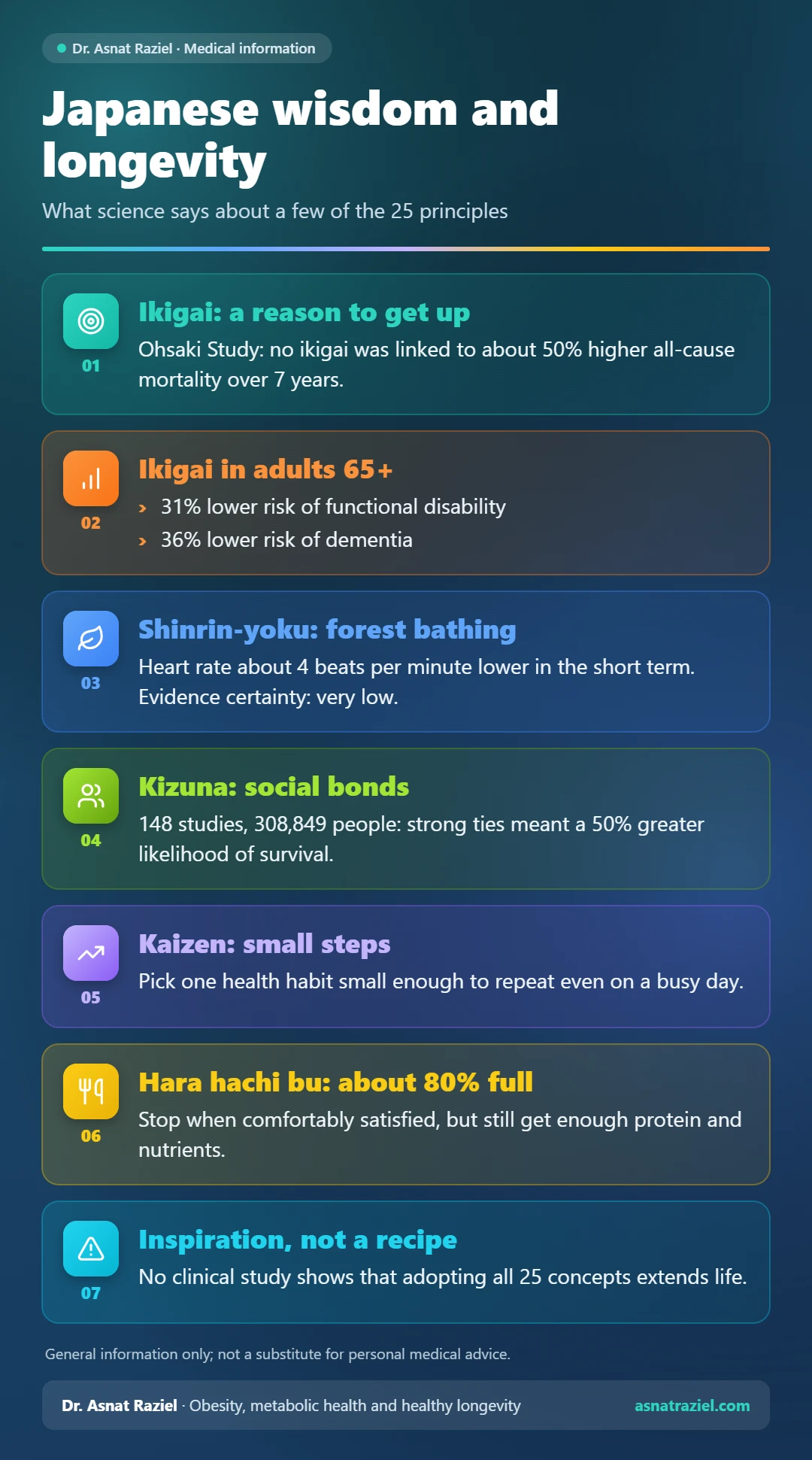
The Japanese Ohsaki Study followed 43,391 adults for seven years. People who reported having no ikigai had about a 50% higher risk of death from all causes, even after statistical adjustment for other factors. In addition, their risk of death from cardiovascular disease was about 60% higher.
A nationwide longitudinal study looked at Japanese adults aged 65 and older. Over three years of follow-up, those with ikigai had a 31% lower risk of developing functional disability and a 36% lower risk of developing dementia. They also reported fewer depressive symptoms and more happiness. Moreover, another Japanese study followed more than 71,000 people aged 40 to 79 for a median of 19.1 years. The researchers found that a strong sense of purpose was linked to lower cardiovascular mortality, mainly among people who were not working.
Still, it is important to stress that these are observational associations. They do not prove that finding ikigai in itself extends life. I have written at length about meaning, purpose and spirituality in medicine in a separate article.
How to apply it: Every morning, ask yourself: what is one thing I am looking forward to today? Meaning does not have to be a grand goal. Sometimes it lies in a conversation with someone you love, in creating something or in a kind act for someone else.
2. Wabi-sabi: the beauty of imperfection
The world pushes us to be younger, more beautiful and more perfect. Wabi-sabi, by contrast, offers a different view. It is an aesthetic world that values simplicity, naturalness, modesty, the marks of time and imperfection. The Stanford Encyclopedia of Philosophy describes how the art of tea favored simple utensils, sometimes even mended ones, over lavish ones.
Thus, an asymmetrical clay bowl, a weathered wooden table or a face that shows a life lived carry a special beauty. For mental health, you can find a parallel here with the idea of self-compassion: the ability to look at ourselves without constant criticism.
How to apply it: Stop measuring life only by what is missing. Instead, appreciate what is already there. See the changes that age brings as part of your personal story, alongside active care for your health and function.
3. Kaizen: a small improvement every day
Kaizen means continuous improvement. The concept is especially associated with Japanese management and industrial culture. But you can apply it in your personal life, too.
For example, instead of a dietary revolution in one day, add a vegetable to your lunch. Instead of committing right away to five workouts a week, start with a short, regular walk. The message is that progress comes from actions you can keep up, not only from bursts of motivation.
The idea fits with research on habit formation. Repetition, a supportive environment and less effort at the start of an action all help a new behavior become routine. You can also read about the power of small lifestyle changes on this site.
How to apply it: Choose one health habit. It should be small enough that you can repeat it even on a busy day.
4. Shinrin-yoku: forest bathing
The concept of shinrin-yoku gained popularity in Japan in the 1980s. It describes a mindful, sensory stay in the forest. This is not strenuous exercise but a deliberate slowing down: you watch the trees, listen to the birds, breathe the forest air and feel the ground.
A systematic review and meta-analysis published in February 2026 included 11 studies. According to the review, forest bathing was linked to a short-term drop in heart rate of about 4 beats per minute on average. It was also linked to lower scores for tension-anxiety and depression-dejection. However, the researchers rated the certainty of the evidence as very low. Therefore, forest bathing should not be seen as a substitute for medical or mental health treatment. A broad global review of research in the field adds background on the effects of time in nature.
How to apply it: Go to a park, a grove or a shaded trail. Keep your phone in your pocket and let your senses be present for 20–30 minutes. You do not need a Japanese forest.
5. Ichi-go ichi-e: this moment will not come again
The phrase roughly means “one time, one meeting.” It comes from the tradition of the Japanese tea ceremony. Even if we meet the same people tomorrow, today’s meeting will never happen in exactly the same way again.
So the idea reminds us to truly listen to the person in front of us. It invites us to enjoy a meal without screens and to notice moments we take for granted.
How to apply it: Each day, choose one encounter, with a family member, a friend or a colleague, and be fully present in it.
Japanese wisdom, part two: breaks, fullness and perseverance
6. Kintsugi: the cracks become part of the beauty
Kintsugi is the Japanese art of repairing broken pottery. Craftspeople use lacquer and decorative materials, sometimes including gold powder. Instead of hiding the break, they highlight it.
As a metaphor for life, kintsugi suggests that hard events, failures and losses do not have to erase our self-worth. We can learn, recover and keep growing. Even so, we should be careful not to romanticize suffering. Not every hard experience leads to growth, and there is no obligation to find beauty in every trauma.
How to apply it: Look back at a past struggle and ask what strengths, relationships or insights grew out of it. Do not deny the pain itself.
7. Hara hachi bu: Japanese wisdom about eating until almost full
One of the sayings most closely tied to Okinawa is to eat until your stomach is about 80 percent full. This is not a clinical method for measuring fullness. In fact, we have no precise way of knowing when we have reached 80%. The idea is to stop when you feel comfortably satisfied, not when you already feel overly full.
The approach may encourage slower eating, attention to hunger and fullness cues, and less mindless eating. I wrote about the mechanisms behind this feeling in my article on the physiology of satiety.
From the perspective of obesity medicine, there is an important caveat here. Patients taking medications that affect appetite still need enough protein, energy and essential nutrients. In other words, feeling full early does not guarantee adequate nutrition. That is why it is worth knowing the principles of nutrition during medication treatment for obesity.
How to apply it: Eat sitting down and slow your pace. Halfway through the meal, pause for a moment and ask whether you are still hungry.
8. Ganbaru: persevering when the road is hard
Ganbaru is a cultural concept that describes effort, determination and perseverance in the face of difficulty. In health, this quality is especially important. Fitness, rehabilitation, changing sleep habits and managing chronic disease usually take time and persistence.
But the concept also has a complicated side. When perseverance becomes a social duty to suffer in silence, it can encourage overwork and neglect of one’s own needs.
How to apply it: Persevere in what matters. At the same time, learn when it is better to rest, ask for support or change direction.
9. Shoshin: beginner’s mind
Shoshin is a concept from the Zen tradition, and it describes a curious, open and flexible attitude. The beginner asks questions. The expert, by contrast, is sometimes sure they already know the answers.
Lifelong learning may encourage mental flexibility and cognitive activity in older age as well. Still, there is no proof that practicing shoshin on its own prevents dementia. You can read about the link between curiosity and brain health on this site.
How to apply it: Learn something new every year: a language, a musical instrument, a dance, a technology or a creative skill.
10. Mottainai: respecting what we have
Mottainai expresses regret over wasting something of value. The concept relates to a respectful attitude toward food, resources, objects, time and human labor. In a society of overconsumption, it suggests choosing mindfully what we buy, what we eat and what we truly lack.
How to apply it: Plan your shopping and meals, throw away less food and repair things when you can.
Japanese wisdom, part three: beauty, space and stillness
11. Mono no aware: being moved by fleeting beauty
Cherry blossom season in Japan is one of the clearest symbols of this concept. The blossoms are stunning, but they last only a short time. Mono no aware describes a sensitivity to the impermanence of things. Knowing that beauty fades does not lessen its value. On the contrary, it may deepen our appreciation of it.
In times of change, aging or parting, this idea offers a way of looking at life. It lets us give up the need for everything to stay as it was.
How to apply it: Notice one beautiful moment during the day, such as a conversation, a view, laughter or music. Enjoy it without trying to hold on to it forever.
12. Yūgen: the deep beauty of what cannot be explained
Yūgen is an aesthetic concept that describes mysterious depth, suggestion and a beauty that is never fully revealed. Mist covering mountains, shadows in a Japanese garden or a melody that stirs a vague emotion all create this experience. The concept reminds us that not everything needs a precise definition or an immediate explanation.
In modern terms, you can find a parallel in the experience of awe: the feeling that we are standing before something greater than ourselves. Researchers study it in relation to well-being, connection and meaning. Still, this is a parallel of ideas, not a claim that the two concepts are the same.
How to apply it: Make time for art, music and nature, without needing to analyze every experience.
13. Ma: the space between things
Ma is about the gap, the pause and the space that give meaning to what surrounds them. In music, the silence between the notes matters as much as the notes themselves. In architecture, empty space is not necessarily a place that needs filling.
Ma can also inspire daily life. We live in a world where the calendar is full, the phone keeps beeping and our attention is split. It is precisely the breaks that let us recover.
How to apply it: Leave gaps in your calendar with no tasks, create breaks between meetings and cut down on unnecessary stimuli.
14. Gaman: bearing hardship with dignity and patience
Gaman describes patience, self-control and the ability to cope with hard situations without losing balance. The principle can help in periods of rehabilitation, career change, medical challenges or personal crisis.
But here, too, we distinguish between resilience and suppression. Healthy coping does not require hiding emotions, avoiding treatment or giving up on help.
How to apply it: Acknowledge the difficulty and identify the next step within your control. Then act, without demanding an instant solution to the whole problem.
15. Omotenashi: wholehearted giving and hospitality
Omotenashi is a Japanese idea of hospitality and sensitivity to the needs of others. It is not just about politeness. It is attention to the small details that make another person feel welcome, respected and understood. According to the Japan National Tourism Organization, the concept has its roots in the tea ceremony.
At a time when loneliness and social isolation are a health challenge, relationships built on mutual care have real value.
How to apply it: Notice what another person truly needs. Offer help on your own initiative and make time to host and to meet.
Japanese wisdom, part four: breath, mind and connection
16. Komorebi: sunlight filtering through the leaves
Komorebi is a Japanese word for the sunlight that filters through the leaves of trees. It is not a structured philosophy of life but a poetic word for a gentle experience in nature. You can turn it into a reminder: life is full of small moments of beauty, but to notice them we sometimes need to slow down.
How to apply it: When you walk outside, watch the light, the shadows, the movement of the leaves and the colors of the sky.
17. Datsuzoku: breaking out of routine
Datsuzoku describes stepping beyond the ordinary and freeing ourselves from convention. As a source of inspiration, it invites us to seek new experiences and to leave the automatic track from time to time. Innovation, creativity and curiosity sometimes require a willingness to do things differently.
How to apply it: Visit a new place, learn an unfamiliar skill or meet people outside your usual circle. You can also change your leisure routine.
18. Seijaku: inner stillness
Seijaku describes quiet and tranquility. In certain aesthetic frameworks, it is linked to a sense of deep calm. It does not mean a complete absence of noise or activity. Instead, it is a quality of stillness that you can experience even within an active life. The principle fits well with breathing practice, meditation, prayer or quiet time.
How to apply it: Set aside a few minutes a day to sit quietly, with no screen, no task and no attempt to produce a result.
19. Zazen: the art of mindful sitting
Zazen is a central meditation practice in Zen Buddhist traditions. The practitioner sits in a stable posture and directs attention to the breath and to presence. They observe their thoughts but do not get carried away by them automatically. The way people practice varies between schools.
Researchers have studied meditation and mindfulness in relation to stress, anxiety, pain and sleep. Some interventions showed benefits, but the effects vary. In addition, not every finding from mindfulness research necessarily applies to zazen. You will find a review of research on meditation and stress on this site.
How to apply it: Start with five minutes of comfortable sitting and attention to your breath. There is no need to fight your thoughts. It is enough to notice them and gently return to the breath.
20. Kokoro: heart, mind and spirit
Kokoro is a broad Japanese concept that includes aspects of heart, emotion, thought and spirit. It reminds us that human experience does not always divide neatly into separate categories of feeling and reason. In lifestyle medicine, too, it is important to look at the whole person: their physical, mental, social and functional state.
How to apply it: When you think about health, do not ask only what the test results say. Also ask how you feel, how you sleep, what your social connections look like and what your quality of life is.
Japanese wisdom, part five: connection, nutrition and order
21. Kizuna: the bonds that connect us
Kizuna means a bond or emotional connection between people. In Japanese culture, the concept expresses belonging, trust, loyalty and mutual support, especially in times of crisis.
In longevity research, social connection is a central topic. A large meta-analysis pooled 148 studies with 308,849 participants. According to the findings, people with strong social relationships had a 50% greater likelihood of survival over the follow-up period. The researchers compared the strength of this link to well-known risk factors for mortality. I have also written about social connections and longevity in a separate article.
How to apply it: Schedule a regular social get-together and join a community group. You can also reconnect with an old friend or start a shared activity.
22. Kodawari: exceptional attention to quality
Kodawari describes a personal commitment to quality, precision and careful work. You can see it in a craftsperson, a chef, a gardener or a professional who keeps refining small details even after many years. There is a satisfaction here that comes from the work itself, not only from outside recognition. Still, it is important to tell the difference between striving for excellence and harmful perfectionism.
How to apply it: Choose one meaningful area and go deeper into it out of curiosity and enjoyment. Do not turn every action into a test.
23. Shokuiku: Japanese wisdom on the plate
Shokuiku means food and nutrition education as part of life. In Japan, it has a formal national framework, including a basic law and government programs run by the Japanese Ministry of Agriculture. The concept covers knowledge and skills for choosing food, healthy eating habits, familiarity with where food comes from and the social side of meals.
From the standpoint of obesity medicine and longevity, the message is important. Healthy eating is not built only on prohibitions or calorie counting. It rests on skills, a supportive environment and a food culture. In this context, it is also worth getting to know the longevity diet.
How to apply it: Learn to prepare basic, nourishing food, eat family meals when you can and include a variety of foods.
24. Danshari: letting go of what we no longer need
Danshari is a modern Japanese approach associated with tidying the home and reducing clutter. The idea is not to get rid of all your belongings. Instead, you examine what truly serves you and what only takes up space. You can also see it as a metaphor for clearing emotional and mental space. Even so, tidying up is not psychological treatment.
How to apply it: Choose a drawer, a closet or a workspace and organize it. Keep mainly things that are useful or meaningful.
25. The 5S method: Japanese wisdom for an environment that supports habits
This is a Japanese organizing method that grew out of the workplace, not a traditional spiritual philosophy. It includes five principles: sort (Seiri), set in order (Seiton), shine (Seiso), standardize (Seiketsu) and sustain (Shitsuke).
The idea also suits personal health. An orderly environment makes desired behaviors more accessible. For example, walking shoes in a visible spot, a water bottle within reach and a kitchen set up for healthy cooking all reduce the effort good choices take.
How to apply it: Design your environment so that it supports the habits you want to keep. That way, you do not have to rely on willpower alone.
What in Japanese wisdom really contributes to longevity?
It is important to separate inspiring life wisdom from scientific evidence. No clinical study shows that adopting all 25 concepts extends life. So they should not be seen as a secret Japanese recipe for living to 100. However, several themes that come up again and again in these ideas have independent research support.
Meaning and social connection. In population studies, a sense of purpose and belonging is linked to good health and mental well-being. In some studies, it is also linked to lower mortality.
Daily movement and lasting habits. Regular physical activity is one of the best-established interventions for maintaining function and health throughout life. In particular, it is recommended to combine aerobic and strength training.
Nature and less mental strain. Time in nature may reduce stress and improve mood in the short term. However, high-quality studies on long-term effects are still lacking.
Quality, mindful nutrition. The right dietary composition matters for metabolic health and for preserving muscle mass. This means enough protein, dietary fiber and energy, as well as consistent eating patterns.
Curiosity, learning and mental flexibility. Cognitive activity, social connection and treating risk factors help protect brain health. Still, there is no proof that learning Japanese concepts in itself prevents brain aging.
A day with Japanese wisdom
You can weave in some of these ideas without overhauling your lifestyle. In the morning, start with ikigai: think of one thing that gives the day meaning. Then go for a short walk in daylight, in the spirit of shinrin-yoku and komorebi.
At breakfast, adopt the idea of shokuiku: choose nourishing food and eat mindfully. During work, use kaizen for one small improvement, and ma to leave space between tasks. When you meet someone close to you, remember ichi-go ichi-e. This encounter is unique, so it is worth being truly present in it.
When something does not go as planned, wabi-sabi reminds you that not everything has to be perfect. At the same time, ganbaru encourages you to keep going, without giving up rest or self-compassion. Finally, at the end of the day, pause for a moment of seijaku. Reflect on what was good and let go of what you did not get to. This is not a medical protocol, but a suggestion for a more mindful routine.
Japanese wisdom and longevity medicine: body, mind and meaning
For years, medicine focused mainly on disease, diagnosis and treatment. Longevity medicine broadens the view. It asks how to preserve physical function, independence, cognitive ability, social connection and quality of life over the years.
Current medical knowledge emphasizes physical activity, preserving muscle mass, quality nutrition and good sleep. In addition, it emphasizes metabolic balance, preventive medicine and treating risk factors. Japanese culture adds an important human perspective. It is not enough to extend life. We also need to ask what makes it full and meaningful.
This balance is especially important today. People invest a great deal in trying to slow biological aging. Yet sometimes they neglect the joy, the relationships and the experiences that give the extra years their value. A person can meet every fitness and nutrition target and still feel lonely. On the other hand, a meaningful life does not remove the need for medical care and for looking after the body. So the best approach combines the two.
The bottom line: Japanese wisdom adds life to your years
Perhaps this is the great gift of Japanese wisdom: the understanding that a good life is not built only from big achievements. It is built from hundreds of small moments. A walk among trees, a shared meal, creating, learning, a lifelong friendship, inner calm and the knowledge that we still have something to give.
Ikigai teaches us to find meaning. Kaizen teaches us to improve gradually. Wabi-sabi invites us to accept imperfection. Shinrin-yoku brings us back to nature. And kizuna reminds us how much we need one another.
There is no need to adopt all of them. Even one principle that fits your personal values, practiced consistently, can be a starting point. After all, the goal is not just to live to 100. The goal is to reach our later years with health, independence, curiosity, love and meaning, and to keep enjoying the journey.
The information in this article is general and does not replace personal medical advice.
References
Sense of life worth living (ikigai) and mortality in Japan: Ohsaki Study
Social relationships and mortality risk: a meta-analytic review




