By Dr. Asnat Raziel, bariatric surgeon specializing in obesity treatment, metabolic health and healthy longevity; Director of the Multidisciplinary Center for Obesity Treatment, Assia Medical, Assuta Ramat HaChayal, Tel Aviv
Somatic experiencing: a story that began with an imaginary tiger
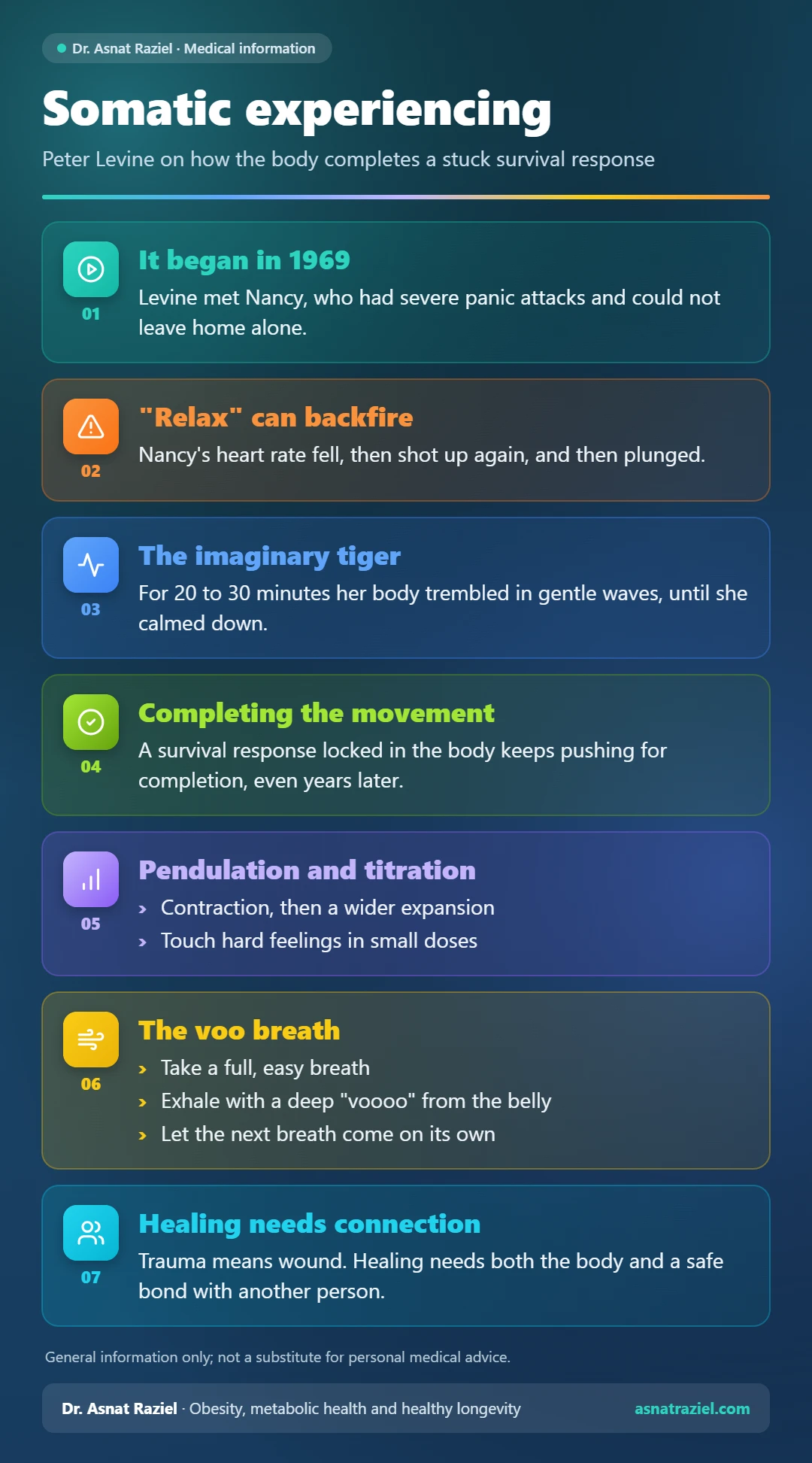
Somatic experiencing is a body-based approach to healing trauma, and its story begins in 1969. That year, Peter Levine met a young woman we will call Nancy. She suffered from severe panic attacks and could not leave her home alone. Levine, then a young researcher, tried to help her with relaxation exercises. What happened in that room changed the course of his career.
Today Levine is a bestselling author and the developer of Somatic Experiencing (SE). At the Nervous System Reboot summit, he spoke with psychologist Ronald Siegel of Harvard Medical School. Here are the highlights of their conversation.
Telling someone to relax doesn’t work
At the start of the session, Nancy’s heart was racing. Levine guided her to relax, and her pulse did come down. But then it suddenly shot up again. Levine admits that he told her exactly the wrong thing: that she had to relax. Her heart rate plunged, and she panicked and said she felt like she was dying.
At that moment, an image came to his mind of a tiger getting ready to pounce. He told Nancy that a tiger was chasing her and that she had to run to the rocks and climb. At first, this only made her panic worse. So he offered her his hand, an imaginary hand, so they could run together.
For 20 to 30 minutes, her body trembled in gentle waves. She took deep, spontaneous breaths and sweated. Eventually, she calmed down completely. Afterward, she said she had remembered herself at age four, held down by force on an operating table with an ether mask over her face. Her body had wanted to escape back then and could not. According to Levine, with the help of the imaginary tiger, her body finally completed that escape.
The core principle of somatic experiencing: completing the movement
Levine asked himself a simple question. Wild animals face danger all the time, and yet they do not develop trauma. What do they do that we don’t?
In his view, the answer is completion. When we are overwhelmed and have no way to flee or fight, the survival response stays locked in the body. It keeps pushing for completion, even many years later. Animals, by contrast, discharge that charge. Levine mentions a well-known video of a polar bear that was sedated so it could be relocated. When the bear woke up, it shook and panted. According to Levine, this is how the body regulates arousal and returns to balance.
The word trauma means wound
Levine notes that the word trauma comes from the Greek word for wound. The wound forms when we are threatened and no one stands by our side. Therefore, he says, healing needs both the body and a safe connection with another person.
Watch the full conversation: Peter Levine on somatic experiencing
The conversation is in English and lasts about an hour. It was recorded at the Nervous System Reboot 2026 summit of the Heart Mind Institute.
Contraction and expansion: a pendulum of healing
Levine illustrates the idea with a toy he once bought at an airport, a ball that contracts and expands. When we touch a traumatic memory, the body contracts. If the person feels safe enough, expansion follows the contraction. After that comes another contraction, and then an even greater expansion. He calls this movement pendulation.
Another principle is titration, meaning a gradual dose. In other words, you touch the difficult experience in small amounts at a time. According to Levine, diving into trauma too quickly can feel like being traumatized again. In addition, he warns against escaping into expansion alone. In his words, bypassing pain with bliss is not healing. Instead, we need to hold both poles together.
The voo exercise: a breath that tells the brain the danger has passed
Levine explains that the vagus nerve is the largest nerve in the body. According to him, most of its fibers carry information from the gut to the brain, not the other way around. So when the belly tightens with fear, the brain receives that signal and amplifies it. For about two years, he searched for a way to send the brain a different signal: the danger is over.
Here is how to practice. First, take a full, easy breath. As you exhale, make a deep “voooo” sound from your belly until you run out of air. Then wait for the next breath to come on its own and fill your belly and chest. Repeat this a few times. According to Levine, many people feel tingling, vibration or warmth in the belly. Sometimes emotions or memories come up too, and you can stop at any moment.
Healing, community and spirituality
At the end of the process, Nancy described a special feeling. She felt held in warm, tingling waves. Levine calls this an unusual state of safety and connection, both to ourselves and to others. The book he is writing these days explores the link between trauma and spirituality.
Levine also talks about his travels among Indigenous tribes in Brazil. There he saw rituals of singing, drumming and moving together. According to Levine, one tribal chief told him that trauma arises when there is no fertile ground of ritual and community. He also describes crying that turns into laughter and joy. In other words, release can also lead to a lift in spirit.
Somatic experiencing, stress and healthy longevity
From my point of view, Levine’s idea is also relevant to physical health. Ongoing arousal affects sleep, appetite and hormones. I offer many of my patients simple tools from my practical guide to stress relief. I have also written about everyday factors that speed up aging and about the link between human connection and longevity. The common thread is clear: a body that feels safe is a body that heals better.
According to Levine, about 200,000 people in more than 50 countries now study the method. There is also a randomized controlled study that tested the method in people with PTSD, and the method’s website collects additional studies.
The bottom line
Somatic experiencing offers a fresh look at trauma. According to Peter Levine, the body is not the enemy but part of the solution. When we feel safe enough, it knows how to complete what got stuck, gently and in small doses. That is why this work is best done with a qualified, experienced therapist.
The information in this article is general and does not replace personal medical or therapeutic advice. If you are coping with trauma or anxiety, please reach out to a qualified professional.
Sources and further reading
Somatic Experiencing for Posttraumatic Stress Disorder: A Randomized Controlled Outcome Study