By Dr. Asnat Raziel, bariatric surgeon specializing in obesity treatment, metabolic health and healthy longevity; Director of the Multidisciplinary Center for Obesity Treatment, Assia Medical, Assuta Ramat HaChayal, Tel Aviv
The window of tolerance: when the body tells the story before words do
The window of tolerance is the range in which we feel, think and respond in a balanced way. One client walked into Dr. Pat Ogden’s therapy room boiling with rage at her landlady. She couldn’t even sit down. Ogden didn’t try to talk with her about the landlady. Instead, the two of them placed their hands on the outside of their knees and pressed inward. Her body calmed down, and then the client said something surprising: it actually wasn’t that important. The problem wasn’t the landlady. The problem was the arousal level of her nervous system.
In times of war, meaning and hope can widen that window. I reflect on this in my essay on Purim, reversal and resilience.
There is also reason for reassurance. In an opinion piece on Ynetnews, Dr. Zvi Fishel, former head of the Israel Psychiatric Association, wrote that acute stress after October 7 usually fades within days to weeks.
Even healthy routines can push us outside this range, as I describe in when healthy habits go too far.
Dr. Pat Ogden is a pioneer of body-based psychology. She founded the Sensorimotor Psychotherapy Institute, which developed an approach that brings the body into the treatment of trauma and attachment wounds. At the Nervous System Reboot summit, she explained why the body is the key to change.
What is the window of tolerance, and why does it matter?
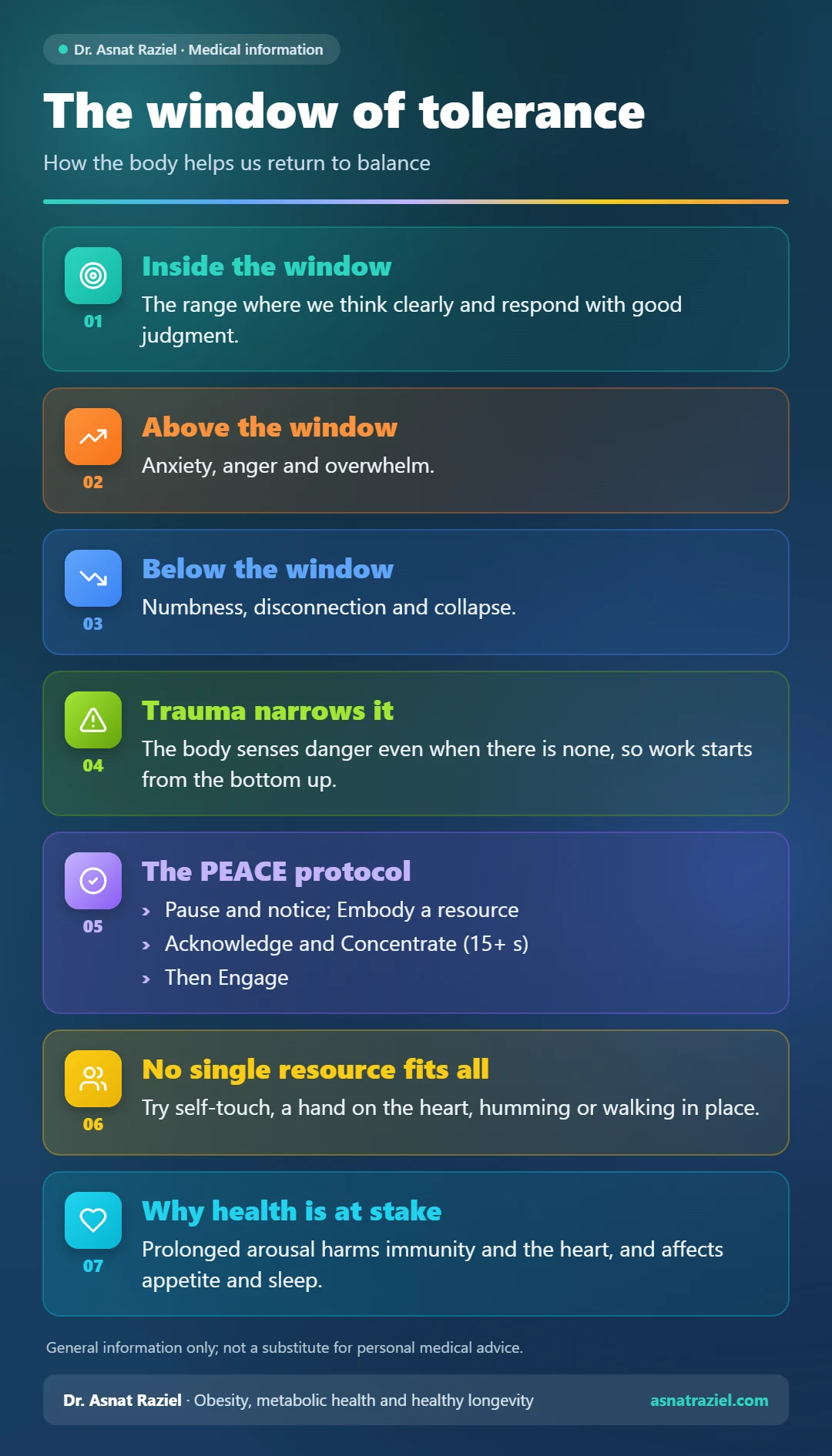
First, it helps to understand the concept itself. In the 1990s, Ogden developed what she called the “modulation model.” Later, psychiatrist Dan Siegel coined the term window of tolerance. Inside the window, we can think clearly and respond with good judgment. Above it come anxiety, anger and overwhelm. Below it come numbness, disconnection and collapse.
According to Ogden, people who have experienced trauma slip out of the window very easily. Their body detects danger even when there is no real danger. In Ogden’s terms, they live in “trauma time” rather than in the present. So the first step is learning to recognize the moment when arousal starts to climb.
The body remembers: posture, movement and shame
Ogden emphasizes an important point. It is not enough to be aware of the body. We also need to change the way we live in it. Our posture, movement and physiology reflect our history. For example, a child who grew up in a demanding home may develop a tense, fast body that is always ready for action.
Chronic shame, she says, often shows up as a slumped posture, a lowered head and a body that folds inward. Moreover, posture also maintains the emotion. When we stand in a certain way, the body unconsciously reminds us of the situations that created that posture. One of her clients worked on both her emotions and her posture. Eventually, standing more upright helped release her feeling of hiding.
Watch the full talk: Dr. Pat Ogden on the window of tolerance
The full interview, in English, was presented at the Nervous System Reboot 2026 summit of the Heart Mind Institute.
Why talking alone isn’t always enough
Ogden distinguishes between two kinds of emotions. Attachment emotions, such as sadness, grief and vulnerability, ease when we feel and express them. By contrast, trauma emotions, such as terror and rage, do not resolve through expression. When people go deep into them, they feel less safe and sometimes relive the event.
Body-based therapies build on similar ideas, as I describe in my article on somatic experiencing.
That is why trauma work starts “from the bottom up.” First we regulate the body, and only then do we work with thoughts and beliefs. According to Ogden, it is very hard to resolve trauma without working with the body, because the patterns live in our physiology and movement habits. I describe one of the body’s own ways to settle in my article on shaking after trauma.
The PEACE protocol: five steps back into the window of tolerance
Ogden presented a simple tool that anyone can practice. It is called the PEACE protocol, and each letter stands for a step:
P – Pause and notice. Identify the first physical sign that your arousal is rising. For one person it is holding the breath; for another, it is a tight throat.
E – Embody a physical resource. Choose a physical action that calms you. Ogden mentions self-touch, a hand on the heart, lengthening the spine, humming, smiling or walking in place.
A – Acknowledge the change. Notice what has shifted. Maybe your shoulders dropped, or maybe your breathing deepened.
C – Concentrate on the change. Stay with the good feeling for at least 15 seconds. According to Ogden, this is how the brain begins to build a new pathway.
E – Engage. Only now return to the conversation or the task. When we are outside the window, we react instead of responding.
It is important to remember that no single resource suits everyone. Ogden herself, for example, actually holds her breath when she feels overwhelmed, because deep breathing doesn’t help her. So it is worth experimenting with several options until you find what works for you.
The window of tolerance in couples and families
Ogden described a couple who argued all the time. When the wife leaned forward with tension, the husband pulled back and raised a finger. She read this as dismissal, and he read her leaning in as aggression. Neither of them noticed the body language. Later, he leaned forward just slightly, and she calmed down immediately. With children, in addition, she uses a simple version called STAR: stop, try an activity, ask what feels better, and return to what you were doing.
The window of tolerance, stress and metabolic health
Ogden noted that prolonged arousal outside the window also harms health, for example the immune system and the heart. In my experience, chronic stress also affects appetite, sleep and weight. You can read more about this in my article on stress and weight. It is also worth learning some practical stress relief techniques and understanding the link between good sleep and metabolic health. What’s more, human connection is itself a powerful regulation tool.
The bottom line
The body is not the enemy. Ogden suggests treating it as a teacher. When we learn to recognize the first signs and choose a suitable resource, we can return to the window of tolerance again and again. Over time, the window itself widens. People coping with trauma will benefit from working with a qualified therapist who uses a body-based approach.
The information in this article is general and does not replace personal medical or therapeutic advice.