By Dr. Asnat Raziel, bariatric surgeon specializing in obesity treatment, metabolic health and healthy longevity; Director of the Multidisciplinary Center for Obesity Treatment, Assia Medical, Assuta Ramat HaChayal, Tel Aviv
Overdoing healthy habits: when the pursuit of health gets out of control
Overdoing healthy habits is something I see in my clinic almost every week. Over the past decade, the pursuit of health has become almost an ideology. Running before sunrise, the gym in the evening, long fasts, supplements and apps that track sleep and steps. But when a “healthy” habit gets out of balance, it stops being healthy.
What is meant to extend life can actually wear down both body and mind. The principle is simple, yet sometimes forgotten: health is not a competition, it is balance. In this article, I will go over four habits that tend to get out of control and explain how to bring them back into balance.
Excessive exercise: when the body pays the price
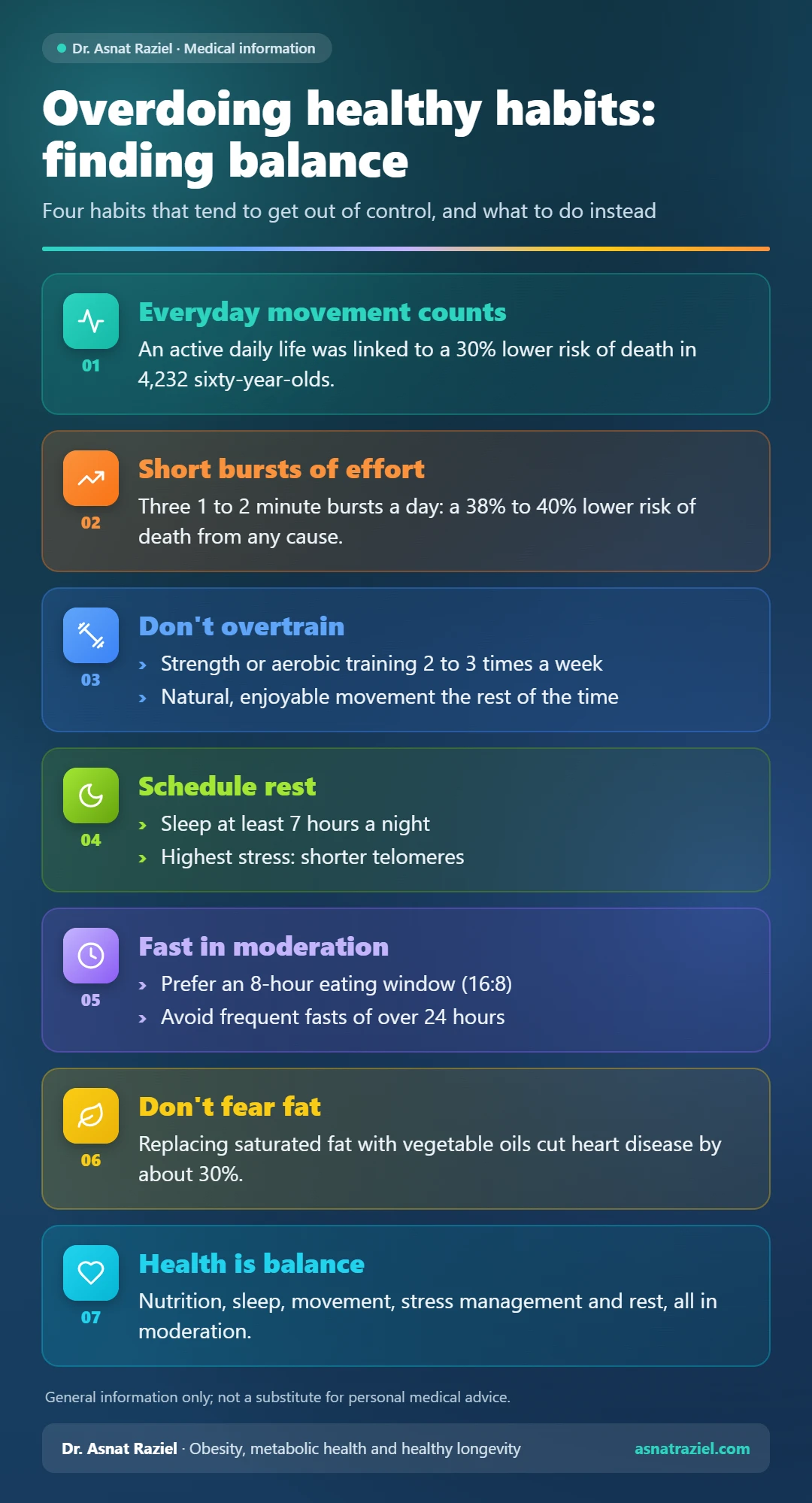
We all know that physical activity improves health. However, “the more, the better” is not always true. Even simple everyday movement contributes to health. A Swedish study followed 4,232 sixty-year-olds for 12.5 years. Those who were active in daily life, for example gardening, doing housework and making home repairs, had a 30% lower risk of death from any cause. This finding held regardless of structured exercise.
In addition, a study published in Nature Medicine looked at 25,241 people who do not exercise. The researchers found that three short bursts of effort a day, of one or two minutes each, were linked to a 38% to 40% lower risk of death from any cause. Examples include climbing stairs quickly or walking briskly to catch the bus.
On the other hand, there is another side. A study in Cell Metabolism found a J-shaped relationship between vigorous activity and cognitive function. In other words, beyond a certain point the benefit declines. Training too intensely, without rest, can harm sleep, immunity and joints.
What is recommended? A relaxed mix: strength or aerobic training two or three times a week, and natural, enjoyable movement the rest of the time. Dancing, walking, easy swimming or playing with your kids. There is no need to prove anything to anyone. A detailed comparison appears in my article on aerobic vs. strength training.
Overdoing healthy habits and a lack of rest
The modern era glorifies efficiency and a fast pace. But our bodies are not built to work nonstop. Too little sleep, no breaks and constant mental load together create chronic stress. A landmark study in the field showed that women with the highest stress levels had shorter telomeres. Telomeres are the “protective caps” at the ends of our chromosomes. The gap was equivalent to at least an extra decade of aging.
The concept of hormesis, the principle that a small stress makes the body stronger, helps explain this. Exercise, a short fast or a cold shower are all forms of controlled stress. Without rest afterward, however, the stress stops strengthening us and starts wearing us down. That is the core risk of overdoing healthy habits.
What to do instead? Schedule rest the way you schedule a meeting. The leading American sleep medicine societies recommend that adults sleep at least 7 hours a night. In addition, it is worth including calming activities: breathing exercises, yoga, meditation or sitting quietly with a cup of tea. Rest is not weakness, but part of health. Read more in my article on sleep, stress and metabolic health.
Extreme fasting: when the diet backfires
Intermittent fasting has become a global trend, and to some extent rightly so. Done in moderation, it may help with weight loss and blood sugar control. An analysis of 99 trials in The BMJ, with 6,582 participants, examined the topic. The researchers found that intermittent fasting leads to weight loss similar to standard calorie restriction. Alternate-day fasting led to only a small difference, of about 1.3 kg, in short trials.
In other words, fasting is not magic. When it becomes aggressive, for example frequent fasts of more than 24 hours, the risks rise. The body may break down muscle for energy, and nutritional deficiencies may develop. So instead of “detoxing,” you place a heavy burden on your body.
What to do instead? Adopt a balanced model, such as an 8-hour eating window (16:8), or partial days of reduced intake. It is important to eat good-quality food within the eating window and to listen to your body. Weakness, dizziness and fatigue are warning signs. You can read more in my article on intermittent fasting and the biological clock.
Overdoing healthy habits on your plate: fear of fat
Years of low-fat diets have made people afraid of fat. But the right fats are essential for the skin, the brain, hormones and cell membranes. An American Heart Association advisory concluded that replacing saturated fat with polyunsaturated vegetable oils reduced heart disease by about 30% in trials. That is a reduction similar to what statin treatment achieves. By contrast, replacing fat with refined carbohydrates and sugar brought no benefit.
In addition, a severe deficiency of essential fatty acids, such as omega-3 and omega-6, can harm the skin and growth. People who cut almost all fat from their menu may be doing themselves harm.
What is recommended? Bring good fat back to your plate: nuts, chia and flax seeds, olive oil, avocado, tahini and fatty fish. Not in large amounts, but quality fats in moderation. You will find more ideas in my article on nutrition for healthy aging.
The big message: health is not a marathon
You cannot push one healthy habit to the extreme to make up for neglecting another. You cannot eat badly and run a marathon to balance it out. Nor will a two-day fast make up for poor sleep. In the same way, pushing your body to the limit will not extend your life.
A healthy lifestyle significantly reduces the risk of disease, but it does not grant complete immunity. It requires a combination of nutrition, sleep, movement, stress management and rest, all in moderation. Not out of perfectionism, but out of self-compassion and presence. Further principles appear in my article on healthy aging.
The bottom line on overdoing healthy habits
Overdoing healthy habits turns good tools into a burden. Sometimes, to age slowly, you actually need to do less: less excessive effort, less fighting with your body and fewer extremes. At the same time, it is worth adding attentiveness, flexibility and self-love. In the end, true health begins with gentleness.
The information in this article is general and does not replace personal medical advice.
References
The importance of non-exercise physical activity for cardiovascular health and longevity
Accelerated telomere shortening in response to life stress
Dietary Fats and Cardiovascular Disease: A Presidential Advisory From the American Heart Association




