By Dr. Asnat Raziel, bariatric surgeon specializing in obesity treatment, metabolic health and healthy longevity; Director of the Multidisciplinary Center for Obesity Treatment, Assia Medical, Assuta Ramat HaChayal, Tel Aviv
Eating disorders at any weight: why the diagnosis is missed
Eating disorders at any weight are an everyday clinical reality, not a rare exception. A normal weight or obesity does not rule out an eating disorder. Even so, many people still look for one only in very thin individuals. As a result, the diagnosis is delayed, sometimes for years.
The dangerous myth of “it doesn’t look like an eating disorder”
One of the biggest barriers to diagnosis is appearance. For years, a mistaken belief took hold that an eating disorder has a single look. For example, extreme thinness, rapid weight loss or refusing food altogether. In reality, this belief is both wrong and dangerous.
A fixation on clean eating can also become a problem, which I explain in my article on orthorexia.
Eating disorders appear at every age, in every gender and across the whole weight range. Population surveys in Australia compared 1998 with 2008. The researchers saw a rise in disordered eating behaviors among men, among people with lower incomes and among those over 45. They called this the “democratization” of eating disorders.
An eating disorder is not measured in kilograms
The medical definition of an eating disorder is not based on weight. Instead, it rests on patterns of behavior, thought and emotion around food, the body and control. Examples include binge eating, avoidance, compensatory behaviors and anxiety around food. All of these can exist even when weight is stable or high.
A striking example is atypical anorexia nervosa. This is a restrictive disorder in people whose weight is normal or high, and many of them have a history of obesity. A review on adolescents describes malnutrition, psychological symptoms and serious physical complications in this group. In other words, the body can be in danger even when the weight looks “normal.”
Eating disorders at any weight and at any age
Contrary to popular belief, eating disorders do not affect only teenagers. Sometimes the disorder began at a young age and continued in changing forms. In other cases, it appears for the first time in adulthood. It is then linked to hormonal changes, stress, illness, trauma or repeated dieting.
In adults, the disorder sometimes shows up as fatigue, pain or loss of muscle mass. In addition, it can harm bone density and worsen metabolic markers. That is why the connection to food is not always obvious right away, either to the patient or to the care team.
Obesity and eating disorders: an overlap no one talks about
There is a significant overlap between obesity and eating disorders, especially binge eating disorder. A 2025 meta-analysis included 85 studies and 94,295 adults seeking obesity treatment. On clinical interview, 14% met the criteria for binge eating disorder. In addition, on a self-report questionnaire, 26% reported moderate binge eating and 12% reported severe binge eating.
Many people with obesity experience urges to eat that they cannot control, along with a sense of losing control. Yet instead of a diagnosis, they are labeled as “overeaters.” You can read more about this in my article on why binges are not a lack of control. Ignoring the disorder itself sometimes leads to unsuitable advice. For instance, strict diets that worsen the disorder and deepen the cycle of guilt.
Why the diagnosis is missed so often
Underdiagnosis stems from a mix of stigma, lack of awareness and weight bias. When a person is not very thin, the people around them tend to downplay the symptoms. Sometimes they blame personality, stress or a lack of discipline. Weight stigma also keeps people from sharing what they are going through.
A commentary published alongside the meta-analysis stresses an important point. Systematic screening for eating disorders in people with higher weight barely exists. Moreover, the fields of obesity and eating disorders still work separately. As a result, the disorder becomes entrenched and the damage accumulates.
Not “mild” just because it isn’t classic
Many people think a disorder that does not meet every criterion must be “mild.” The research shows otherwise. A meta-analysis of 69 studies compared classic eating disorders with “other” eating disorders under the DSM-5, the American psychiatric diagnostic manual. The “other” disorders showed similar impairment, and at times even greater impairment. Therefore, every eating disorder deserves full treatment.
How to diagnose eating disorders at any weight
Accurate detection requires a broad view that does not focus on weight alone. The key questions concern eating patterns, thoughts about food and feelings of guilt. It is also worth asking about avoidance, binges and the link between stress and eating. A rapid change in weight, in either direction, also warrants evaluation, because rapid weight loss is linked to signs of malnutrition in adults as well.
When the diagnosis is made correctly, a personalized treatment plan can be built. Treatment combines emotional, nutritional and medical support, and sometimes medication too. Respectful language when talking about weight also matters, because it allows patients to tell the truth.
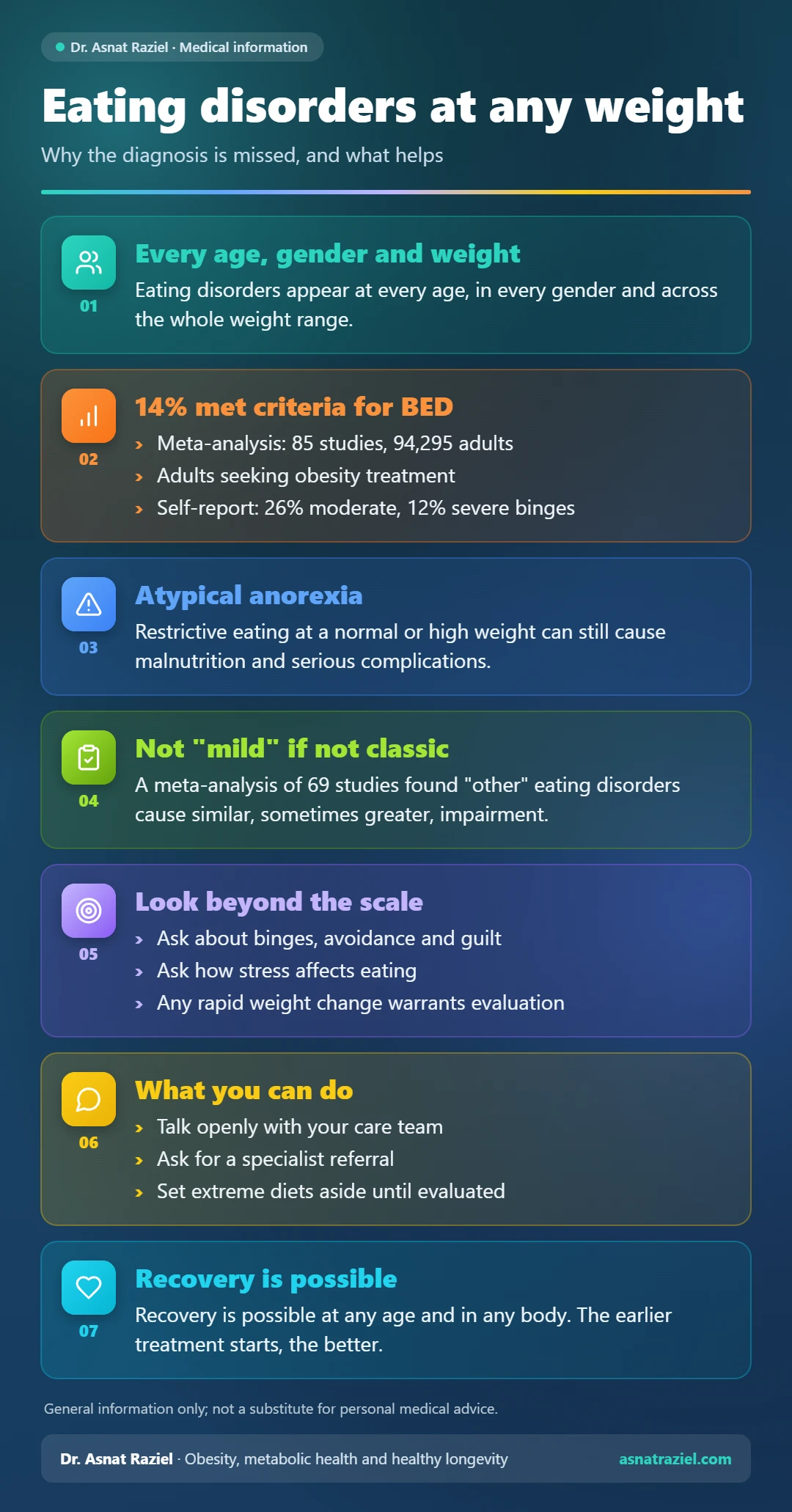
Eating disorders at any weight: what to do when you notice signs
The first step is to talk about it openly. Share your thoughts, binges or restrictions with your care team. In addition, ask for a referral to a professional who specializes in eating disorders. People already being treated for obesity are entitled to this kind of evaluation as well.
At the same time, it is wise to set extreme diets aside until the evaluation is complete. They can make the disorder worse. Instead, you can start with practical tools for coping with emotional eating. Finally, remember that recovery is possible at any age and in any body. The earlier treatment begins, the better the chance of success.
The bottom line
Eating disorders at any weight and at any age are a medical fact. Understanding this reduces stigma and opens the door to treatment. Ultimately, the question is not how a person looks, but how they live with food. If you notice a worrying pattern in yourself or someone close to you, please reach out to a professional. For more background, see my article on eating disorders in modern medicine.
This article provides general information and is not a substitute for personal medical advice.
References
The changing demographic profile of eating disorder behaviors in the community
Impairments among DSM-5 eating disorders: A systematic review and multilevel meta-analysis
Atypical Anorexia in Youth: Cautiously Bridging the Treatment Gap