By Dr. Asnat Raziel, bariatric surgeon specializing in obesity treatment, metabolic health and healthy longevity; Director of the Multidisciplinary Center for Obesity Treatment, Assia Medical, Assuta Ramat HaChayal, Tel Aviv
The biology of eating disorders: not a character flaw
The biology of eating disorders explains what my patients have felt for years: this is not a choice. For a long time, people saw eating disorders as a problem of self-control, body image or bad decisions. This view seeped into public discourse, and sometimes into the medical system as well. However, it does not stand up to scientific scrutiny.
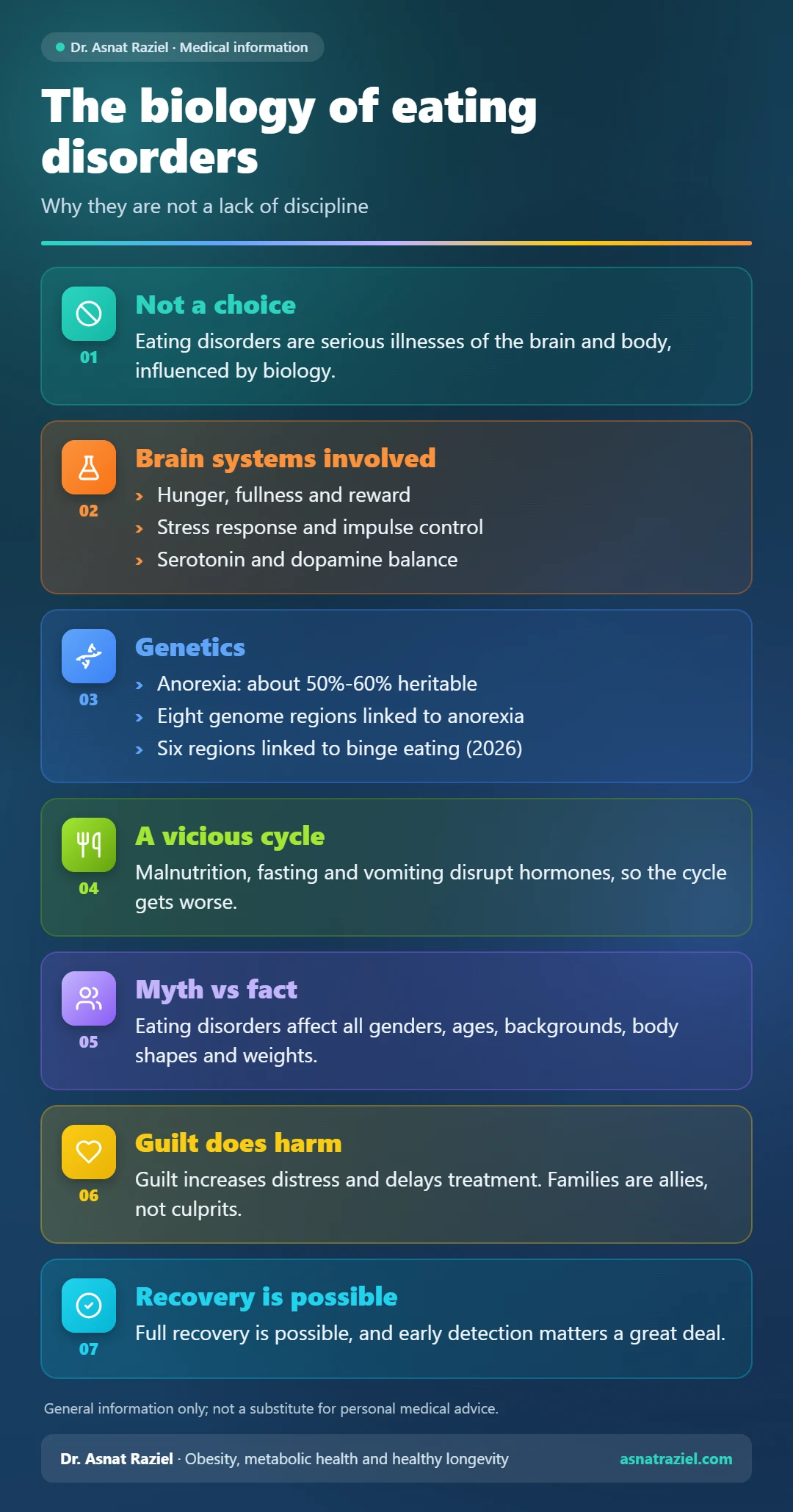
Today it is clear that eating disorders are complex illnesses of the brain and body, with a distinct biological and genetic basis. The Academy for Eating Disorders (AED) put it simply: eating disorders are not a choice, but serious illnesses influenced by biology. That is why a change in understanding is essential for accurate diagnosis, effective treatment and less stigma.
What happens in the brain
Imaging studies show changes in how key brain regions function. These are the regions that regulate hunger and fullness, process reward, respond to stress and control impulses. When these systems are out of sync, the brain interprets food, hunger and fullness in an entirely different way. As a result, even when there is a genuine wish to eat in a balanced way, the brain sends mixed messages.
A review in Nature Neuroscience describes the progress in the field. The researchers combine genetic studies, brain imaging and animal models. The goal is to understand which biological pathways drive the illness. Even so, they note that there are still very few effective medications that act on this biology.
Researchers focus especially on the serotonin and dopamine systems. Serotonin plays a role in anxiety, mood and the feeling of fullness. Dopamine drives reward and motivation. When the balance between them is disrupted, food can become a source of anxiety or, conversely, an urge that is hard to stop. In addition, the body’s stress system affects both of them.
The genetics behind the disorder
Twin and family studies show a significant hereditary component. For example, in anorexia, researchers estimate that heredity explains about 50% to 60% of the risk, similar to other well-known psychiatric illnesses. A large 2019 genetic study found eight regions of the genome linked to anorexia. In addition, these genes are also linked to metabolic traits, such as blood sugar and blood lipid levels.
In 2026, the picture broadened. A new genetic analysis identified, for the first time, six regions of the genome linked to binge eating. Some of them also relate to impulse control. In other words, a person does not “choose” to develop an eating disorder. They are born with a biological vulnerability, and in a certain environment it may turn into an active illness. On the other hand, genes alone do not decide who will become ill. Environment, dieting and stress all play an important role.
The biology of eating disorders and the hunger-fullness system
In eating disorders, the system that regulates eating loses its balance. Some people have a weak or unstable feeling of fullness. Others read the signals from their body in a distorted way. On top of that, malnutrition, fasting and vomiting themselves disrupt hormones, so the cycle gets worse. Therefore, behavior around food is not the result of weakness. It reflects a biological system that has lost its balance.
I know these mechanisms well from the world of obesity, too. For example, food noise and the role of satiety hormones show how much the brain controls eating. Likewise, obesity as a chronic disease teaches us to stop talking about willpower.
The biology of eating disorders versus the myths
The first myth is that you can spot an eating disorder by appearance. In reality, according to the AED, many people with an eating disorder look healthy, yet they are very ill. The second myth is that this is a problem of young girls only. In fact, eating disorders affect all genders, ages, backgrounds, body shapes and weights. I have also written about this in my article on eating disorders at any weight.
The third myth is that it will “pass on its own.” In contrast, eating disorders raise the risk of medical complications and suicide. That is why understanding the biology of eating disorders is not a theoretical matter. It explains why people should seek help early, and why treatment must be both medical and psychological.
Why guilt and criticism make things worse
Talk of guilt, shame and self-blame is not just ineffective. It is harmful. In practice, guilt increases distress, encourages hiding and delays seeking treatment. In addition, the AED stresses that families are not to blame. On the contrary, they can be the best allies of the patient and the care team.
A medical approach that recognizes an eating disorder as an illness makes multidisciplinary treatment possible. The American Psychiatric Association guideline includes focused psychotherapy, nutritional support, medication where appropriate and medical monitoring. When patients understand that they are facing an illness and not a personal failure, cooperation improves.
Where to get help in Israel
The first step is a conversation with your family doctor. Israel’s national health basket covers treatment for eating disorders. For example, at Maccabi (in Hebrew), members aged 12 and over can receive an evaluation and a course of treatment. Also, the Israeli Association for the Prevention, Treatment and Research of Eating Disorders (in Hebrew) publishes a directory of treatment centers and therapists.
If you are in emotional distress, you can contact ERAN, emotional first aid (in Hebrew), at 1201, around the clock. In immediate danger, call Magen David Adom (Israel’s emergency medical service) at 101 or go to an emergency room.
The bottom line: the biology of eating disorders changes the question
Moving from blame to scientific understanding is not just a matter of words. It is a therapeutic step in its own right. Recognizing eating disorders as illnesses allows early detection, precise treatment and less unnecessary suffering. Instead of asking why someone can’t “just eat normally,” we should ask what is happening in their brain and how we can help. The AED also reminds us that full recovery is possible, and early detection matters a great deal.
Further reading: anorexia and bulimia through new eyes, binges are not a lack of control, diagnosing eating disorders in every body and what modern medicine knows about eating disorders.
This article provides general information and is not a substitute for personal medical advice.
References
The Science Behind the Academy for Eating Disorders’ Nine Truths About Eating Disorders
Genetics and neurobiology of eating disorders
The Israeli Association for the Prevention, Treatment and Research of Eating Disorders (in Hebrew)
ERAN: emotional first aid by phone and online (Kol Zchut, in Hebrew)