By Dr. Asnat Raziel, bariatric surgeon specializing in obesity treatment, metabolic health and healthy longevity; Director of the Multidisciplinary Center for Obesity Treatment, Assia Medical, Assuta Ramat HaChayal, Tel Aviv
Biohacking and longevity: between science, hope and marketing
Biohacking and longevity are among the most intriguing topics in medicine today. Many people are no longer satisfied with the goal of living many years. They want to extend their healthspan: the years in which the body and brain work well, without chronic disease and without a decline in quality of life.
Alongside the scientific interest, a huge commercial market has grown up. NAD+ infusions, peptides, red light therapy, cryotherapy, infrared saunas, smartwatches, dietary supplements and novel tests are sometimes presented as magic solutions for slowing aging. The question is whether this is a real breakthrough, or whether some of the promises are running ahead of the evidence. As in most areas of medicine, the answer is far more complicated than the advertising headlines.
What is biohacking?
The term biohacking, a kind of biological “hack”, describes an attempt to improve how the body works using biological knowledge, technology and lifestyle changes. For some people, this means regular sleep, physical activity and a carefully planned diet. Others add measurements of heart rate, heart rate variability, sleep quality, blood sugar and body composition. And some turn to treatments such as NAD+ infusions, peptides, cold exposure, infrared light or pressure chambers.
In fact, biohacking is not a single treatment. It is a worldview that seeks to improve the body’s function and preserve it over the years. However, not every intervention has the same level of scientific proof.
NAD+: a small molecule with a huge role
One of the most talked-about molecules today is NAD+ (nicotinamide adenine dinucleotide), a coenzyme found in every cell in the body. It takes part in almost every energy-producing process. In addition, it is essential for the work of the mitochondria, the cell’s power plants, and it helps repair DNA damage. It also affects the sirtuins, a group of proteins linked to the aging process.
With age, NAD+ levels in the body naturally decline. This gave rise to a hypothesis: if we restore the levels to where they were in youth, perhaps we can slow some aging processes. It is a fascinating biological theory, and it is the subject of intensive research.
Are NAD+ infusions the fountain of youth?
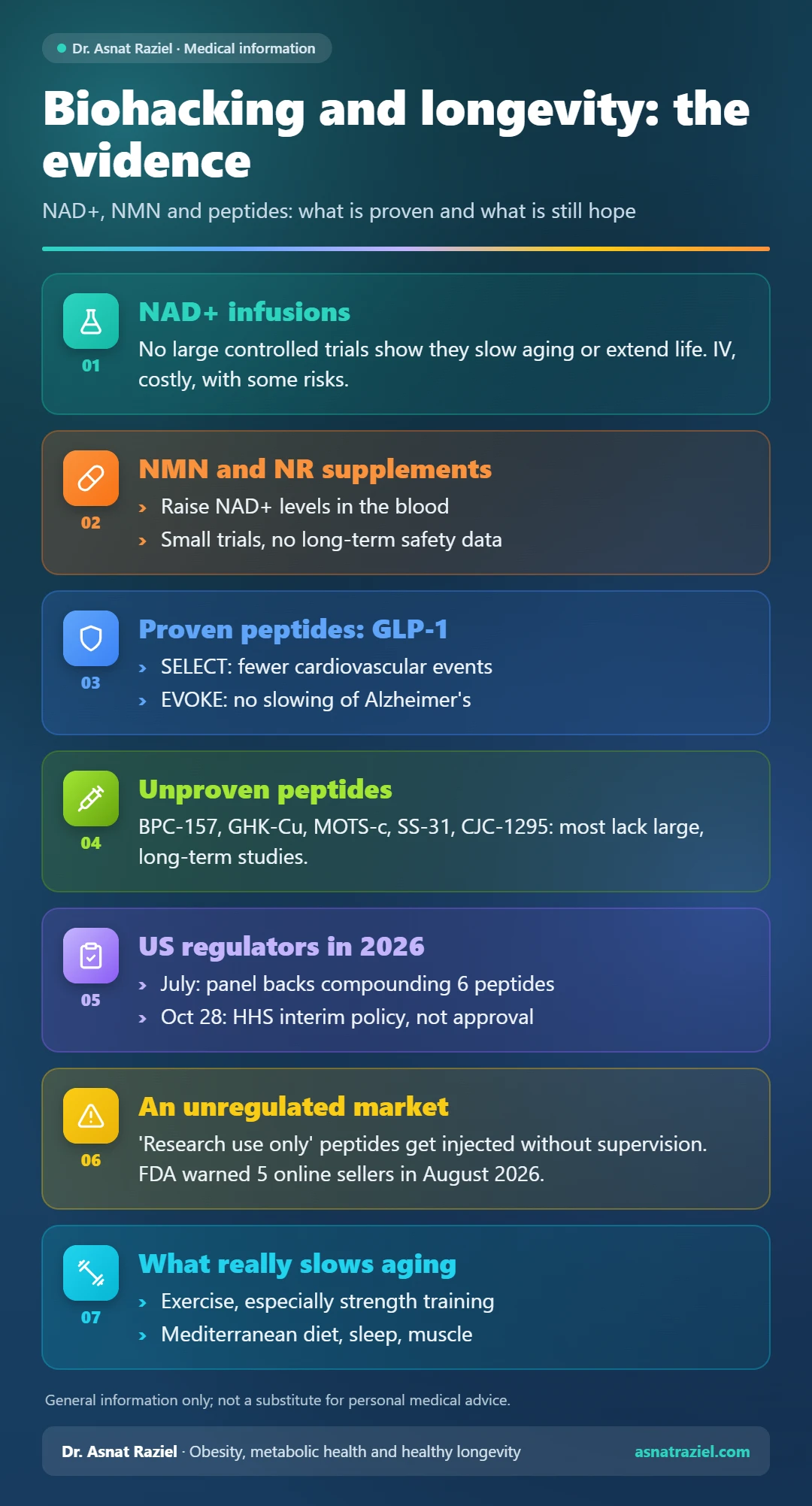
Despite the enthusiasm, it is important to distinguish between a promising mechanism and a treatment proven to work in humans. NAD+ plays a central role in the cell. Yet as of November 2026, no large, controlled clinical trials have shown that NAD+ infusions slow aging, extend life or improve the long-term health of healthy people.
Many patients report more energy, better focus and faster recovery after exertion. However, personal reports do not replace controlled research. In addition, this is an intravenous treatment that is expensive and carries certain risks. So each case needs to be assessed individually, and it should not be seen as a routine treatment.
Not just infusions: NMN and NR supplements
Alongside the infusions, researchers are studying molecules such as NMN (nicotinamide mononucleotide) and NR (nicotinamide riboside). They come in capsules and are meant to raise NAD+ levels in the cells. A review of clinical trials of NMN found that taking NMN by mouth is generally safe and raises NAD+ levels in the blood. On the other hand, the trials were small and measured few outcomes, and long-term safety data are lacking.
In September 2025, the FDA declared that NMN may be marketed as a dietary supplement in the United States. It is important to understand that this is a legal decision about the supplement’s status, not proof that it works. I covered this shift in my article on the NMN supplement. To date, no one has shown that these supplements extend life or change the pace of aging in humans.
Biohacking and longevity: the world of peptides
If one field is drawing enormous interest today, it is the world of peptides. Peptides are short chains of amino acids. They act as messenger molecules between the body’s cells. They activate receptors and affect metabolism, tissue healing, inflammation, muscle building, hormone regulation and the nervous system.
In fact, peptides are not a new idea. Insulin, for example, is a peptide that doctors have used for more than a hundred years. The difference is that today, hundreds of new peptides are in development, each aimed at a precise biological target. You will find a broad overview of the field in my article on peptides in modern medicine.
When the science has already proven itself
The great success story of the peptide world is the family of GLP-1 and GIP drugs. These include semaglutide, tirzepatide and next-generation drugs. These drugs have revolutionized the treatment of obesity and diabetes. Later, the SELECT trial showed that semaglutide reduces cardiovascular events. In addition, these drugs improve liver health and protect the kidneys. You can read more in my article on Wegovy and heart protection.
Even here, though, science demands humility. The hypothesis that these drugs protect the brain did not stand the test: in the two EVOKE trials, with 3,808 participants, oral semaglutide did not slow the progression of Alzheimer’s disease. In other words, even a proven drug needs separate proof for each claim.
Biohacking and longevity: between hope and reality
Alongside the approved drugs, there are many other peptides, such as BPC-157, GHK-Cu, MOTS-c, SS-31 and CJC-1295. They are sometimes presented as a solution to almost every problem, from faster injury healing to younger-looking skin. Some have shown intriguing results in animals or in the lab, and researchers have tested some in small human studies. However, most of them lack large, long-term studies to establish efficacy and safety.
SS-31 is an interesting example. In September 2025, it received accelerated FDA approval under the name elamipretide for Barth syndrome, a rare genetic mitochondrial disease. However, the approval does not cover slowing aging. In addition, in July 2026, an FDA advisory committee narrowly recommended allowing pharmacies to compound six peptides, including BPC-157 and MOTS-c. The FDA’s own staff recommended against it because of a lack of safety data.
Then, on October 28, 2026, the US Department of Health and Human Services (HHS) issued an interim policy. Under it, regulators will not take enforcement action against licensed pharmacies that compound these six peptides, under conditions such as patient-specific prescriptions and quality testing. This is not FDA approval, and HHS states that it does not establish safety or effectiveness. A final rule has not yet been issued.
The real danger: an unregulated market
One of the biggest problems today is not the peptides themselves, but the way they are sold. Online, many peptides are marketed under the label “for research use only”. In practice, people buy them and inject them without medical supervision. Often there is no certainty about the manufacturing quality, purity, dose or even the identity of the substance in the vial.
In August 2026, the FDA sent warning letters to five online peptide sellers, precisely because of these labels. When you inject a biological substance into your body, any manufacturing flaw can matter. That is why it is important to distinguish between quality research and the use of unregulated products.
Biohacking and longevity: what really slows aging?
Despite all the innovation, the core message remains simple. Even in 2026, the interventions proven again and again are regular physical activity, especially strength training. Alongside them come a Mediterranean diet rich in protein and unprocessed food, quality sleep and preserving muscle mass. In addition, it is important to control blood pressure, blood sugar and blood lipids, avoid smoking, treat obesity, reduce stress and maintain social connections.
Everything else, including NAD+, some peptides and various biohacking technologies, may join the toolbox in the future. Even so, the level of evidence is still uneven. You will find an overview of the drugs being studied today in my article on longevity drugs.
Bottom line on biohacking and longevity
The coming decade is likely to bring dramatic progress. New peptides, molecules that affect NAD+, gene therapies, artificial intelligence and measurement of biological age will change the way we understand aging. However, medicine advances through evidence, not through promises.
In the end, biohacking and longevity are not a search for one miracle drug. They are a thoughtful combination of a healthy lifestyle, advanced diagnostics, technology and science-based treatments. That is how we can add life to years, and not just years to life.
The information in this article is general and does not replace personal medical advice.
References
The Safety and Antiaging Effects of Nicotinamide Mononucleotide in Human Clinical Trials: an Update
Amid Pressure from NPA, FDA Declares NMN Lawful in Dietary Supplements
Semaglutide and Cardiovascular Outcomes in Obesity without Diabetes
Results of EVOKE and EVOKE+ trials show no effect of oral semaglutide on AD progression
FDA Grants Accelerated Approval for First Treatment for Barth Syndrome
FDA Panel Backs 6 Peptides for Compounding
5 Things to Know About HHS’s Interim Peptide Compounding Policy
Peptides at a Crossroads: What Wellness Providers Need to Know About HHS and FDA Actions




