By Dr. Asnat Raziel, bariatric surgeon specializing in obesity treatment, metabolic health and healthy longevity; Director of the Multidisciplinary Center for Obesity Treatment, Assia Medical, Assuta Ramat HaChayal, Tel Aviv
The 10-second balance test: what can it tell you?
The 10-second balance test, standing on one leg for ten seconds, has attracted a lot of interest in recent years. Can this simple ability say something about how long we will live? It sounds like yet another social media trend. Yet behind the test lies scientific research that has caught the attention of aging experts, doctors and physical therapists. The short answer: the test does not predict the future. Even so, it may well reflect how well your body is functioning, and that is closely tied to health and longevity.
In this article, I focus on the practical side: how to do the test safely at home, how to read your result and what to do if you could not hold the position. For another simple marker of how the body is aging, see my article on grip strength and aging.
Ten seconds that tell a whole story
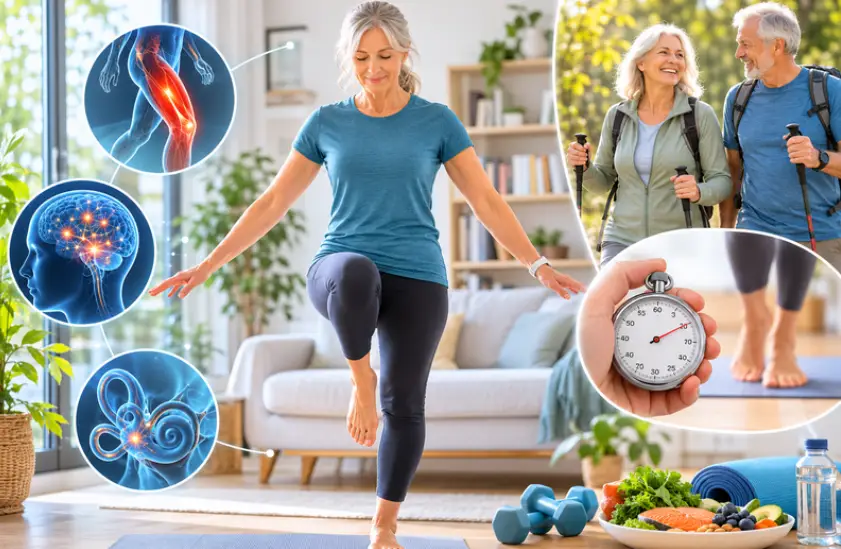
The test is very simple. You stand barefoot, lift one leg and try to stay steady for ten seconds. You may not hold on to anything, and you may not move the foot you are standing on. Sounds easy? Not always.
For healthy young people, this is an almost trivial task. With age, however, and in the presence of chronic disease, excess weight, muscle weakness or nerve damage, it becomes a real challenge.
What the research on the 10-second balance test found
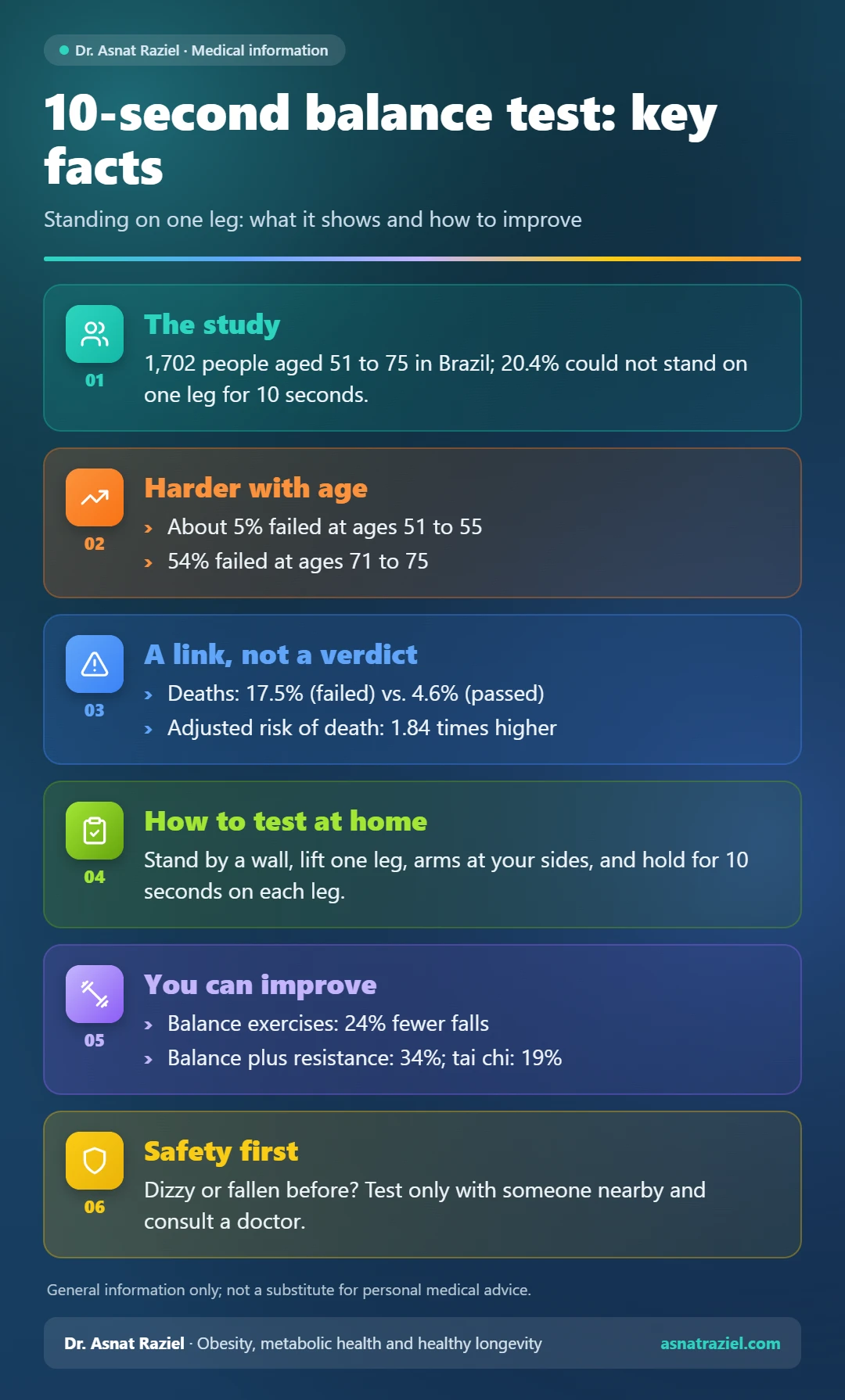
The key study on this topic was published in 2022 in the British Journal of Sports Medicine. It included 1,702 participants aged 51 to 75 from Brazil. Of these, 20.4% could not stand on one leg for ten seconds. Moreover, the failure rate rose sharply with age. According to a press release from the University of Eastern Finland, about 5% of those aged 51 to 55 failed, compared with 54% of those aged 71 to 75.
The researchers followed the participants for a median of 7 years. During that period, 17.5% of those who failed the test died, compared with 4.6% of those who passed. In other words, out of 100 people who failed, about 17 to 18 died during follow-up. By contrast, fewer than 5 out of 100 who passed died. After adjusting for age, sex, body mass index and underlying conditions, the risk of death from any cause was 1.84 times higher in those who failed. The researchers suggested including the test in the routine physical examination of middle-aged and older adults.
In the original study, participants placed the front of the free foot on the back of the opposite lower leg. Their arms stayed at their sides and their gaze was fixed straight ahead. Each participant had up to three attempts, on either foot.
Does balance really determine how long we live?
Not at all. Here it is important to understand the difference between a statistical link and cause and effect. The researchers themselves noted limitations. They had no information on previous falls, physical activity, diet or medications. In addition, about 68% of the participants were men, and all of them were from Brazil.
The ability to stand steadily does not extend life on its own. Instead, it reflects many systems working together: muscle mass, the nervous system, vision, the balance system in the inner ear, coordination, core strength and the brain’s ability to plan movement. When all of these systems work well, overall health is usually good too. That is why the test is a window into how the body functions, and not a crystal ball.
Why is the 10-second balance test so important?
One of the main reasons is fall prevention. According to the World Health Organization, falls are the second leading cause of death from unintentional injury worldwide. In 2023, falls caused about 842,000 deaths, and about 71% of them were in people aged 60 and over. Beyond death, falls lead to fractures, hospital stays and loss of independence.
In addition, good balance usually reflects an active lifestyle. People who exercise regularly strengthen their muscles and maintain bone density. They also reduce chronic inflammation and improve their metabolic health. All of these contribute to healthy aging, as I wrote in my article on healthy aging and longevity.
How to do the 10-second balance test at home
Stand next to a wall or a stable surface, in case you need support. Lift one leg and keep your arms at your sides. Try to hold the position for ten seconds, without moving your supporting foot and without using your hands. Then repeat the test on the other leg.
If you did not succeed, there is no need to panic. A balance test like this is not a medical diagnosis. It is a sign that it is worth investing in fitness, strength and stability. People who suffer from dizziness or have fallen before should do the test only with another person nearby, and should consult a doctor.
Harvard Health’s guide to the 10-second balance test gives similar advice. Keep a counter or wall within reach, practice daily and talk with a doctor if unsteadiness persists, since inner ear or nerve problems can play a role.
What your result means, and what to do next
Here is a simple way to read the result. If you held the position for ten seconds on both legs, that is reassuring, but keep moving to maintain it. If you could not, remember that in the study about 5% of people aged 51 to 55 failed, compared with 54% of those aged 71 to 75, so the test gets harder with age. Either way, a failed attempt is not a verdict. It is a signal to start the kind of training that, according to the Cochrane review below, cuts the rate of falls. And if you feel dizzy or have fallen before, talk to your doctor first.
The good news: you can improve at any age
Unlike many risk factors, balance is a skill you can train. Even at a very old age, consistent practice can bring improvement.
A Cochrane review examined this question in 108 trials with 23,407 participants aged 60 and over. According to the review, balance and functional exercises reduced the rate of falls by 24%. Combining several types of training, mainly balance together with resistance training, reduced it by 34%. Tai chi reduced the rate of falls by 19%. Accordingly, the world guidelines on fall prevention recommend giving all older adults guidance on fall prevention and physical activity.
Even small habits help. For example, you can stand on one leg while brushing your teeth. You can also take the stairs instead of the elevator, or do leg strength exercises a few times a week. I wrote about combining types of training in my article on aerobic versus strength training.
Balance and obesity: what is the connection?
Excess weight does not only affect the number on the scale. It shifts the body’s center of gravity, impairs stability, makes movement harder and increases the risk of falls. At the same time, weight loss can also lead to a loss of muscle mass. The risk is especially high when weight loss is not accompanied by enough protein and resistance training.
That is why modern obesity treatment no longer focuses only on kilograms. The goal is to preserve muscle mass, strengthen the body and improve function. I discussed this in more detail in my articles on sarcopenia and obesity and on obesity and physical function. In other words, what matters is not only how much weight you lost, but also how strong, steady and independent you have remained.
The 10-second balance test: a small test with a big message
Ten seconds on one leg will not decide how many years you will live. But they can certainly hint at whether your body is aging well. Instead of seeing the balance test as a score or a verdict, it is better to see it as an invitation to act.
Maintain your muscle mass and exercise regularly. In addition, eat enough protein, get good sleep and treat metabolic conditions. Above all, keep moving at every age. Ultimately, longevity is not measured only in years. It is also measured in the ability to keep standing on your own two feet, in every sense.
The information in this article is general and does not replace personal medical advice.
References
Exercise for preventing falls in older people living in the community
World guidelines for falls prevention and management for older adults: a global initiative