By Dr. Asnat Raziel, bariatric surgeon specializing in obesity treatment, metabolic health and healthy longevity; Director of the Multidisciplinary Center for Obesity Treatment, Assia Medical, Assuta Ramat HaChayal, Tel Aviv
Stopping GLP-1 before pregnancy: what did the new study find?
Stopping GLP-1 before pregnancy is a necessary step, but it has consequences for weight. Many women lose weight with incretin-based drugs and then plan a pregnancy, so they need to stop treatment well in advance. A large study published in JAMA found that after stopping, women gained an average of 3.3 kg more during pregnancy. The researchers also reported higher rates of gestational diabetes, high blood pressure in pregnancy and preterm birth. However, this is a statistical association, not proof that stopping the drug itself caused the complications.
A new question in the era of weight-loss drugs
Incretin drugs have transformed the treatment of obesity and type 2 diabetes. Ozempic and Wegovy contain semaglutide and act on the GLP-1 receptor. Mounjaro, by contrast, contains tirzepatide, which works through two pathways: GIP and GLP-1.
These drugs reduce hunger, increase fullness and improve blood sugar control. As a result, many people achieve substantial weight loss. At the same time, many women of reproductive age use them. Some are planning a pregnancy after improving their metabolic health. This raises an important question: what happens to weight when you stop the drug ahead of pregnancy?
Why is stopping GLP-1 before pregnancy necessary?
Wegovy and Mounjaro are not meant for treating obesity during pregnancy. They have not been tested in pregnant women, and data on exposure in pregnancy are still limited. Animal studies sometimes showed changes in fetal growth, but we can’t draw direct conclusions for humans from that. That’s why the recommendation is to stop treatment before a planned pregnancy, as a precaution.
Yet stopping comes with a possible cost. The drug no longer keeps hunger in check, fullness weakens and food noise may return. In some women, blood sugar rises too. In other words, it isn’t enough to tell a woman to “stop and get pregnant.” The transition needs a plan as well.
When should you stop Wegovy or Ozempic?
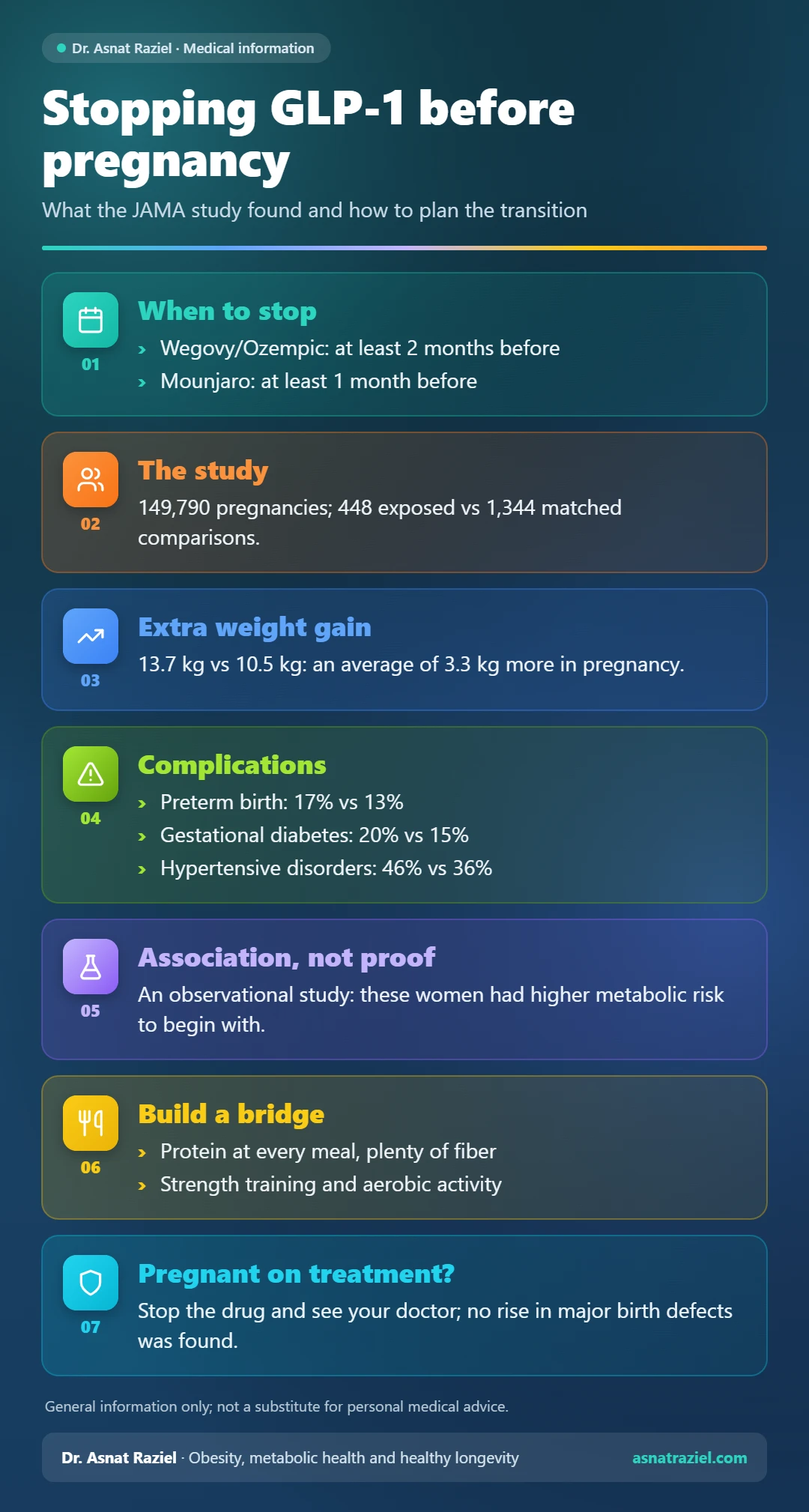
Semaglutide stays in the body for a long time. That’s why the US Wegovy label recommends stopping treatment at least two months before a planned pregnancy. A woman planning a pregnancy should factor in this period ahead of time.
And when should you stop Mounjaro?
Tirzepatide has a shorter half-life than semaglutide. According to the European product information, treatment should be stopped at least one month before a planned pregnancy. If pregnancy is discovered during treatment, the drug is stopped right away. So there is no need to apply the semaglutide waiting period to Mounjaro.
Stopping GLP-1 before pregnancy: nearly 150,000 pregnancies
The study looked at 149,790 singleton pregnancies between 2016 and 2025 in a single US academic health system. The researchers compared women who took a GLP-1 drug before or in early pregnancy with similar women who did not. After statistical matching, 448 exposed pregnancies and 1,344 comparison pregnancies were included.
The average age of the exposed women was 34, and their average BMI (body mass index) was 36.1. About 84% had obesity, and about 23% had diabetes before pregnancy. So these were women at high metabolic risk from the outset. Some of the differences are probably also linked to obesity and diabetes themselves.
3.3 kg more during pregnancy
This is the study’s headline finding. Women exposed to GLP-1 drugs gained an average of 13.7 kg during pregnancy, compared with 10.5 kg in the comparison group. The average difference was 3.3 kg. In addition, 65% of women in the GLP-1 group gained more than the recommended range, compared with 49% in the comparison group.
This finding makes clinical sense. Even outside pregnancy, we see that appetite comes back after stopping the injections. In pregnancy, natural hormonal changes that encourage energy storage add to this.
Gestational diabetes, blood pressure and preterm birth
The researchers also found differences in pregnancy outcomes:
- Preterm birth: 17% in the exposed group versus 13% in the comparison group.
- Gestational diabetes: 20% versus 15%.
- Hypertensive disorders of pregnancy: 46% versus 36%.
On the other hand, the researchers found no significant difference in the rate of babies who were large or small for gestational age. The cesarean section rate was also similar in both groups.
Does stopping GLP-1 before pregnancy cause complications?
This study can’t tell us that. It is a retrospective observational study, meaning it analyzed data collected in the past. It found a link between prior exposure and stopping on the one hand, and greater weight gain and some complications on the other. But association is not causation. The women who took the drug may simply have had more severe metabolic disease to begin with. The researchers themselves also point to factors that were not fully measured. So the message is not that stopping is dangerous. The message is that these women need close follow-up and a prevention plan.
Stopping GLP-1 before pregnancy: building a bridge
To me, this is the most important message. A woman who lost weight with the help of a drug shouldn’t be left without support on the day she stops. It’s best to start the transition plan even before the last injection. First, build a regular meal structure with protein at every meal. In addition, favor vegetables, legumes, whole grains and fiber-rich foods, which support fullness.
At the same time, it’s worth cutting back on ultra-processed foods and sweetened drinks. Physical activity matters too: strength training preserves muscle, and aerobic activity supports metabolic health. For women with diabetes, prediabetes or past gestational diabetes, we also monitor blood sugar levels. You’ll find more in my guide on weight-loss drugs and pregnancy.
How much weight should you gain in pregnancy?
A healthy pregnancy includes weight gain, so the goal is not to prevent it. The goal is to stay within the range that suits your BMI before pregnancy. For a singleton pregnancy, the CDC recommendations are:
- Underweight: about 12.7 to 18.1 kg.
- Normal weight: about 11.3 to 15.9 kg.
- Overweight: about 6.8 to 11.3 kg.
- Obesity: about 5 to 9.1 kg.
These are general ranges only. The care team adjusts them to the woman’s medical situation and to the baby’s growth.
Got pregnant during treatment?
This happens quite often. Weight loss sometimes improves ovulation and the chance of conceiving, as I explained in my article on incretins, fertility and pregnancy. If the pregnancy test is positive, stop the drug and see your doctor. However, exposure in the first weeks does not mean harm was done.
A multinational study in JAMA Internal Medicine looked at 51,826 pregnancies in women with type 2 diabetes, including data from Maccabi, one of Israel’s health funds. Of these, 938 babies were exposed to GLP-1 drugs around conception. Compared with insulin, the researchers found no significant increase in major birth defects, with an adjusted relative risk of 0.95. A prospective study in BMJ Open also found no increase in birth defects after first-trimester exposure. These are reassuring data, but they are not enough to conclude that treatment is safe in pregnancy.
What if the woman is also being treated for diabetes?
Here, early planning is especially important. Stopping the drug may raise glucose levels, and a woman with diabetes needs good control around conception. The American Diabetes Association’s 2026 guidelines emphasize planning before pregnancy: switching early to a pregnancy-appropriate treatment and reaching blood sugar targets before conception. Insulin is the main tool for diabetes in pregnancy. Metformin is suitable in some situations, but it is not an automatic substitute. It’s also worth reading about GLP-1 drugs for women with diabetes.
Some women become pregnant before they manage to stop. I review the safety data in my article on GLP-1 in early pregnancy.
Mounjaro and birth control pills
Not all GLP-1 drugs affect the pill to the same degree. The issue matters most with tirzepatide, which slows stomach emptying. As a result, it may change how the pill is absorbed, mainly at the start of treatment and after a dose increase. According to the US label, the FDA recommends switching to a non-oral contraceptive, or adding a barrier method, for four weeks after starting treatment and after each dose increase. By contrast, the European product information states that the drop in pill exposure after a single dose is not clinically significant. That’s why every woman starting Mounjaro needs proper contraception counseling.
What about breastfeeding?
Here, too, knowledge is evolving. According to the European product information, after a single 5 mg dose of tirzepatide, drug levels in breast milk were undetectable or very low. Therefore, tirzepatide may be considered during breastfeeding. By contrast, the US Wegovy label notes that there are no data on whether the injection passes into breast milk. It also does not recommend breastfeeding during treatment with the Wegovy pill. In other words, there is no single rule for all these drugs, and the decision is individual.
Bottom line: stopping GLP-1 before pregnancy takes planning
Treating obesity before pregnancy can help a woman enter pregnancy with good metabolic balance and fewer risk factors. But when the drug is stopped, the biology of obesity doesn’t disappear. Hunger returns, fullness weakens, and weight and blood sugar may rise. That’s why stopping GLP-1 before pregnancy is a medical phase in its own right. It’s best to prepare a nutrition and activity plan in advance, track weight and blood sugar, and involve an obesity specialist, a gynecologist, an endocrinologist and a dietitian. That way, the transition to pregnancy can be planned, monitored and as safe as possible. After the birth, you can continue with postpartum weight loss with professional support.
The information in this article is general and does not replace personal medical advice.
References
Gestational Weight Gain and Pregnancy Outcomes After GLP-1 Receptor Agonist Discontinuation
WEGOVY (semaglutide) Prescribing Information
Mounjaro: EPAR – Product Information
Can Mounjaro (tirzepatide) be used with oral contraceptives or hormone replacement therapy?
Safety of GLP-1 Receptor Agonists and Other Second-Line Antidiabetics in Early Pregnancy
15. Management of Diabetes in Pregnancy: Standards of Care in Diabetes-2026