By Dr. Asnat Raziel, bariatric surgeon specializing in obesity treatment, metabolic health and healthy longevity; Director of the Multidisciplinary Center for Obesity Treatment, Assia Medical, Assuta Ramat HaChayal, Tel Aviv
New obesity treatments: what is really new and what is still on the way
New obesity treatments are advancing faster today than ever before. At every major scientific conference, researchers present new drugs, long-term studies and fresh insights into how the disease works. However, not every conference headline becomes a treatment you can get tomorrow morning. In this article, I will explain what has already been approved, what is still in research and how to read the news with a critical eye.
Why medical conferences matter to you, too
Conferences such as the European Congress on Obesity (ECO), the American Diabetes Association (ADA) Scientific Sessions and ObesityWeek are where researchers present results for the first time. Often, the full paper appears in a medical journal on the same day. That is why we doctors follow them closely. I have reviewed the major obesity medicine conferences in a separate article.
In addition, conferences set the professional agenda. For example, at the most recent ECO congress, the focus shifted from weight loss alone to broad metabolic health. Similarly, the Endocrine Society statement describes obesity as a chronic disease that requires ongoing treatment.
I also summarized the main lessons in a separate piece on six takeaways from obesity medicine conferences.
New obesity treatments in pill form
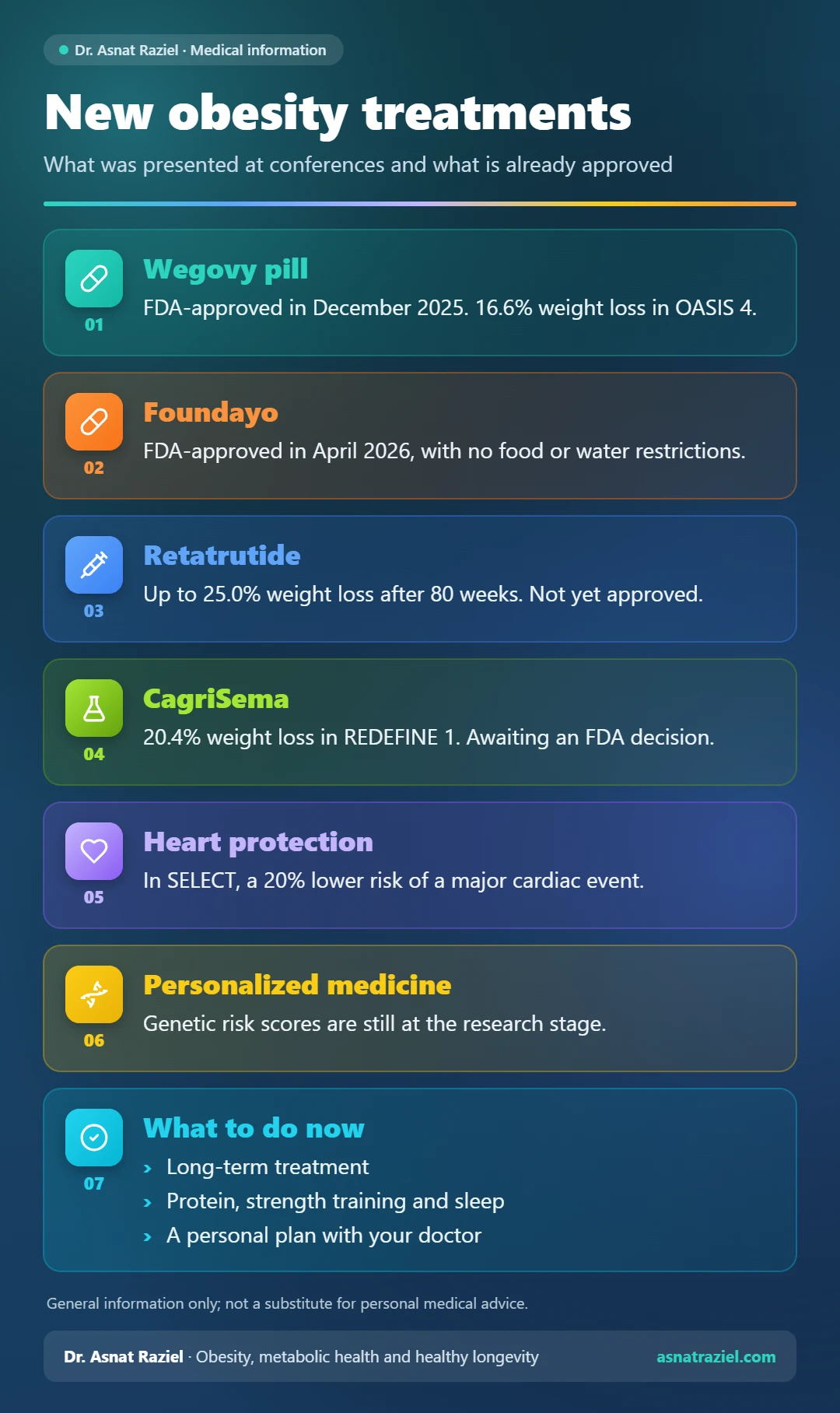
For patients, the most tangible change is the move from injections to pills. On December 22, 2025, the US Food and Drug Administration (FDA) approved the Wegovy pill, oral semaglutide at a dose of 25 mg once a day. In the 64-week OASIS 4 trial, average weight loss reached 16.6% among those who stayed on treatment.
Then, in April 2026, Foundayo (orforglipron) from Eli Lilly joined it. In the ATTAIN-1 trial, the highest dose led to 12.4% weight loss after 72 weeks. One important practical advantage is that you can take it without any food or water restrictions. You will find more about this drug in my Foundayo treatment guide. In addition, a recent review of the new drugs describes where it fits among the other options.
New obesity treatments: dual and triple combination injections
The next generation of injections acts on several hormones at once. Retatrutide activates three receptors: GLP-1, GIP and glucagon. The TRIUMPH-1 trial included 2,339 adults with obesity and without diabetes. After 80 weeks, average weight loss reached 23.7% on the 9 mg dose and 25.0% on the 12 mg dose, compared with 3.9% on placebo. Even so, the drug has not yet been approved for use. You will find more details in my article on the TRIUMPH trials.
Another approach combines semaglutide with an analog of the hormone amylin. In the REDEFINE 1 trial, this combination, called CagriSema, led to 20.4% weight loss after 68 weeks, compared with 3.0% on placebo. On the other hand, 79.6% of patients had digestive side effects, mostly mild to moderate. The company has filed for FDA approval, and as of October 2026 no decision had been announced.
Beyond weight: the heart, breathing and joints
The key message from recent conferences is that the goal is not just the number on the scale. The SELECT trial included 17,604 people with heart disease and overweight or obesity, without diabetes. Semaglutide cut the risk of a major cardiac event by 20%: 6.5% compared with 8.0% on placebo. Furthermore, in TRIUMPH-1, retatrutide reduced knee pain in patients with osteoarthritis. It also reduced the number of breathing pauses during sleep.
In other words, medication is becoming a tool for improving overall health. I have gathered a broad overview of all anti-obesity drugs, and how to tailor them, on my page about medications for obesity and metabolic disease.
Genetics, epigenetics and personalized medicine
Why does one person lose 25% on a drug while another loses only 8% on the same one? This is where genetic research comes in. A review of the genetics and epigenetics of obesity describes hundreds of gene variants linked to obesity. From these, researchers build “risk scores” that try to predict who will develop obesity and who will respond to treatment. Epigenetics, meaning changes in how genes are switched on without any change to the DNA sequence, adds another layer of information.
However, these tools are not yet ready for routine use in the clinic. At the same time, artificial intelligence tools are appearing at conferences as a way to analyze large amounts of data. In the future, we will likely combine the two, but for now this is still research.
How conference news reaches you
A major conference is a complex event, with thousands of participants and dozens of lecture halls. Most talks are recorded, so you can watch some of them from home.
On the other hand, it is important to tell science apart from marketing. An advertising campaign for a product is no substitute for a peer-reviewed paper. So when you read a headline about a “miracle drug,” ask three questions. How many people took part in the study? How long did it last? And has the drug been approved yet?
New obesity treatments: what this means for you
First, obesity is a chronic disease, so treatment also continues over time. It is worth planning it like any big decision in life: with information, professional support and a long-term plan. Second, even new obesity treatments work best alongside a protein-rich diet, strength training and good sleep.
Finally, not every drug suits every person. The decision depends on other health conditions, other medications, whether you prefer a pill or an injection and what is available in Israel. A dietitian works in our clinic. In addition, when needed, I refer patients to a multidisciplinary mind-body team. It includes dietitians, psychologists, holistic coaches, naturopaths and complementary medicine practitioners, as well as Pilates and yoga instructors and experts in stress-reduction techniques. You can read about this whole-person approach in my guide to obesity treatment.
Bottom line
Today, new obesity treatments include pills already approved in the United States, injections that combine several hormones and studies that show heart protection. Some of these drugs have not yet been approved, so it is worth following the news with patience and a critical eye. If you are considering treatment, I recommend talking to a doctor who specializes in obesity. You can learn more about my experience and approach on my about page.
This article provides general information and is not a substitute for personal medical advice.
Questions and answers
Is there already an approved pill for obesity?
Yes. The FDA approved the Wegovy pill in December 2025 and Foundayo in April 2026. Availability in Israel varies, so it is best to check with your doctor.
When will retatrutide reach the market?
There is no date yet. The drug showed strong results in phase 3 trials, but it has not yet been approved in any country.
Do new obesity treatments replace diet and exercise?
No. The drugs work best alongside a balanced diet, strength training and good sleep, which also help preserve muscle mass.
How can I tell whether a headline about a new drug is reliable?
Check whether the study appeared in a medical journal, how long it lasted, how many people took part and whether the drug has been approved.
Sources
Retatrutide, a Triple Hormone Receptor Agonist, for Treatment of Obesity
Coadministered Cagrilintide and Semaglutide in Adults with Overweight or Obesity
Semaglutide and Cardiovascular Outcomes in Obesity without Diabetes
Wegovy pill approved in the US as first oral GLP-1 for weight management
FDA approves Foundayo, an oral GLP-1, for adults with obesity
The Obesity Drug Revolution: New Frontiers in Pharmacotherapy
Genetics and Epigenetics in Obesity: What Do We Know so Far?