By Dr. Asnat Raziel, bariatric surgeon specializing in obesity treatment, metabolic health and healthy longevity; Director of the Multidisciplinary Center for Obesity Treatment, Assia Medical, Assuta Ramat HaChayal, Tel Aviv
Menopause weight gain is rarely about eating more. Instead, it comes from two drivers: a body that trades muscle for belly fat, and sleep that gets worse. This article is a practical guide to both, with a checklist you can start tomorrow morning.
Menopause weight gain: what really changes in your body
Weight gain in menopause is one of the most common complaints I hear at the clinic. Women tell me they eat the same as before, yet their belly is growing and their clothes feel tight. The explanation is not just a “slow metabolism.” At this age, the body goes through a change in its composition: less muscle, more fat, and fat that builds up around the belly.
In this article, I focus on the practical side: what happens to your body, why sleep matters so much, and what you can do as early as tomorrow morning. I wrote about drug treatment separately, in my guide to medical treatment for obesity in menopause.
What happens to body composition in menopause
Menopause is defined as one year without a period. The years before it are called the menopause transition, when estrogen levels fall and rise on and off. The large SWAN study followed women for years and measured their body composition with DEXA scans.
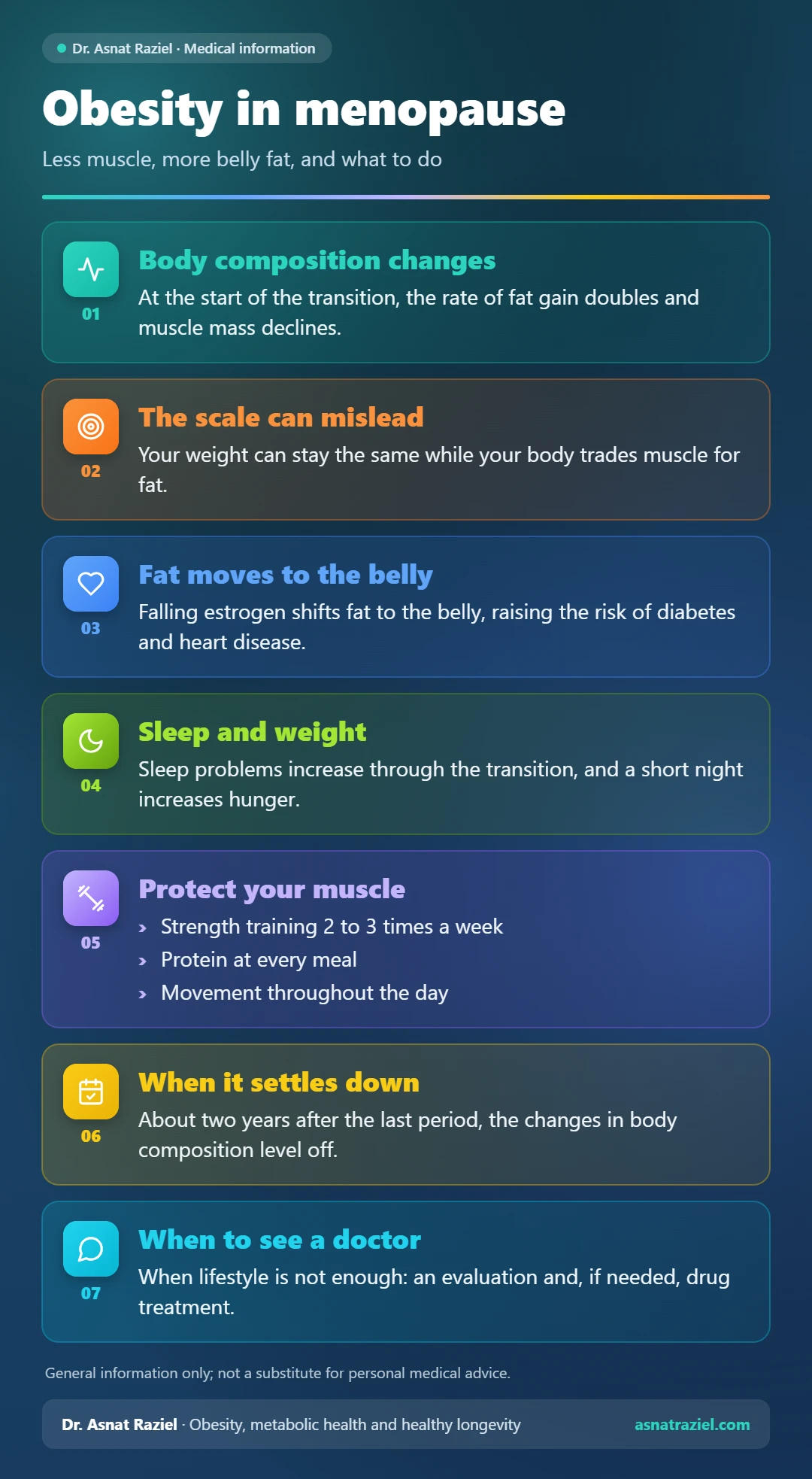
The researchers found that at the start of the transition, the rate of fat gain doubles. At the same time, muscle mass begins to decline. The process continues until about two years after the last period, and then it levels off. Interestingly, the rate of weight gain itself did not change during that period. In other words, your weight can stay about the same while your body trades muscle for fat.
Why fat builds up around the belly
Before menopause, estrogen encourages fat storage in the hips and buttocks. A review on weight regulation in menopause explains that when estrogen falls, the effect of male hormones becomes stronger. As a result, the body stores fat mainly around the belly, including visceral fat around the internal organs. This fat is linked to a high risk of diabetes and heart disease.
According to the same review, women in the menopause transition gain an average of about half a kilo a year. However, about one in five women gains 4.5 kg or more. The researchers note that the weight gain itself is linked mainly to age and lower energy expenditure, not only to hormones.
How to track menopause weight gain
Since the main change is in body composition, weight alone does not tell the whole story. The review I mentioned notes that waist circumference, the waist-to-hip ratio and imaging tests reflect risk better than BMI alone. BMI, the body mass index, is the ratio of weight to height.
That is why it is worth measuring your waist once a month, in the morning, at the level of the navel. In addition, a body composition test shows how much fat and how much muscle you have. This way, you can see progress even when the scale barely moves. For example, a woman who exercises can lose fat and build muscle without a big change on the scale.
Sleep and menopause weight gain
The link between sleep and weight becomes even stronger at this age. A study that followed 3,045 women found that trouble falling asleep and staying asleep increased throughout the menopause transition. Frequent hot flashes and lower estradiol levels were linked to much poorer sleep.
What does this have to do with weight? A short night increases hunger and cravings for sweet and fatty food the next day. In addition, fatigue lowers the motivation to move. I wrote about these mechanisms in my article on sleep and brain health.
Small steps toward better sleep
- A fixed wake-up time, even on weekends.
- A cool, well-ventilated room, and a light blanket for hot flashes.
- No caffeine after noon, and little alcohol in the evening.
- If hot flashes wake you up every night, talk to your doctor about treatment.
Preventing menopause weight gain: muscle, food and movement
Strength training is the foundation
Because muscle declines during this period, strength training is the most important tool. Two to three times a week is enough to get started. You can train with weights, resistance bands or your own body weight. I wrote about the right way to build muscle in my article on strength training during weight loss.
Israeli endocrinologist Dr. Irit Hochberg gives similar advice in her Ynetnews article on managing menopause weight gain. She recommends at least 150 minutes of aerobic activity a week, plus strength training at least twice a week.
Protein and a balanced plate
Include a protein source at every meal: eggs, yogurt, legumes, fish or chicken. In addition, filling half your plate with vegetables adds volume and keeps you full. For example, a breakfast of yogurt with nuts is far more filling than a pastry. This way, you protect your muscle without counting every calorie.
What about extreme diets? At this age, they can be especially harmful. A sharp calorie deficit speeds up the loss of muscle, which is already declining. That is why moderate, steady weight loss is better, with a focus on food quality and regular meals.
Movement throughout the day
Daily walks, taking the stairs and getting up from your chair every hour all add up over the day. Moreover, this kind of movement also helps sleep and mood. You will find more ideas in my article on lifestyle for women in menopause, and in my article on a heart-healthy lifestyle.
Your menopause weight gain checklist
To put it all together, here is a short checklist based on the steps above:
- Measure your waist once a month, in the morning, at the level of the navel.
- Do strength training two to three times a week.
- Include protein at every meal and fill half your plate with vegetables.
- Wake up at the same time every day, even on weekends.
- Stop caffeine after noon and keep the bedroom cool.
- Walk every day and get up from your chair every hour.
None of these steps requires a prescription. Together, they target both drivers of weight gain at this age: body composition and sleep.
When to seek medical treatment for menopause weight gain
Sometimes lifestyle changes are not enough. Some women also describe food noise, constant thoughts about food. This is a biological phenomenon, not a weakness. In such cases, it is worth getting checked.
The evaluation includes blood tests, a waist measurement and sometimes a body composition test. Depending on the findings, drug treatment for obesity can be considered. There are also studies that tested new treatments in this group, such as Foundayo (orforglipron) in women in menopause. Alongside this, treating the hot flashes themselves can improve sleep, and therefore appetite control.
At our clinic, we build a plan for every woman that combines nutrition, movement, sleep and, when needed, medication. You can read about my approach on the about page.
Bottom line
Weight gain in menopause stems mainly from a change in body composition: less muscle, more fat, and a shift of that fat to the belly. So the goal is not just the number on the scale. Strength training, protein, daily movement and good sleep are the foundation, and when needed, effective medical treatment is available too.
The information in this article is general and does not replace personal medical advice.
Frequently asked questions
Why am I gaining weight in menopause without changing my diet?
Because your body loses muscle and burns less energy. In addition, poor sleep increases hunger. Hormones mainly affect where the fat is stored.
Can menopause weight gain be prevented?
No. The change in body composition is very common, but strength training, protein and good sleep slow it down considerably.
Does hormone therapy help with weight loss?
Hormone therapy is not a treatment for obesity. However, it can ease hot flashes and improve sleep, and in that way help indirectly. The decision is personal and is made together with your doctor.
When do the changes in body composition settle down?
According to the SWAN study, about two years after the last period, the rate of fat gain and muscle loss levels off.
Sources
Changes in body composition and weight during the menopause transition
Weight regulation in menopause
Sleep disturbance during the menopausal transition in a multi-ethnic community sample of women