By Dr. Asnat Raziel, bariatric surgeon specializing in obesity treatment, metabolic health and healthy longevity; Director of the Multidisciplinary Center for Obesity Treatment, Assia Medical, Assuta Ramat HaChayal, Tel Aviv
How weight loss drugs work: the satiety revolution in the brain
How weight loss drugs work is the question behind almost every first visit in my clinic. In this article, I compare the drugs by the number of pathways they activate: one for semaglutide, two for tirzepatide, three for retatrutide and, in the future, four. If you want the story of the hunger neurons and why hunger returns after stopping, you will find it in my separate article on what GLP-1 drugs do to hunger cells in the brain.
The link between obesity drugs and the brain is the key to understanding the revolution of recent years. People once thought that obesity was simply the result of overeating and a lack of willpower. Today, science understands something completely different. Obesity is a biological disease, and the brain, hormones and the body’s energy-regulation system largely drive it.
Our body constantly runs a sophisticated system that asks one question: “Is there enough energy to survive?” When the brain thinks there is not enough energy, it switches on defense mechanisms, even when there is actually a large excess of fat. It increases hunger, slows metabolism, triggers cravings for high-calorie food and tries to reverse any weight loss.
This is where the new drugs come in. They are not simple “appetite suppressants” like those of the past. Instead, they act on the system that controls hunger and fullness in the brain and gut. In this way, they change how the body perceives hunger, fullness and energy.
How does fullness happen in the first place?
When we eat, the gut releases hormones that send a message to the brain: “The food has arrived, you can relax.” These hormones act on several areas of the brain. First, on the hypothalamus, which regulates hunger and fullness. In addition, on the reward and food-pleasure centers, and on systems linked to urges and habits. You will find a fuller explanation in my article on the physiology of satiety.
In many people with chronic obesity, this system does not work properly. The brain keeps “looking for food” even when the body has enough energy. That is why many patients describe nonstop thoughts about food, hunger that returns quickly and difficulty feeling full. Some also describe emotional or compulsive eating. The new drugs strengthen the body’s natural fullness signals.
Semaglutide: one pathway that turns up the volume of fullness
Semaglutide, the active ingredient in Wegovy and Ozempic, mimics a natural hormone called GLP-1. The gut releases it after eating, and it acts in several places at once:
- Brain: it reduces hunger and affects the reward centers and the desire for food.
- Stomach: it slows stomach emptying, so the feeling of fullness lasts longer.
- Pancreas: it increases insulin release when blood sugar rises, and so helps balance it.
Many patients describe a new feeling of “quiet in the head.” There are fewer thoughts about food, less urge to snack and less constant preoccupation with eating. This phenomenon relates to food noise, meaning an intrusive preoccupation with food. Put simply, the drug turns up the volume of the body’s natural fullness signals.
Tirzepatide: two engines instead of one
Tirzepatide, the active ingredient in Mounjaro, acts on two receptors at the same time: GLP-1 and GIP. GLP-1 is mainly responsible for fullness and for slowing stomach emptying. By contrast, the hormone GIP is another gut hormone that acts on the brain, on fat tissue and on metabolism.
Together, they create an especially strong effect. In the SURMOUNT-1 trial, patients on the 15 mg dose lost an average of 20.9% of their body weight after 72 weeks, compared with 3.1% on placebo. Many patients describe a sense of freedom: no longer fighting food all day long.
How weight loss drugs work in the third generation: retatrutide
Retatrutide represents the next generation. It acts on three pathways: GLP-1, GIP and glucagon. Here comes a new and important component: glucagon. If GLP-1 tells the brain “eat less,” glucagon tells the body “burn more.” In other words, not only less hunger, but probably also higher energy expenditure and more fat burning in the liver. You can compare it to a car: you put in less fuel, and the engine also burns a lot of energy.
In a phase 2 trial, patients on the 12 mg dose lost an average of 24.2% of their body weight after 48 weeks. In December 2025, the company reported on the phase 3 TRIUMPH-4 trial in patients with obesity and knee osteoarthritis. After 68 weeks, patients who stayed on the 12 mg dose lost an average of 28.7% of their body weight, compared with 2.1% on placebo. As of October 2026, the drug is still not approved.
CagriSema: two fullness systems working together
CagriSema combines semaglutide with cagrilintide, which mimics the hormone amylin. Amylin is a fullness hormone that the pancreas releases together with insulin after eating. It acts mainly in the fullness areas of the brainstem.
The combination of GLP-1 and amylin creates a double system of fullness signals. The result is less hunger, a strong feeling of fullness and fewer cravings, meaning intense desires for a specific food. In the REDEFINE 1 trial, patients lost an average of 20.4% of their body weight after 68 weeks, compared with 3.0% on placebo. The company submitted the drug to the FDA in December 2025. As of early November 2026, it is still not approved, and the company expects a decision by the end of 2026. You will find more in my article on amylin drugs for obesity.
The future of obesity drugs and the brain: the tetra-peptide
The next step in the drug world is medications that act on four pathways. Semaglutide works through one mechanism, tirzepatide through two and retatrutide through three. A tetra-peptide is expected to act on four biological pathways at once. No such drug is in use yet, but research labs are already working on the fourth generation.
Possible combinations include GLP-1, GIP, glucagon and amylin. In the future, other pathways may join as well, such as PYY, leptin and CCK, and even an effect on the brain’s dopamine system. The goal is not only to reduce hunger, but to influence the body’s entire energy-regulation system.
What would a tetra-peptide actually do?
You can imagine the brain as a huge control room. In people with chronic obesity, the control room is “convinced” that the body is in danger of starvation. So it increases hunger, encourages fat storage and lowers energy expenditure. In this way, it makes keeping weight off very hard.
A tetra-peptide would try to talk to several brain centers at the same time: the hunger center, the fullness center, the reward system and the energy-regulation systems. Instead of a single hormonal signal, the brain would receive a “hormonal choir.” The hope is for less hunger, less preoccupation with food and higher energy burning. In addition, researchers hope for better preservation of muscle mass and a deep reduction in visceral fat, meaning the fat around the abdominal organs. These are all still hypotheses, and no one has tested them in humans yet.
How weight loss drugs work: one, two, three or four pathways
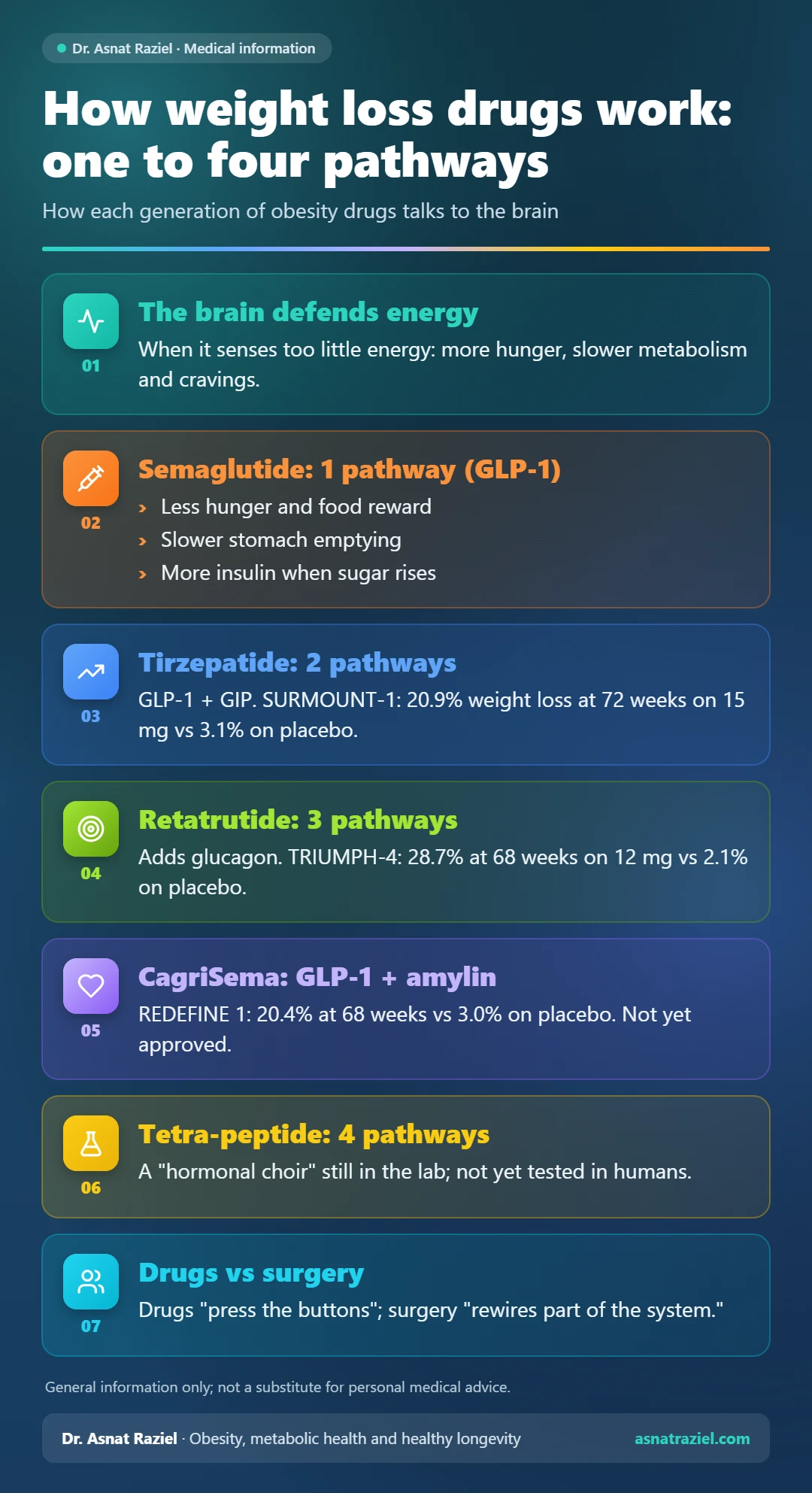
When patients ask me how the drugs differ, I explain it by counting pathways. Semaglutide works through one, GLP-1, and mainly turns up the brain’s fullness signals. Tirzepatide adds GIP, and in SURMOUNT-1 the 15 mg dose led to 20.9% weight loss. Retatrutide adds glucagon as a third pathway, which may also raise energy burning; in TRIUMPH-4, patients who stayed on 12 mg lost 28.7%. CagriSema takes a different route and pairs GLP-1 with amylin, with 20.4% in REDEFINE 1. A future tetra-peptide would combine four pathways, but no one has tested it in humans yet.
How weight loss drugs work compared with bariatric surgery
Many people think that bariatric surgery only reduces stomach volume. In fact, it is also a hormonal and metabolic operation. A 2024 review describes a rise in the fullness hormones GLP-1 and PYY after gastric bypass and sleeve gastrectomy, along with a drop in leptin levels. That is why patients experience early fullness, less hunger and changes in taste and food preferences. Sometimes even the craving for sweets goes down.
The main difference is simple. Drugs provide an external, ongoing hormonal signal. Surgery, by contrast, changes the anatomy and the passage of food through the gut, so the body itself produces strong fullness signals again. In addition, surgery affects the microbiome, bile acids, the gut’s nervous system and the entire gut-brain axis. You can put it this way: the drugs “press the buttons,” and surgery “rewires part of the system.” A full comparison appears in my article on obesity drugs vs bariatric surgery.
Obesity drugs and the brain: where is the world heading?
The future is probably not “a drug instead of surgery” or “surgery instead of a drug.” The future is a combination: bariatric surgery, advanced metabolic drugs and personalized nutrition. Alongside them come physical activity, good-quality sleep, stress management and emotional support. The reason is simple: obesity is not just a disease of weight, but a disease of the energy-regulation system. Ultimately, understanding the link between obesity drugs and the brain is the great news of recent years. Science is finally beginning to truly understand the disease.
The information in this article is general and does not replace personal medical advice.
References
Tirzepatide Once Weekly for the Treatment of Obesity
Triple-Hormone-Receptor Agonist Retatrutide for Obesity – A Phase 2 Trial
Coadministered Cagrilintide and Semaglutide in Adults with Overweight or Obesity
Gut motility and hormone changes after bariatric procedures
Eli Lilly funded the tirzepatide and retatrutide studies, and Novo Nordisk funded the CagriSema study.