By Dr. Asnat Raziel, bariatric surgeon specializing in obesity treatment, metabolic health and healthy longevity; Director of the Multidisciplinary Center for Obesity Treatment, Assia Medical, Assuta Ramat HaChayal, Tel Aviv
The satiety hormone revolution: where it began
The real story of GLP-1 health benefits goes far beyond the scale. In this article, I focus on what the large trials have shown for the heart, kidneys, liver and breathing during sleep, and on why that matters for health policy in Israel. If you want to understand how satiety itself works in the gut and brain, see my article on the physiology of satiety.
The satiety hormone revolution has changed the way medicine treats obesity. For decades, we tried to tackle the disease with partial tools: extreme diets, older medications and surgery. Over the past decade, it has become clear that obesity is not a problem of discipline or choice. It is a complex biological disease that disrupts the body’s hunger and satiety mechanisms. This shift in understanding led to a treatment breakthrough: satiety hormones.
This is a new generation of drugs based on the natural hormones of the digestive system. They act on the hunger and satiety centers in the brain, on metabolism and on the regulation of blood sugar and fats. In the medical literature, they are called NuSH, nutrient-stimulated hormone therapies, meaning treatments based on hormones that the body releases in response to food. A 2026 review describes how this group of drugs has transformed the treatment of obesity and type 2 diabetes. In everyday language, the clearest and most accessible name is satiety hormones.
What do satiety hormones actually do?
In people with obesity, the body’s biological satiety mechanism is impaired. The body “does not feel full” even after an adequate meal. The hormonal signals between the gut, the pancreas and the brain do not work properly. Satiety hormones act exactly at this point. They strengthen the signals that tell the brain the body is full, and they slow stomach emptying. In addition, they improve insulin release and reduce glucagon release.
The result is not just eating less, but restoring deep metabolic regulation. That is why the treatment affects many systems in the body, not only weight.
Weight loss, but that is only the beginning
The most striking figure is weight loss. In the SURMOUNT-5 trial, which directly compared the two leading drugs, patients lost 20.2% of their body weight with tirzepatide, the active ingredient in Mounjaro. In contrast, with semaglutide, the active ingredient in Wegovy, they lost 13.7%. This was after 72 weeks. In the past, weight loss of this size was achieved almost only with surgery.
However, in medicine, weight is an intermediate marker, not the goal. Significant weight loss improves blood sugar control, blood pressure, blood fats and heart function. Here is what the large trials have shown.
GLP-1 health benefits for the heart and blood vessels
In the SELECT trial, 17,604 people with obesity and heart disease, but without diabetes, took part. A major cardiac event, meaning cardiac death, heart attack or stroke, occurred in 6.5% of patients on semaglutide, compared with 8.0% on placebo. That is a 20% reduction in risk. Following the trial, the FDA also approved Wegovy to reduce cardiovascular risk. Read more about the trial in my article on how Wegovy protects the heart.
Diabetes and kidneys: changing the course of disease
Satiety hormones have become a central treatment for type 2 diabetes. They lower blood sugar without causing hypoglycemia, meaning a dangerous drop in blood sugar, when they are given without other glucose-lowering drugs. In addition, they lower weight instead of raising it.
There has also been progress in kidney disease. In the FLOW trial, 3,533 people with type 2 diabetes and chronic kidney disease took part. Semaglutide at 1.0 mg a week reduced the risk of a major kidney event or death from kidney or heart causes by 24%. Moreover, the risk of death from any cause fell by 20%. As a result, in January 2025, the FDA also approved Ozempic to reduce kidney risk in these patients.
Fatty liver and sleep apnea
Fatty liver disease is one of the silent and dangerous expressions of obesity. Until recently, there was almost no drug treatment for it. In the ESSENCE trial, patients with MASH, an inflammatory form of fatty liver disease, received semaglutide 2.4 mg. After 72 weeks, the inflammation resolved in 62.9% of them, compared with 34.3% on placebo. In August 2025, the FDA approved Wegovy for MASH without cirrhosis. You can find details in my article on Wegovy for fatty liver disease.
In addition, the SURMOUNT-OSA trials studied adults with obesity and moderate to severe sleep apnea. After 52 weeks of tirzepatide, the number of breathing pauses per hour fell by 25.3 to 29.3, compared with only about 5 on placebo.
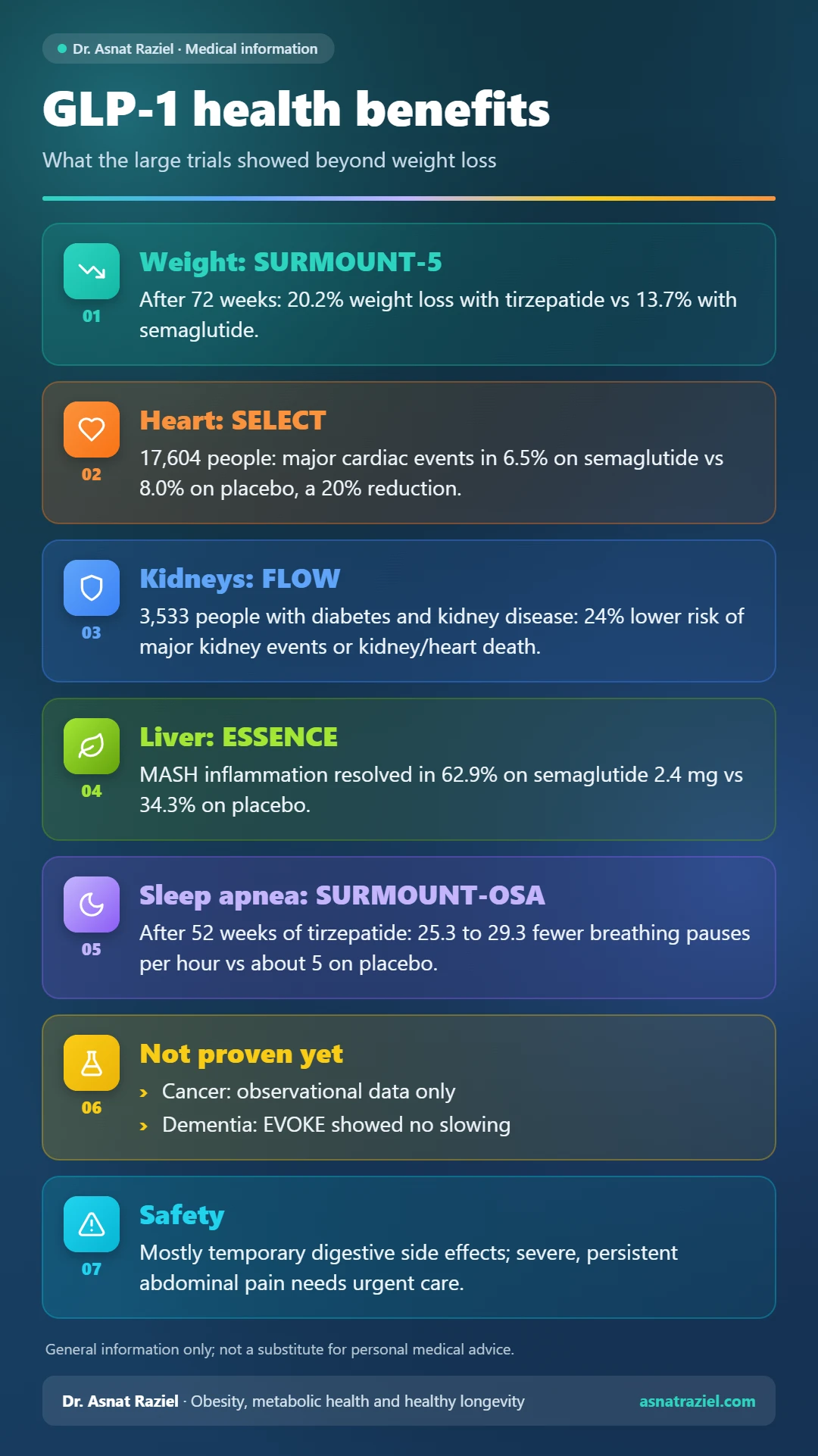
GLP-1 health benefits at a glance: what the trials proved
Put together, the big trials tell a clear story. For the heart, SELECT showed a 20% lower risk of a major cardiac event with semaglutide. For the kidneys, FLOW showed a 24% lower risk of a major kidney event or death from kidney or heart causes, and a 20% lower risk of death from any cause. In the liver, ESSENCE showed that inflammation resolved in 62.9% of patients, compared with 34.3% on placebo. For breathing during sleep, SURMOUNT-OSA showed 25.3 to 29.3 fewer breathing pauses per hour with tirzepatide. In other words, weight loss is only the visible part of these benefits. That is why these drugs belong in the treatment of chronic disease, not in the beauty aisle.
GLP-1 health benefits: what we do not know yet
First, observational data point to a lower rate of some obesity-related cancers. However, these are observational studies, so they do not yet prove cause and effect. Second, there was great hope for an effect on the brain and memory. Yet in late 2025, the EVOKE trials in 3,808 people with mild cognitive impairment or early Alzheimer’s disease showed no slowing of the disease. In other words, there is currently no proof that these drugs prevent dementia.
The satiety hormone revolution: what about safety?
The common side effects are mainly digestive: nausea, diarrhea or constipation. They are usually temporary, and raising the dose gradually helps manage them. And what about mood? In January 2026, the FDA asked to remove the warning about suicidal thoughts, after an analysis of 91 trials.
On the other hand, pancreatitis is a rare but real risk. In January 2026, the UK drug regulator strengthened its warning about acute pancreatitis. That is why severe, persistent abdominal pain requires immediate medical attention. You can find details in my article on weight-loss drugs and the pancreas. Like any long-term treatment, this one also requires ongoing medical follow-up.
Israel compared with the world
Many countries have built satiety hormones into public health policy for high-risk groups. The reason is the understanding that this is an investment that reduces costly illness in the future. In addition, in December 2025, the World Health Organization published its first guideline on using these drugs for obesity. In Israel, however, the 2026 national health basket (the publicly funded list of covered treatments) includes Wegovy only for adolescents aged 12 to 18. Many adults remain without treatment because of the cost, and health gaps are widening. Read more in my article on weight-loss drugs and Israel’s health basket.
The bottom line on GLP-1 health benefits
Satiety hormones are not a trend and not “skinny shots.” They represent a new medical approach: treating a biological disease, not personal blame. The satiety hormone revolution has already proven its benefit for the heart, kidneys, liver and breathing. That is why adding them to the health basket for adults as well, with controlled criteria, is a necessary step. This way, the health system can reduce illness, save lives and adapt to 21st-century medicine.
The information in this article is general and does not replace personal medical advice.
References
Tirzepatide as Compared with Semaglutide for the Treatment of Obesity
Semaglutide and Cardiovascular Outcomes in Obesity without Diabetes
Effects of Semaglutide on Chronic Kidney Disease in Patients with Type 2 Diabetes
Phase 3 Trial of Semaglutide in Metabolic Dysfunction-Associated Steatohepatitis
Tirzepatide for the Treatment of Obstructive Sleep Apnea and Obesity
Results of EVOKE and EVOKE+ trials show no effect of oral semaglutide on AD progression