By Dr. Asnat Raziel, bariatric surgeon specializing in obesity treatment, metabolic health and healthy longevity; Director of the Multidisciplinary Center for Obesity Treatment, Assia Medical, Assuta Ramat HaChayal, Tel Aviv
Gene therapy for obesity: a DNA injection instead of a weekly shot?
A single DNA injection that works for months sounds like science fiction, yet it is the idea behind a new approach to gene therapy for obesity. Today, people treated with Ozempic, Wegovy or Mounjaro inject themselves once a week. A new study, however, points in a completely different direction. The body itself would produce the therapeutic hormone after just one injection.
Researchers at The Wistar Institute in Philadelphia carried out the study. The journal Trends in Biotechnology published it in June 2026. It is important to say right away that the researchers tested the method in mice only. Still, this is one of the most intriguing directions in obesity medicine today. In this article, I will explain exactly what the researchers did, what they found and what is still unknown.
The body makes the drug itself
The existing drugs, semaglutide and tirzepatide, mimic gut hormones called incretins. They act on appetite, on satiety and on blood sugar control. However, the body gradually breaks them down, so patients have to inject them again and again.
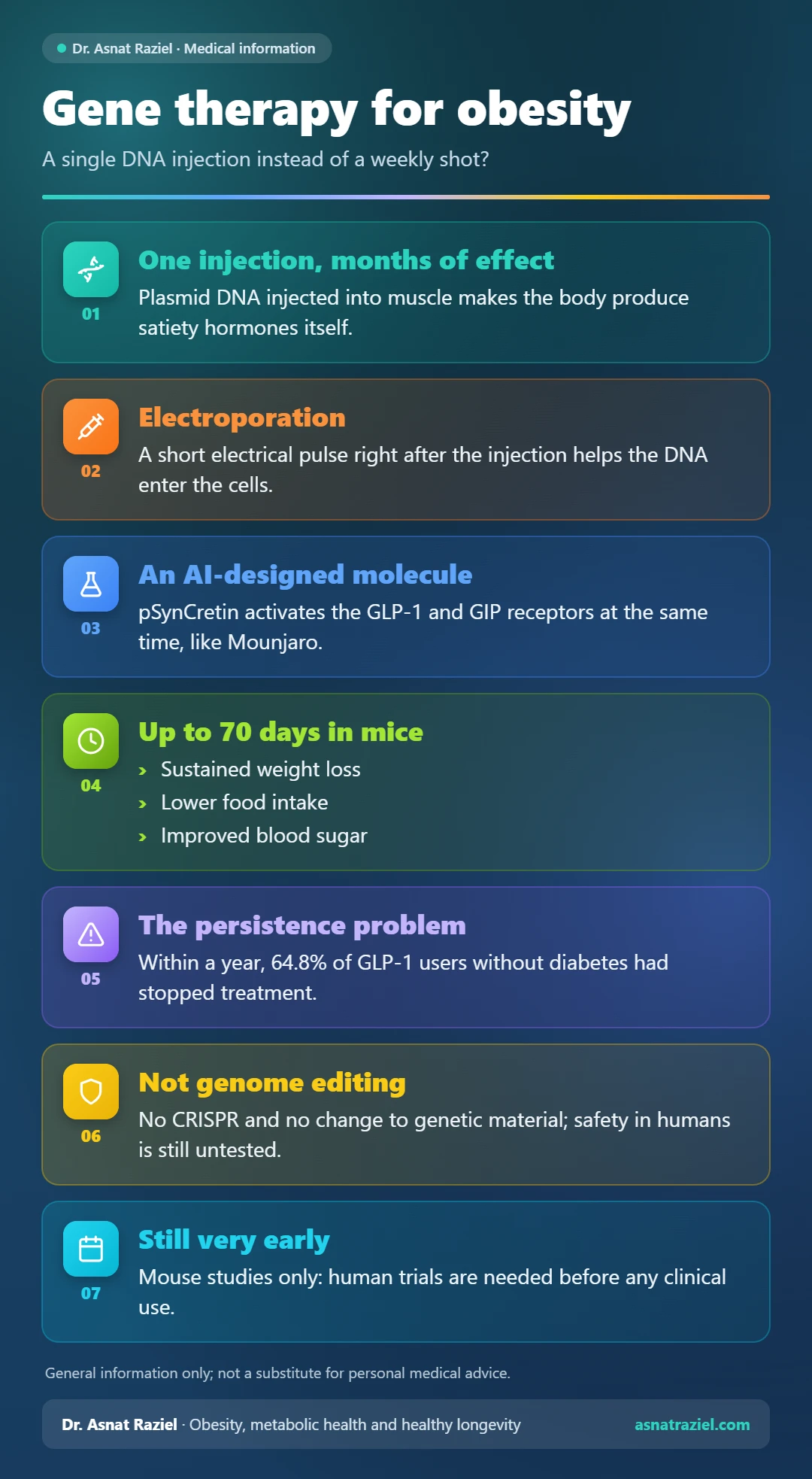
The researchers chose a different path. They injected a plasmid, a small circular DNA molecule, into muscle. The plasmid carries the instructions for making GLP-1-like and GIP-like hormones. Right after the injection, the researchers applied a short electrical pulse. This method, called electroporation, helps the DNA enter the cells. From that moment, the muscle cells produce the hormone themselves. In other words, the body becomes a temporary “factory” for the drug.
To make the hormone last, the researchers attached it to part of an antibody. This link slows its breakdown in the blood. In addition, they used artificial intelligence to design a dual molecule called pSynCretin. This molecule activates the GLP-1 and GIP receptors at the same time, much like the idea behind Mounjaro. If you want to understand the mechanism in depth, you will find an explanation in my article on how satiety hormones act on the brain.
What the DNA injection showed in mice
The researchers tested the method in mice that had developed obesity on a high-fat diet. According to the Wistar Institute’s press release, a single dose produced measurable hormone levels for up to 70 days. During this period, the researchers saw:
- Sustained loss of body weight.
- Lower food intake.
- Improved blood sugar levels.
Moreover, the researchers compared the method with semaglutide. The mice that received semaglutide began to regain weight as soon as the injections stopped. By contrast, the mice that received the DNA kept their improvement until the end of the follow-up period. According to the institute, the effect lasted up to ten times as long as drugs like Ozempic and Wegovy. However, the study does not detail how this ratio was calculated.
Why it matters: the challenge of persistence
One of the biggest problems in obesity treatment is sticking with it. A large US study followed 125,474 adults who started a GLP-1 drug. Within a year, 64.8% of patients without diabetes had stopped treatment. Among people with type 2 diabetes, the rate was 46.5%.
The reasons vary: cost, side effects, forgetfulness, fear of needles and drug shortages. In addition, stopping treatment leads to weight regain in most cases, as I explained in my article on weight regain after stopping the drug. So any method that reduces the number of injections may help. Incidentally, a similar trend is under way with standard drugs, and you can read about it in my article on monthly weight-loss injections.
Is a DNA injection gene therapy for obesity?
For many people, the word DNA raises an understandable concern. That is why it is important to explain what the technology does and what it does not do. First, there is no editing of the genome and no use of CRISPR technology. The plasmid is meant to serve as a temporary production instruction inside the cell, not to change the patient’s genetic material.
Second, the technology itself is not entirely new. According to the researchers, plasmid DNA has already produced active antibodies in humans for more than a year. On the other hand, those were different molecules, not satiety hormones. Ultimately, researchers must test the safety of a DNA injection for these hormones in humans, in long, controlled studies.
What this means for the future of gene therapy for obesity
The study joins a broader trend: a shift from short-acting drugs to biological platforms that work over long periods. Instead of manufacturing more and more molecules in a factory, science is looking for ways for the body to make them itself, in a controlled way. If this kind of gene therapy for obesity succeeds, it may also suit other chronic diseases that require regular biological treatment.
It is worth remembering that the existing drugs already show broad benefits. For example, the SELECT trial included 17,604 patients with obesity and heart disease, without diabetes. Semaglutide reduced the risk of a major cardiovascular event by 20% compared with placebo. In addition, the World Health Organization published its first guideline on the use of GLP-1 drugs for obesity in December 2025. A broad overview of the drugs in the pipeline appears in my article on new targets for obesity drugs.
Gene therapy for obesity: still very early days
Alongside the excitement, it is important to keep things in proportion. The research is at the preclinical stage, meaning before any trial in humans. The road to approval includes safety studies, dose finding and clinical trials in several phases. Furthermore, many technologies that succeed in mice never make it into clinical use.
Another important question is control. A weekly drug can be stopped at any moment if side effects appear. By contrast, a hormone that the body produces for months is hard to stop. So any future development will also have to answer this question.
The research team is already looking ahead. The researchers are currently studying the effects of incretins on the immune system, including a possible role in the course of cancer. They also say the platform could be adapted to other therapeutic proteins. In other words, the idea behind this gene therapy for obesity may reach far beyond the world of obesity.
The bottom line
A DNA injection for satiety hormones, a form of gene therapy for obesity, is a fascinating research direction, but it is not a substitute for today’s treatments. We have already moved from a daily injection to a weekly one, and now to pills as well, with the Wegovy pill and Foundayo already approved. The next step may be a treatment given once every few months. Until then, the best treatment is the one that suits you and that you can stick with. I have written at length about the importance of persistence in treatment.
The information in this article is general and does not replace personal medical advice.
References
Engineering single-dose plasmid DNA for sustained in vivo delivery of designer incretins
Semaglutide and Cardiovascular Outcomes in Obesity without Diabetes
WHO issues global guideline on the use of GLP-1 medicines in treating obesity