By Dr. Asnat Raziel, bariatric surgeon specializing in obesity treatment, metabolic health and healthy longevity; Director of the Multidisciplinary Center for Obesity Treatment, Assia Medical, Assuta Ramat HaChayal, Tel Aviv
Causes of emotional eating: when food answers a feeling
What really drives emotional eating? In this article, I look at the causes of emotional eating: stress hormones, sleep, the brain’s reward system and strict dieting. Understanding the biology is the first step to breaking the cycle. If you want to check whether you have the pattern, see my article on the warning signs of emotional eating.
Obesity and emotional eating are connected in ways that go far beyond willpower. We usually think of eating as a simple act: we get hungry and eat, we feel full and stop. Yet for many people, and especially for people with obesity, the picture is much deeper. Food responds to stress, sadness, boredom, fatigue or loneliness. In these moments, it is no longer just food, but a way to soothe emotion.
In this article, I explain who really runs our choices: the brain, hormones, sleep and emotion. I will also suggest practical ways to break the cycle. You will find more everyday tools in my practical guide to coping with emotional eating.
Emotional eating is not weakness
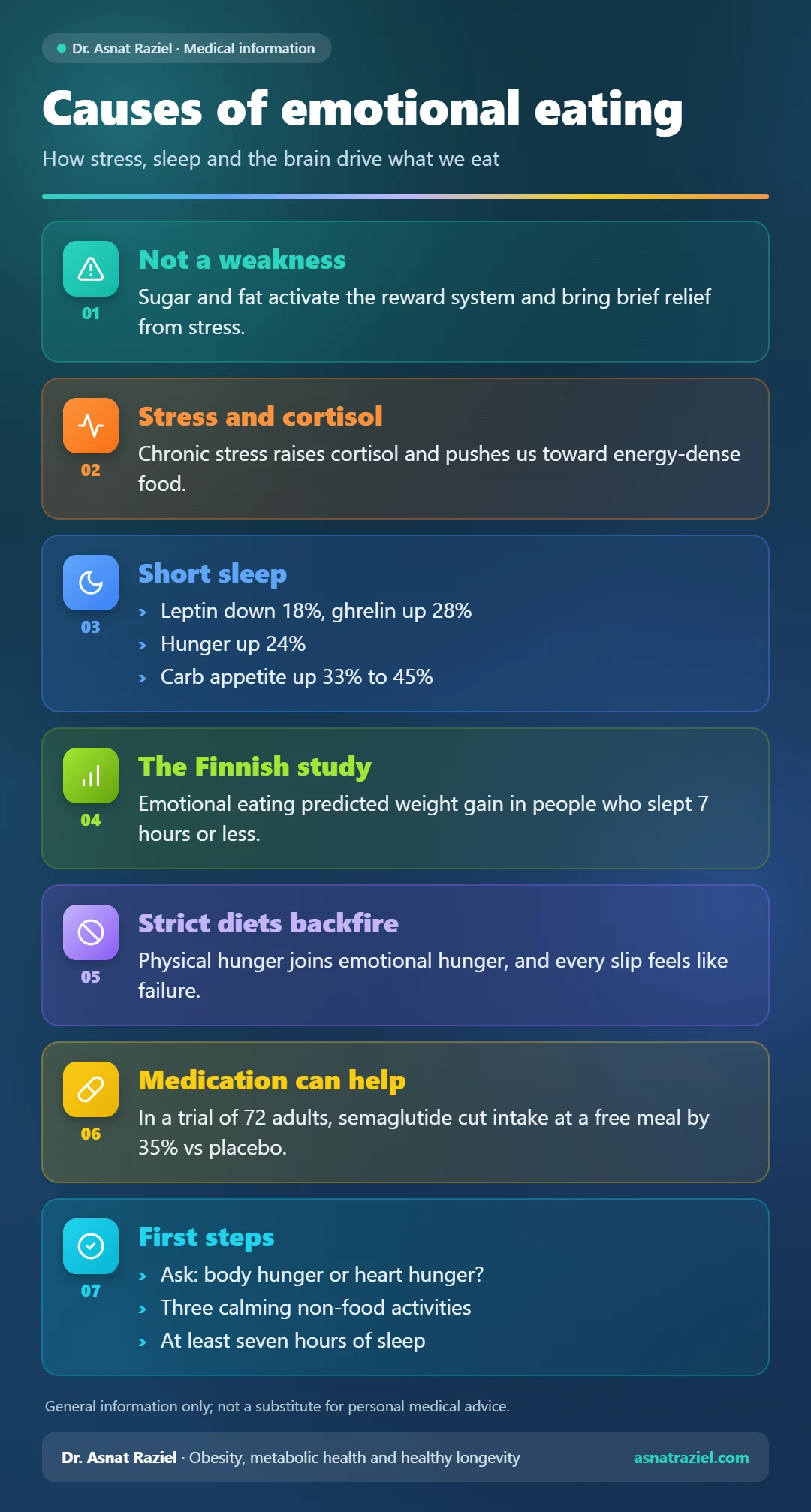
Emotional eating is not a lack of discipline or a personal failure. It is a common human pattern that relies on deep mechanisms in the brain. Foods high in sugar and fat activate the reward system and release dopamine. As a result, they bring momentary relief from stress. The relief fades quickly, but the brain learns to link food with calm.
When the pattern repeats again and again, it becomes an automatic habit. Eventually, it runs even without any physical hunger. That is why many people describe eating “on autopilot” at the end of a hard day.
Stress and cortisol: a key cause of emotional eating
Chronic stress activates the body’s stress system and raises cortisol levels. A scientific review of stress and the reward system describes how cortisol and the reward system work together to push us toward energy-dense food. According to the authors, chronic stress may also contribute to the buildup of belly fat. In addition, repeated attempts to restrict food may increase the pull toward especially tasty food.
This creates a familiar cycle: stress, then emotional eating, then weight gain, then more stress. Willpower alone does not break this cycle. What helps is changing the biological and behavioral conditions. You can read more in my article on the link between stress and obesity.
What research says about obesity and emotional eating
This link is not just an impression from the clinic. A Finnish population study followed adults aged 25 to 74 for seven years. At the start, 5,024 people took part. The researchers found that depression and emotional eating both predicted a larger increase in BMI and waist circumference. Moreover, emotional eating explained part of the link between depression and weight gain.
Another finding from the same study is especially important. Emotional eating predicted weight gain in people who slept 7 hours or less. In contrast, the link did not appear in people who slept 9 hours or more. In other words, sleep changes how strongly emotion affects eating.
Sleep and fatigue: hidden causes of emotional eating
Emotional eating is linked to especially high activity in the brain’s reward areas. At the same time, the frontal areas responsible for control, planning and delaying gratification work less well. Lack of sleep, fatigue and sometimes ADHD make the pattern worse.
For example, a small sleep restriction experiment included 12 healthy young men. After two nights of short sleep, levels of leptin, the satiety hormone, fell by 18%. In contrast, levels of ghrelin, the hunger hormone, rose by 28%. Hunger rose by 24%, and appetite for carbohydrate-rich food rose by 33% to 45%. For this reason, short sleep is one of the most underrated causes of emotional eating. When the brain is tired or emotionally flooded, food becomes the fastest and most available solution. You can read more in my article on sleep, the brain and appetite.
Why strict diets are among the causes of emotional eating
Strict, restrictive diets can make emotional eating worse. First, physical hunger joins emotional hunger. Second, the sense of failure grows, and food becomes the enemy. In this state, every “slip” feels like total failure. It often leads to overeating.
This is one reason why people with emotional eating go through repeated cycles of weight loss and regain.
Causes of emotional eating, connected: how stress, sleep and dieting feed each other
These causes rarely act alone. Chronic stress raises cortisol and pushes the reward system toward energy-dense food. Short sleep then adds to the pressure, because leptin falls and ghrelin and hunger rise. Meanwhile, the frontal areas that help us pause and plan work less well. On top of that, strict dieting adds physical hunger and a sense of failure. As a result, each factor makes the others stronger. That is also why the Finnish study is so telling: emotional eating predicted weight gain mainly in people who slept 7 hours or less. Therefore, treating only one cause, such as calories, rarely breaks the cycle.
Treating obesity and emotional eating: it does not last without the emotions
Treatment that focuses only on calories and meal plans misses the causes of emotional eating. To change emotional eating, you need to identify triggers, develop tools for emotional regulation and build alternatives that are not food. That is why psychological or behavioral support is not a luxury. For many patients, it is an essential part of treatment.
Current medical thinking supports this direction too. The Lancet Commission on clinical obesity defined obesity in 2025 as a chronic disease that deserves full medical treatment. In addition, the World Health Organization’s guideline from December 2025 recommends offering an intensive behavioral program, with healthy eating and physical activity, to people who receive GLP-1 drugs. This is a conditional recommendation, based on limited evidence.
The role of drug treatment
Obesity medication does not “cure” emotional eating, but it can make it easier. In a controlled trial of semaglutide 2.4 mg, the active ingredient in Wegovy, 72 adults with obesity took part. After 20 weeks, participants ate 35% less energy at an unrestricted meal than with placebo. They also reported much better control of eating and fewer food cravings.
When physical hunger and cravings calm down, there is room to breathe. In that space, the patient can learn new patterns. As a result, the emotional work becomes possible, rather than a constant struggle against the body. And what about mood? In January 2026, the FDA asked to remove the warning about suicidal thoughts from the drug labels, after a broad analysis showed no increased risk. Even so, any change in mood is a reason to talk to your doctor. You can find details in my article on GLP-1 drugs and depression.
Building a new relationship with food
The goal is not to make emotions disappear, but to learn to respond to them differently. When patients can tell physical hunger from emotional hunger, they gain a choice. In addition, when they have tools to cope with emotion without food, the change becomes deep and stable. This is a process of relearning, not of prohibition.
A few simple first steps:
- Pause before eating and ask: am I hungry in my body or in my heart?
- For one week, write down when unplanned eating happens and how you felt before it.
- Make a list of three calming activities that are not food, such as a short walk, a phone call or a shower.
- Get at least seven hours of sleep, because fatigue increases hunger.
- Seek professional support if the pattern keeps coming back or comes with a sense of losing control.
A human view of obesity and emotional eating
Emotional eating is a sign that a person is trying to care for themselves in the only way that was available to them. Good treatment does not judge the pattern. Instead, it understands the causes of emotional eating and offers alternatives. When emotions get room in treatment, food stops being the only language.
A final thought
What runs our choices is not just the plate. The brain, emotions, sleep and biology all take part in the decision. That is why treating obesity and emotional eating in a way that recognizes this is not weak, but wise. When we combine body and mind, the way opens to change that is not temporary, but sustainable.
The information in this article is general and does not replace personal medical advice.
References
Stress, eating and the reward system
Depression, emotional eating and long-term weight changes: a population-based prospective study
Definition and diagnostic criteria of clinical obesity
WHO issues global guideline on the use of GLP-1 medicines in treating obesity