By Dr. Asnat Raziel, bariatric surgeon specializing in obesity treatment, metabolic health and healthy longevity; Director of the Multidisciplinary Center for Obesity Treatment, Assia Medical, Assuta Ramat HaChayal, Tel Aviv
Balance and aging: a simple test that reveals a lot
Balance and aging are more closely linked than you might think. How long can you stand on one leg? It sounds like a simple task, but studies from recent years show that it reflects the state of your body. The ability to stay steady is linked to how your nerves and muscles work, to your risk of falling and even to life expectancy.
We usually assess health by blood pressure, blood sugar, cholesterol, weight, muscle mass and cardiorespiratory fitness. In longevity medicine, functional measures join that list. Balance is one of the most interesting of them, because it reflects many body systems working together.
Why is balance so important?
To stand steadily, your body performs a complex task. Your eyes provide information about your surroundings. The vestibular system in the inner ear detects movement and changes in position. In addition, proprioception, the body’s deep sense of position, lets the brain know where each part of the body is. The brain processes this information, and the muscles and joints respond quickly.
So balance isn’t just a measure of leg strength. It reflects the combined work of the brain, nerves, sensation, muscles and skeleton. All of these systems change with age. Muscle mass and strength decline, reactions slow down and sensation in the feet weakens. Sometimes vision and the vestibular system are affected as well. For a related look at how the body changes with age, see my article on stooped posture with age.
The 10-second one-leg test
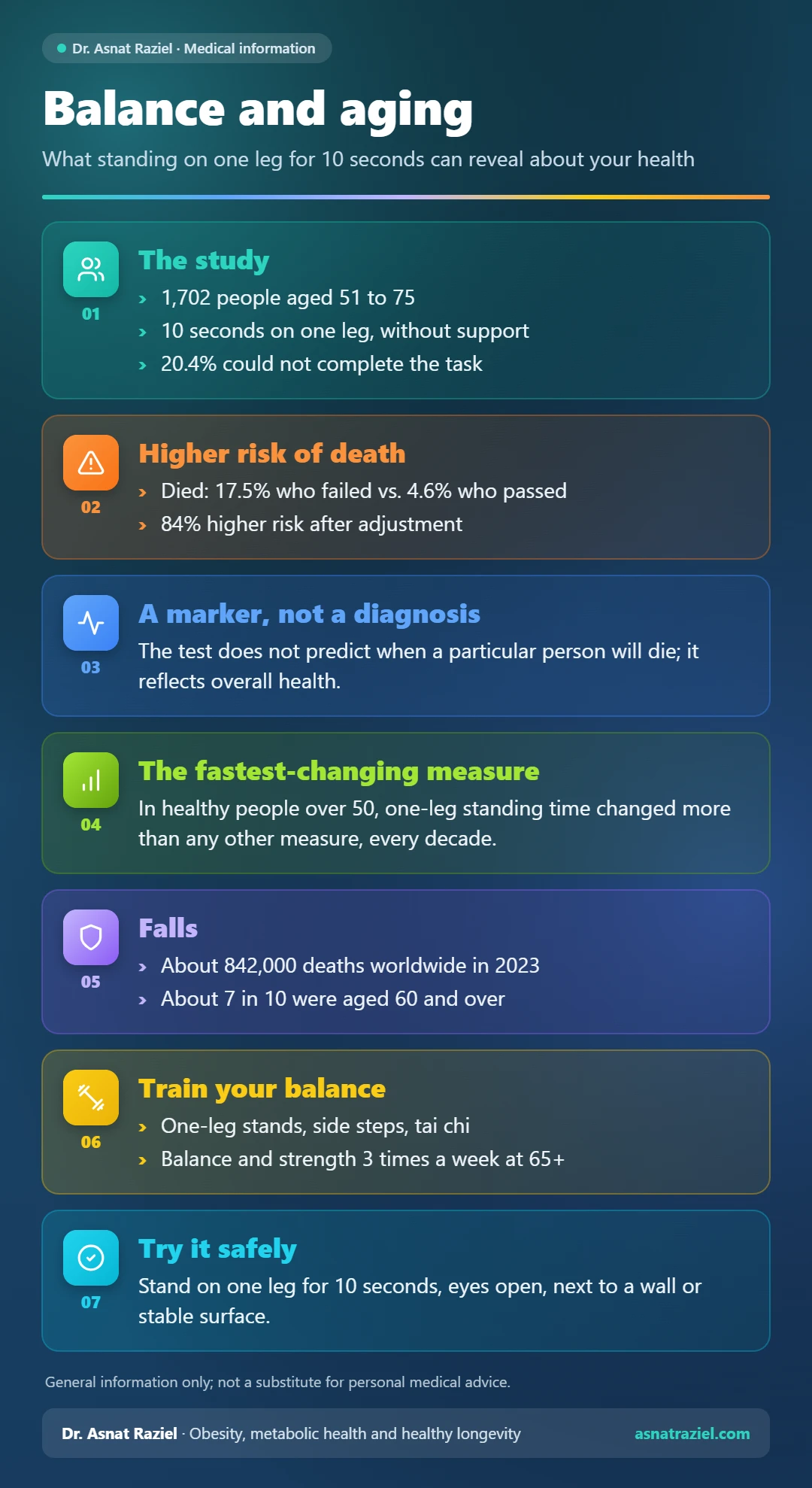
One of the most notable studies was published in 2022 in the British Journal of Sports Medicine. The researchers tested 1,702 people aged 51 to 75 and asked them to stand on one leg for 10 seconds without support. About 20.4% of the participants could not complete the task.
During a median follow-up of seven years, 17.5% of those who failed the test died, compared with 4.6% of those who passed. After adjusting for age, sex, BMI and underlying conditions, the risk of death from any cause was 84% higher in those who could not do it. In addition, the test improved risk prediction beyond the familiar risk factors.
What the test doesn’t tell you
It’s important to read this finding correctly. Standing on one leg doesn’t determine how many years you will live, and failing the test isn’t a medical diagnosis. The study found only a statistical association. In other words, poor balance is a possible marker of your overall health and functional status. Lifestyle medicine experts at Stanford also emphasize that the test does not predict when a particular person will die. Even so, precisely because it is so simple, the researchers suggested adding it to routine physical exams in middle and older age.
Balance and the aging of nerves and muscles
A study published in 2024 in PLOS ONE by a group of Mayo Clinic researchers examined healthy people over 50. The researchers compared several measures: grip strength, knee strength, walking patterns and balance. Walking patterns barely changed with age. In contrast, the time people could stand on one leg changed more than any other measure, in every decade. Strength, for example, changed at a much slower rate.
Therefore, the researchers suggested that standing on one leg could serve as a reliable measure of neuromuscular aging, in women and men alike. This finding supports an important idea: assessing aging shouldn’t rely only on blood tests or on the age printed on your ID. A simple physical task also provides a great deal of information, much like grip strength.
Balance and aging: the link to falls
Balance has a very practical significance: preventing falls. According to the World Health Organization, falls caused about 842,000 deaths worldwide in 2023. About seven in ten of them were people aged 60 and over. A fall in older age can lead to a fracture, a hospital stay and reduced mobility.
What’s more, after a fall, a fear of falling again sometimes develops. The person moves less, fitness declines, muscles weaken and independence suffers. This creates a cycle of declining movement and function, which is also linked to sarcopenic obesity. That’s why maintaining your balance is part of maintaining your independence and quality of life.
Longevity isn’t just about the number of years
One of the central goals of longevity medicine is to extend healthspan: the years we live in good health, with good function and independence. The question isn’t only whether we’ll live to 80 or 90. It’s just as important to ask how we’ll live during those years. Nature offers clues too, as I describe in my article on butterflies and aging. Will we be able to walk briskly, climb stairs, get up from a chair without help and carry groceries? And what happens when we trip? That’s why muscle mass, grip strength, walking speed, rising from a chair, cardiorespiratory fitness and balance are becoming part of assessing healthy aging.
You can improve your balance
The good news is that balance isn’t a fixed trait. You can train it. Practice includes standing on one leg, walking in a straight line, side steps, getting up from a chair without using your hands and exercises that gradually challenge your stability. The World Health Organization notes that such exercises, as well as tai chi, reduce falls. Its physical activity guidelines recommend that people aged 65 and over do varied activity that emphasizes balance and strength at least three times a week. Here is also a video with exercises to improve balance.
Strength training is also very important. Strong muscles allow the body to react quickly when we momentarily lose our footing. The combination of strength, balance, aerobic activity and flexibility preserves function throughout life. It’s also worth reading about aerobic vs. strength training.
Don’t wait until you’re older
Balance isn’t a topic that belongs only to people in their 70s or 80s. Even at a young age and in midlife, it affects the quality of your movement, your sports performance and how you react to a sudden change in the ground beneath you. From a longevity perspective, it’s worth building a functional reserve early: muscle, strength, fitness, flexibility and stability. The goal is to reach older age with the highest possible functional capacity.
Should you try standing on one leg?
You can do a simple test: stand on one leg for 10 seconds with your eyes open. Do it in a safe place, next to a wall or a stable surface you can hold on to. If you can’t do it, there’s no reason to panic. The test doesn’t predict any one person’s life expectancy. Instead, it’s a reminder to work on strength, stability and function. On the other hand, a new balance problem, dizziness, repeated falls or a change in the way you walk all call for a medical evaluation.
Balance and aging: the bottom line
Today, the world is searching for advanced tests of biological age: genetics, epigenetics, biomarkers and body composition. All of these matter, but we mustn’t forget the simple measures. The ability to walk, get up from a chair, maintain muscle and stand steadily says a lot about how your body is aging. That’s why the link between balance and aging is worth measuring, alongside lab tests. Sometimes ten seconds on one leg reveal something very important about our health.
The information in this article is general and does not replace personal medical advice.
References
Age-related changes in gait, balance, and strength parameters: A cross-sectional study
What a 10-Second Balance Test Can (and Can’t) Tell Us About Longevity
World Health Organization 2020 guidelines on physical activity and sedentary behaviour




