By Dr. Asnat Raziel, bariatric surgeon specializing in obesity treatment, metabolic health and healthy longevity; Director of the Multidisciplinary Center for Obesity Treatment, Assia Medical, Assuta Ramat HaChayal, Tel Aviv
Obesity in older adults: why the approach is changing
Obesity in older adults calls for a different approach from the one we use in younger people. At ObesityWeek 2026, speakers presented clear data on what happens to muscle as we age. At the same time, the European Association for the Study of Obesity (EASO) published a comprehensive position statement on diagnosis and treatment after age 65. The core message is simple. It is not just about a number on the scale. The goal is to protect muscle, function and independence.
What happens to our muscles as we age
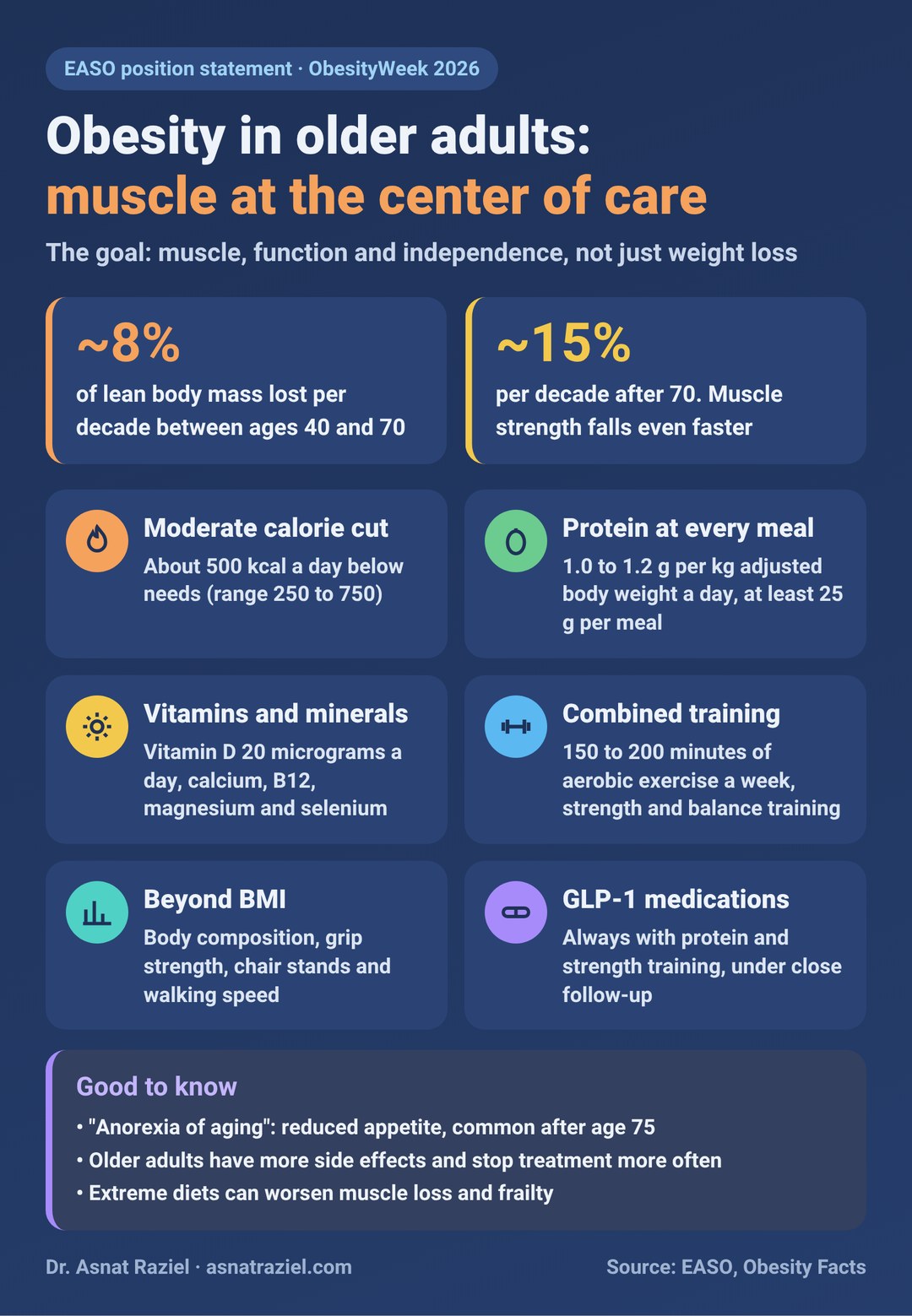
Even completely healthy people lose muscle with age. Data at the conference showed a steady decline. Between ages 40 and 70, healthy adults lose about 8% of their lean body mass per decade. After 70, the loss rises to about 15% per decade.
Moreover, muscle strength declines faster than muscle mass. The graph shown at the meeting reveals a gap that widens especially after ages 75 to 84. In other words, muscle does not just shrink. It also gets weaker. That is why getting up from a chair, climbing stairs and keeping your balance gradually become harder.
Sometimes muscle loss accelerates and starts to affect function. We call this sarcopenia, a progressive disorder of skeletal muscle. A review in The Lancet describes it as a skeletal muscle disorder that can be diagnosed and treated. When it occurs together with excess fat, doctors call it sarcopenic obesity.
How common is obesity in older adults?
According to EASO, obesity in older adults affects up to one third of older people worldwide. Rates vary by sex and by region. In addition, aging itself changes body composition. Hormonal changes, less movement, dietary shifts and multiple medications all promote fat gain and muscle loss.
Why BMI alone is not enough to diagnose obesity in older adults
Body mass index (BMI) cannot tell fat from muscle. So a person with a "normal" BMI may have excess fat and too little muscle together. For this reason, EASO recommends a body composition test, such as a DXA scan. It also recommends measuring the waist-to-height ratio.
It also recommends testing real-life function. For example, grip strength below 16 kg in women and below 27 kg in men signals weakness. Taking more than 15 seconds to stand up from a chair five times is another warning sign. A walking speed of 0.8 meters per second or less also points to declining function.
Nutrition guidelines for treating obesity in older adults
1. Moderate calorie restriction
Moderate calorie restriction is the key to weight loss. EASO suggests cutting about 500 kcal a day below energy needs. The range is 250 to 750 kcal a day. This helps prevent muscle loss, nutritional deficiencies and frailty. Frailty is a state of weakness and high vulnerability to falls and illness. By contrast, extreme diets can make sarcopenia worse.
2. Enough protein
High-quality protein, rich in essential amino acids such as leucine, is essential for maintaining muscle mass and function. The recommendation is 1.0 to 1.2 grams of protein per kilogram of adjusted body weight (ABW) per day. Adjusted body weight is your ideal weight plus one quarter of your excess weight.
For example, take a woman who weighs 90 kg and whose ideal weight is 60 kg. Her excess weight is 30 kg, and a quarter of that is 7.5 kg. So her adjusted body weight is 67.5 kg. Her daily target is about 68 to 81 grams of protein. It also matters to spread protein across the day. Aim for at least 25 grams at each of the three main meals. However, people with kidney disease should avoid going above 1.2 grams per kilogram.
3. Vitamins and minerals
Nutritional deficiencies harm muscle health and metabolic function. EASO specifically mentions vitamin D, at 20 micrograms a day. It also lists calcium, magnesium, vitamin B6, vitamin B12 and selenium. So it is worth checking blood levels and supplementing as needed.
Exercise for obesity in older adults: strength and balance
EASO recommends combined training: flexibility, balance, aerobic exercise and strength training. Aerobic training should reach 150 to 200 minutes a week at moderate intensity. Strength training should be moderate to high intensity. It limits muscle loss and helps preserve bone density. In addition, balance exercises reduce falls and the fear of falling.
The best-known study in this field was published in NEJM. Researchers assigned 160 older adults with obesity to diet plus aerobic training, diet plus strength training, or diet plus both. Weight fell by 9% in every exercise group. However, the combination improved the physical performance test by 21%. Either type of training alone improved it by 14%. Moreover, the groups that included strength training lost much less muscle and bone.
What happens to muscle quality on GLP-1 medications
An interesting talk at the meeting, from the University of Pennsylvania, asked a new question. Not only how much muscle people lose, but whether the remaining muscle works better. The researchers scanned the calf muscle with 7-tesla MRI before treatment and after 10% weight loss.
The preliminary findings included five young women who started semaglutide or tirzepatide. In the calf, fat mass fell by 15% and muscle mass fell by 8%. At the same time, fat inside the muscle cells decreased in all four participants who could be analyzed. In addition, muscle recovery time after exertion shortened from about 95 seconds to about 61 seconds. This is a possible sign of better mitochondrial function, the "power plants" of the cell.
However, these are very early data. The sample was small, the findings did not reach statistical significance, and all participants were young. So we cannot draw conclusions about older adults. The practical message stays the same: alongside the medication, keep up strength training and a protein-rich diet.
Medications for obesity in older adults
Changes in hunger and fullness
With age, taste and smell weaken. At the same time, the digestive system becomes more sensitive. The pylorus, the muscle at the outlet of the stomach, becomes more active. Gut hormones also rise more after meals. Together, these changes contribute to the "anorexia of aging", a natural decline in appetite and food intake. It is especially common after age 75, and it raises the risk of malnutrition.
Protecting muscle during treatment
Incretin-based medications such as semaglutide (Wegovy) and tirzepatide (Mounjaro) increase fullness and slow stomach emptying. In older adults, this effect may add to the natural drop in appetite. In addition, a considerable share of the weight lost is lean mass. That is why EASO states that drug treatment should be combined with adequate protein intake and resistance training.
Side effects and stopping treatment
Older adults experience more side effects from obesity medications, and they stop treatment at higher rates. Beyond that, data on people aged 75 and over are still limited. So EASO recommends individualized treatment with close follow-up, within the association’s framework for the pharmacological treatment of obesity.
What about bariatric surgery?
Age alone is no longer a reason to rule out surgery. International guidelines have removed the upper age limit for fit patients. Observational studies show meaningful weight loss, sometimes slightly less than in younger patients. On the other hand, complication rates are higher, so a frailty assessment before surgery is especially important.
Obesity in older adults: what you can do today
Measure more than weight: ask for a body composition test and simple function tests, such as grip strength and standing up from a chair.
Cut calories gently: about 500 kcal a day is enough. A crash diet may cost you muscle.
Eat protein at every meal: dairy, eggs, fish, chicken and legumes, at least 25 grams per meal.
Train for strength and balance: gradually and with guidance, even if you have never trained before.
Stay in touch with your care team: report a sharp drop in appetite, weakness or dizziness while on medication.
Further reading: weight loss after 65 and detecting sarcopenia in time. See also weight loss drugs and frailty.
Bottom line: we treat obesity in older adults to protect independence
The treatment of obesity in older adults is changing. Instead of chasing kilograms, the goal is a strong, stable and independent body. Moderate calorie restriction, enough protein, strength training and close medical follow-up are the foundation. The new medications add an important tool, as long as we combine them correctly. In the end, muscle is the best investment for the years ahead.
This article is general information and does not replace personal medical advice.
References
EASO position statement: interview with Professor Lorenzo M Donini
Aerobic or Resistance Exercise, or Both, in Dieting Obese Older Adults
Assessment and Treatment of the Anorexia of Aging: A Systematic Review
Noninvasive metabolic imaging of skeletal muscle during GLP-1 agonist weight loss – Ryan Armbruster, University of Pennsylvania, ObesityWeek 2026