By Dr. Asnat Raziel, bariatric surgeon specializing in obesity treatment, metabolic health and healthy longevity; Director of the Multidisciplinary Center for Obesity Treatment, Assia Medical, Assuta Ramat HaChayal, Tel Aviv
A physical activity prescription: my fourth report from ObesityWeek
A physical activity prescription does not have to start at 150 minutes a week. That was one of the strongest messages in the final talk of the practical workshop at ObesityWeek in Washington. According to the speaker, the biggest drop in mortality comes from moving from zero to five minutes of activity. In other words, simply getting started is the most important step.
Dr. Michelle Look, a family and sports medicine physician who has also cared for Olympic athletes, gave the talk. Summer, a registered dietitian, joined her. The talk picked up where my report on personal nutrition plans left off. It covered food logs, movement, protecting muscle and choosing a medication. It also closed the workshop that opened with obesity as a disease of diseases.
Food logs: look for patterns, not blame
First, a food log is not there to criticize every bite. Instead, you look for patterns: where, what and why someone eats, and which meals they skip. It also helps to know which foods they enjoy and what fits their culture.
Summer said she rarely focuses on tracking numbers, especially for patients on GLP-1 medications. For Kathleen, the patient in the case study, she suggested just one goal: breakfast at home, similar to what Kathleen already likes, plus a piece of fruit for fiber. A more filling breakfast may also improve lunch choices.
She explores barriers together with the patient, using motivational interviewing. For Kathleen, the barrier was a rushed morning. The solutions came from her: wake up ten minutes earlier, keep grab-and-go food at home, or prepare breakfast the night before. A goal like “stop eating out” is too big. So it is better to start with one day a week and pick that day together.
Food logs also help explain side effects. According to Dr. Look, a meal larger than your appetite signals can cause nausea, bloating, abdominal pain, constipation or diarrhea during treatment. That is why she asks for a few days of logging before a visit, not daily tracking. If logging feels triggering, photos of the plate work too.
Start with the patient’s “why”
Dr. Look stressed that physical activity still matters in the era of highly effective medications. Its benefits go far beyond weight loss: heart and metabolic health, stress, sleep, energy and quality of life.
So she asks every patient why losing weight matters to them. For example, keeping up with friends on a walk, playing with the grandchildren, or traveling without slowing everyone down. She writes the answer in the medical record, because every visit comes back to it.
Another tip: ask about “physical activity,” not “exercise.” The word exercise makes many people picture a gym and an hour of hard work. She also recommends a “physical activity vital sign”: how many days a week, and for how many minutes, a person moves on purpose.
A physical activity prescription: frequency, type, time and intensity
A good physical activity prescription defines four things: how often, what kind of movement, for how long and how hard. Kathleen said she walks for 15 minutes, two to three times a week. Dr. Look would not double the time right away. Instead, she would ask her to walk one block faster, until she is out of breath for about 30 to 45 seconds, and then slow down.
This approach is called habit stacking: building on a habit that already exists. In other words, you do not add a new, heavy task. You upgrade something that already happens. For people with joint pain, she prefers gradual steps. For example, 15 minutes twice a day is better than jumping straight from 15 to 30 minutes.
The live illustration drawn during the workshop shows these exact messages: prescribe movement, stack habits, and make one block of the morning walk faster.
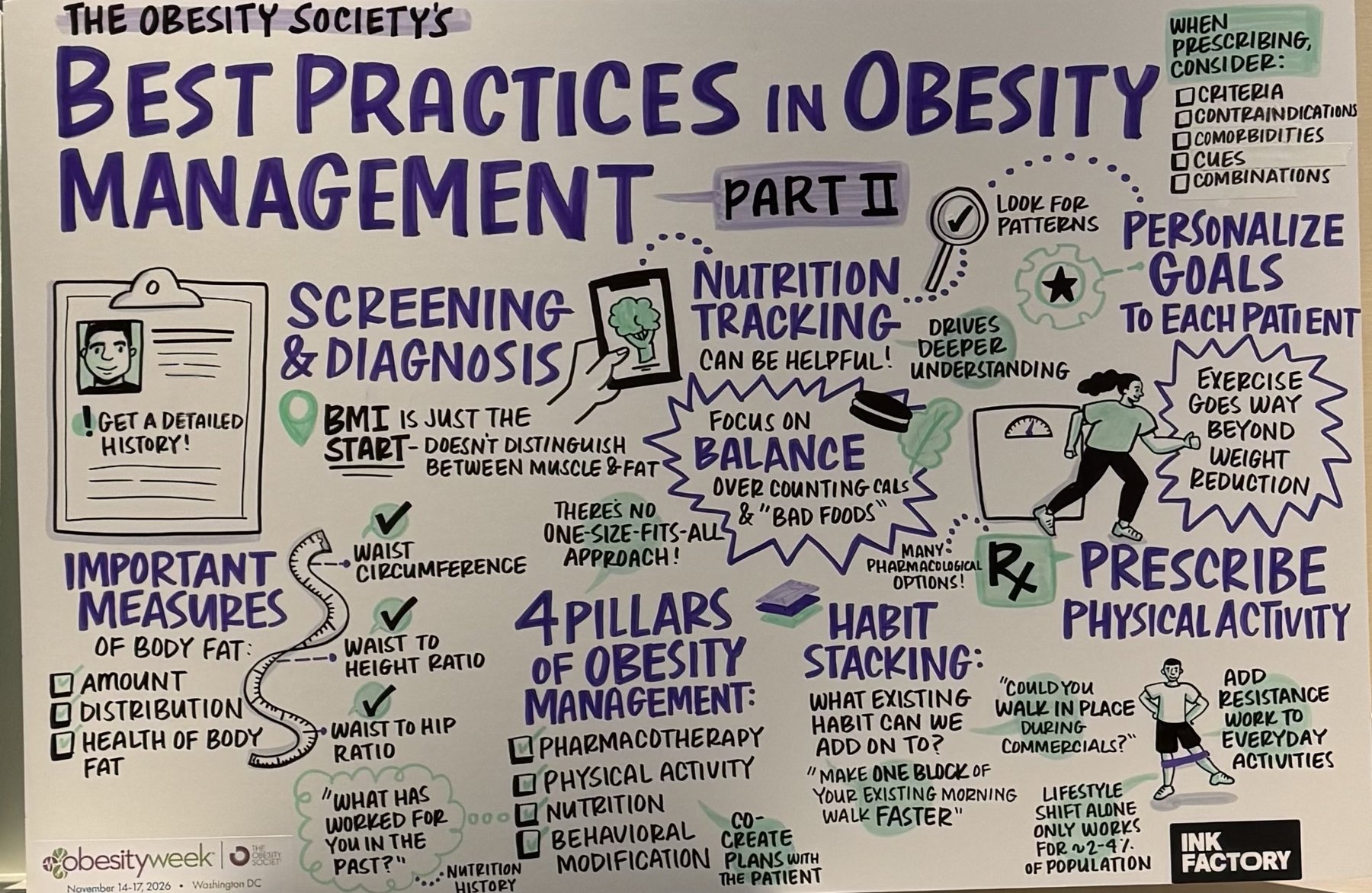
Illustration: Ink Factory for The Obesity Society, ObesityWeek, Washington DC. Photo: Dr. Asnat Raziel. Click the image to enlarge.
A physical activity prescription starts with five minutes
Dr. Look challenged the all-or-nothing view of 150 minutes a week. In the mortality curve she showed, the steepest improvement came between zero and five minutes of activity. So getting a person who sits all day to move at all is a major win.
Her examples are simple: tap your toes, stand up during TV commercials, march in place, or walk once around the house during each commercial break. Still, the target stays clear. The US physical activity guidelines recommend 150 to 300 minutes a week of moderate-intensity activity, plus muscle-strengthening activity at least two days a week. In her words, 150 minutes is the goal, and 300 minutes would be welcome.
Protecting muscle during weight loss
Weight loss includes fat, muscle, water and sometimes bone. Dr. Look cited an expected ratio of about three parts fat lost for every one part muscle. So she stresses adequate protein, and resistance training as part of the physical activity prescription. Read more about fat inside the muscle and healthy aging.
Muscle quantity also says little about muscle quality. People with obesity may carry more muscle than average, but of poorer quality because of fat inside the muscle. She also described how belly fat shifts the center of gravity forward. As a result, the hips rotate inward, the knees drift inward and the feet flatten, which can lead to back, hip, knee and foot pain.
Getting up from a chair: the most useful exercise
Dr. Look demonstrated a chair squat, meaning standing up and sitting down. Stand in front of the chair, push your hips back as if the seat were wet, then stand tall, brace your belly and squeeze your glutes. Anyone who needs support can hold on or use a resistance band. She also suggested seated rows for the upper back, and band exercises for the thighs while watching TV or on a Zoom call.
A physical activity prescription that fits daily routines
The trick is to link an exercise to an existing habit. For example, stand on one foot while brushing your teeth, do a modified plank while the coffee brews, or try a wall sit between patients. A sticky note on your coffee mug or TV remote is a helpful reminder.
Finally, she builds the plan with the 5 A’s of behavior change: ask if the patient is willing, acknowledge that it is hard, choose a practical step together, agree on a plan and arrange follow-up. If the plan does not work, you make a new one.
Realistic expectations: what lifestyle change can do
According to Dr. Look, an intensive lifestyle program leads to an average loss of about 7% of body weight. However, after a year many people regain much of it. So she urges realistic goals, rather than assuming every patient will reach a BMI of 25.
Even a 5% loss improves blood pressure and blood sugar. On the other hand, many complications of obesity call for double-digit weight loss. If lifestyle change is not enough, it is reasonable to consider medication. She compared it to treating diabetes or high cholesterol: you set a plan and follow up, and the first attempt is not the final word.
How to choose an obesity medication
Dr. Look reviewed older and newer medications. She noted that lower-cost drugs can still help people who cannot access GLP-1 medications. These are the approximate average weight-loss figures from the trials she presented:
Orlistat: 5-10%. Naltrexone-bupropion: 6-9%. Liraglutide: 8-12%. A phentermine-based option: 10-11%. A newer semaglutide dose: 19%. Tirzepatide: 21-25%.
Still, a trial average does not predict how one person will respond. She described patients who lost 30% of their body weight on older medications. In addition, “placebo” groups in these trials also received lifestyle support, including a 500-calorie daily deficit and 150 minutes of activity a week.
When choosing a medication, consider the indication, contraindications, other conditions, cost and coverage. It helps to pick a drug that also treats something else. For example, bupropion for someone who smokes, naltrexone-bupropion when cravings are strong, and GLP-1 medications for people with type 2 diabetes.
Safety, pregnancy and follow-up
GLP-1 medications carry a contraindication for people with a personal or family history of medullary thyroid cancer or MEN2 syndrome. This rests on findings in rats that have not been seen in humans so far. She also advises telling patients to seek care for a lump in the neck, persistent hoarseness or pain when swallowing.
For pancreatitis, check records, imaging and lipase results before assuming it really happened. In her view, gallstone pancreatitis after the gallbladder has been removed is not a contraindication. Pregnancy planning matters too. Dr. Look recommends stopping GLP-1 medications at least two months before trying to conceive, and adding barrier contraception when starting or increasing the dose of some medications.
Finally, she measures response against the patient’s “why.” For example, Kathleen reported more energy after a month, even before much weight loss. As a traditional benchmark, she mentioned a 4-5% loss after 12 weeks at the maximum dose. But before deciding a drug “doesn’t work,” check whether the dose actually went up, or whether insurance approval or a shortage held it back.
Bariatric surgery: the updated guidelines
Dr. Look briefly reviewed the updated indications for metabolic and bariatric surgery. The guidelines recommend surgery at a BMI of 35 or higher, regardless of other conditions. It should also be considered at a BMI of 30 to 34.9 when metabolic disease is present. She noted that surgery changes hormones, and weight regain afterward is no reason for blame. If weight stalls or climbs again, medication can be added, and it is worth discussing early.
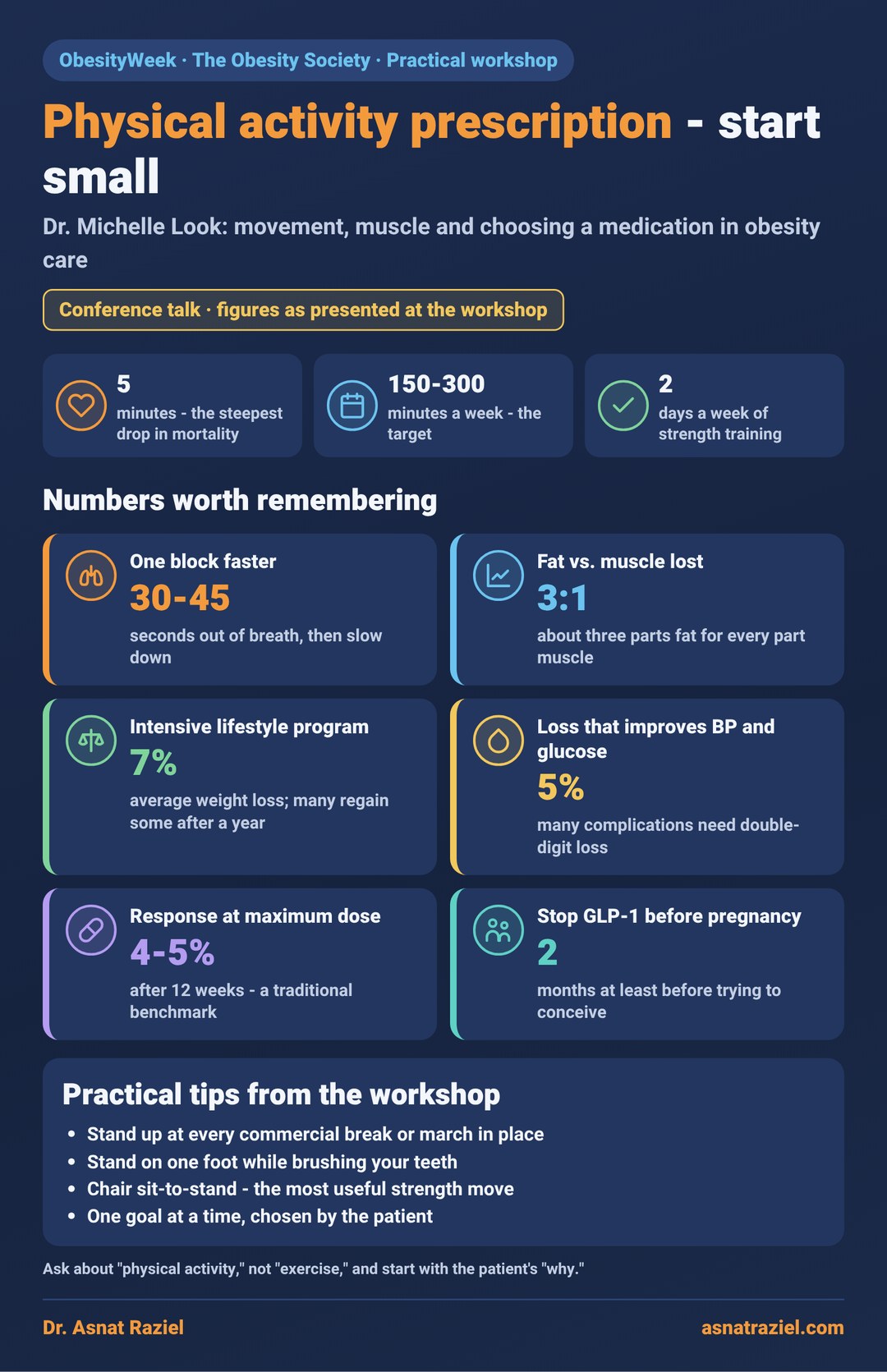
What you can do today
Here are some practical steps from the talk:
- Write down your “why”: what you want to be able to do when you feel better.
- If you sit most of the day, start with five minutes: stand up at every commercial break or march in place.
- Upgrade an existing habit: one faster block on your walk, or standing on one foot while brushing your teeth.
- Add strength training twice a week; getting up from a chair counts. This matters even more during medication treatment.
- Pick one nutrition goal for the week, such as breakfast at home.
- If you are planning a pregnancy and taking an obesity medication, talk to your doctor ahead of time.
At our multidisciplinary center, we build a physical activity prescription together with nutrition, emotional support, medication and sometimes surgery. That way, every patient gets a plan that fits their life. I have also written about nutritional deficiencies during weight-loss drug treatment.
Bottom line: a physical activity prescription for every patient
A physical activity prescription starts with what the patient already does and builds on it step by step. Five minutes of movement is far better than none, protecting muscle matters as much as losing weight, and the medication is chosen for the person, not the average. In the end, the goal is a better life, not just a number on the scale.
This article is general information and is not a substitute for personal medical advice.
References
Top 10 Things to Know About the Second Edition of the Physical Activity Guidelines for Americans
The talk was given at The Obesity Society’s practical workshop at ObesityWeek, Washington DC. The figures in this article are based on the speakers’ presentations.