By Dr. Asnat Raziel, bariatric surgeon specializing in obesity treatment, metabolic health and healthy longevity; Director of the Multidisciplinary Center for Obesity Treatment, Assia Medical, Assuta Ramat HaChayal, Tel Aviv
Bariatric surgery and cancer risk: what a large Nordic study found
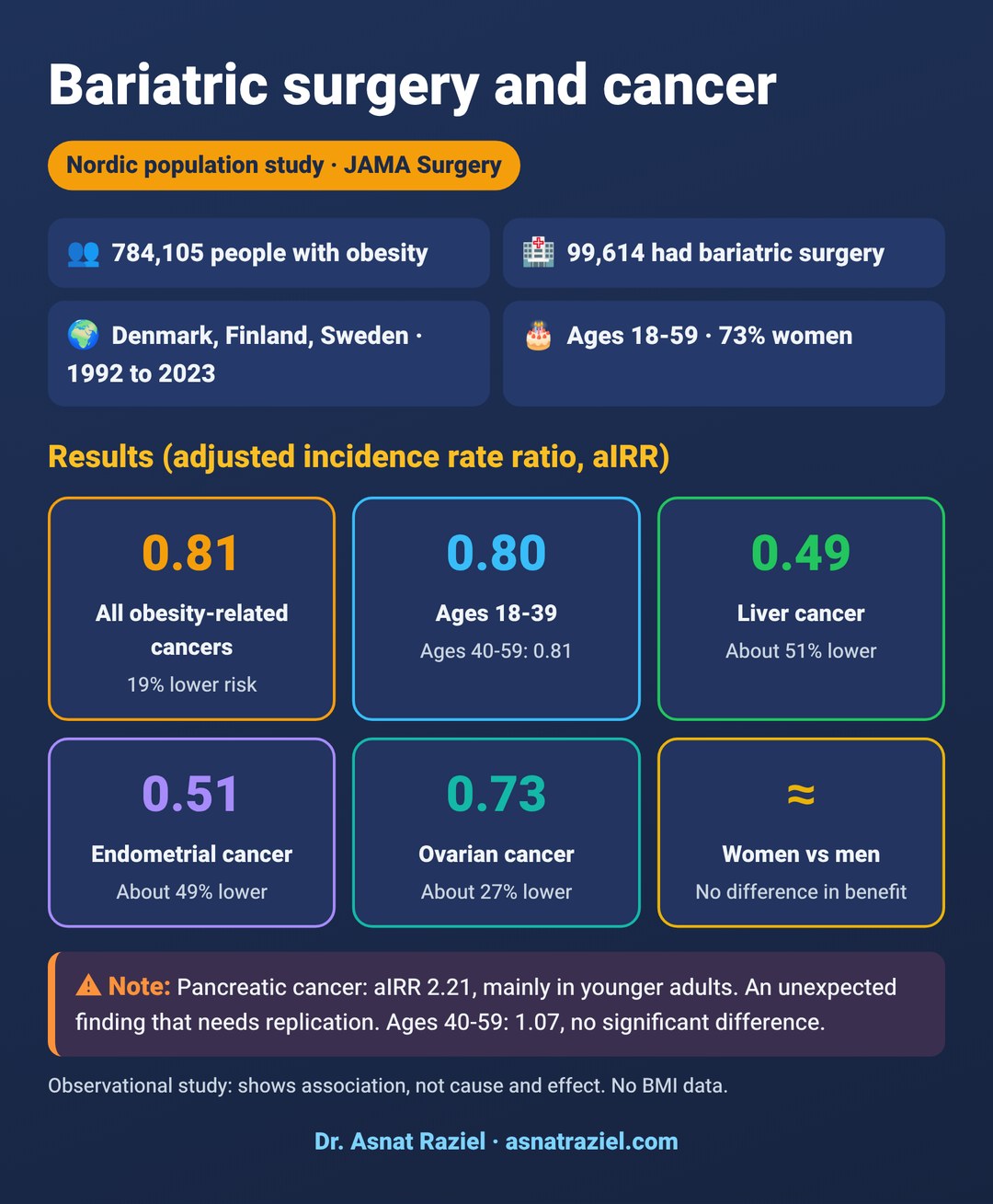
Bariatric surgery and cancer risk come up in my clinic almost every week. Now we have an especially strong answer. A large population study from three Nordic countries followed 784,105 people with obesity. Surgery was linked to a 19% lower risk of obesity-related cancer. What’s more, the benefit was similar in younger and older adults, and in women and men.
Why does obesity raise cancer risk?
Obesity is linked to at least 13 types of cancer. These include cancers of the uterus, liver, ovary, kidney, pancreas and colon. However, the weight itself is only part of the story. Fat tissue releases hormones and inflammatory signals, and insulin levels rise. As a result, together these encourage cells to divide.
What did the bariatric surgery and cancer risk study look at?
Researchers led by the Karolinska Institutet used national registries from Denmark, Finland and Sweden. In addition, the data covered 1992 to 2023. Everyone was 18 to 59 years old and had a diagnosis of obesity. Among them, 99,614 had bariatric surgery. Most participants, 73%, were women.
In short, the question was simple. Does the cancer benefit of surgery differ by age at surgery or by sex? Until now, most studies had not answered this clearly.
Bariatric surgery and cancer risk: the main results
After adjusting for other factors, the risk of obesity-related cancer was 19% lower. In other words, the adjusted incidence rate ratio (aIRR) was 0.81. Put simply: for every 100 such cancers in the group without surgery, there were roughly 81 in the surgery group, in an adjusted comparison.
Younger and older adults
For people who had surgery at ages 18 to 39, the ratio was 0.80. By comparison, for ages 40 to 59, it was 0.81. The difference between age groups was not significant. The researchers also found no difference between women and men for cancers that affect both sexes.
The largest drops by cancer type
- Liver cancer: about 51% lower (aIRR 0.49).
- Endometrial cancer: about 49% lower (aIRR 0.51).
- Ovarian cancer: about 27% lower (aIRR 0.73).
One finding that calls for caution: pancreatic cancer
However, the researchers also saw an unexpected result. Pancreatic cancer risk was higher in the surgery group, with a ratio of 2.21. In particular, the increase appeared mainly in younger adults. The authors stress that this needs to be checked in other cohorts.
In a published letter, other researchers pointed to a higher rate of diabetes in the surgery group. They also noted that at ages 40 to 59 the ratio for pancreatic cancer was only 1.07, with no significant difference. So metabolic factors that were not measured may explain part of the finding. For me, it is a reminder that a yearly medical follow-up after surgery is not a formality.
Limits of the bariatric surgery and cancer risk data
This is an observational study. It shows an association, not cause and effect. In addition, the researchers had no BMI (body mass index) data. Also, follow-up may be too short for slow-growing cancers. On the other hand, the size of the population and the length of the data make it one of the strongest studies in the field.
Bariatric surgery and cancer risk: what it means for you
The main message is encouraging. Large, lasting weight loss is linked to less cancer, not only to less diabetes and heart disease. Moreover, the benefit is not limited to one age group. Someone weighing surgery in their 40s or 50s can benefit too.
These data fit with research on GLP-1 medications and cancer prevention. There too, the larger and more lasting the weight loss, the better the picture looks.
What you can do today
Assess your personal risk
First, measure your waist circumference, not just your weight. Next, it is also worth checking fasting glucose, HbA1c (average blood sugar over the past three months), liver tests and blood lipids. Standard cancer screening, such as mammography and stool tests for hidden blood, stays important at any weight.
Choose the right treatment
Fortunately, there are several effective options today. Medications such as Wegovy and Mounjaro are available in Israel by prescription. For some patients, bariatric surgery is the option most likely to bring large, stable weight loss. For example, people who did not respond enough to medication can consider surgery after GLP-1 treatment. We make that decision together, based on health status and personal preferences.
A lifestyle that supports any treatment
- A Mediterranean-style diet rich in vegetables, legumes and fiber, with as little processed food as possible.
- Strength training two to three times a week, alongside aerobic activity.
- At least seven hours of sleep, and treatment of sleep apnea when needed.
- Less alcohol and no smoking, two proven cancer risk factors.
At our center, care is multidisciplinary. A dietitian, a psychologist, an exercise professional and a physician work together. Because of this, each patient gets the right mix of nutrition, movement, medication and, when appropriate, surgery.
The bottom line on bariatric surgery and cancer risk
The Nordic study supports what we see in the clinic. Bariatric surgery and cancer risk are linked in an encouraging direction: fewer obesity-related cancers, at any age and in both sexes. Still, the pancreatic finding needs further study, and a yearly follow-up after surgery is part of care. This article is general information and does not replace personal medical advice.
References
Bariatric Surgery and Risk of Obesity-Related Cancer by Age and Sex
Bariatric surgery’s cancer-preventive benefits consistent between sexes, across age groups
The study was funded in part by the Swedish Cancer Society, the Nordic Cancer Union and Region Stockholm.