By Dr. Asnat Raziel, bariatric surgeon specializing in obesity treatment, metabolic health and healthy longevity; Director of the Multidisciplinary Center for Obesity Treatment, Assia Medical, Assuta Ramat HaChayal, Tel Aviv
Moderate calorie restriction: what it does for the brain and body
Moderate calorie restriction made headlines again at the LM2026 Lifestyle Medicine Conference in Orlando. In the closing keynote, Dr. John Findley, CEO of the American College of Lifestyle Medicine, said that cutting calories by about 12% improves working memory. That, he said, is roughly one bagel a day. I looked up the studies behind that statement. The picture is interesting, but also far more nuanced than it sounded from the stage.
What calorie restriction actually means
Calorie restriction is a sustained reduction in the energy you take in from food, without giving up protein, vitamins or minerals. In other words, you eat a little less, but you do not eat badly. In animal studies, sharp restriction extended lifespan in several species. However, the question that matters for us is what happens in people, at a level they can live with.
Calorie restriction is not the same as intermittent fasting or a fasting-mimicking diet. With fasting, you limit your eating window or certain days. With calorie restriction, by contrast, you eat a little less every day. I wrote about the cyclical approach in Fasting-mimicking diet and longevity.
The CALERIE trial: the big human experiment
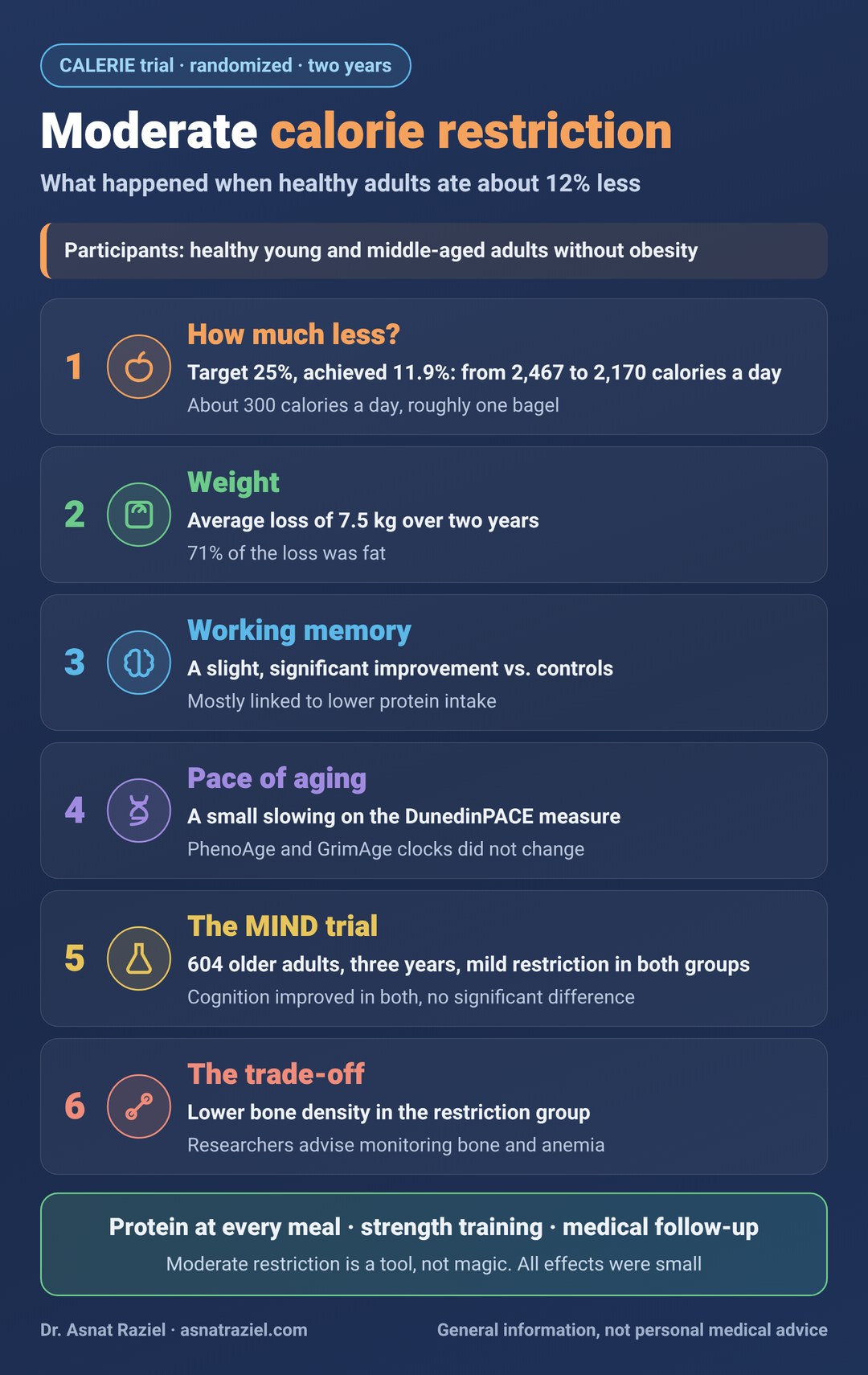
The figure Findley quoted comes from the CALERIE trial. This was a two-year randomized trial in healthy young and middle-aged adults without obesity. The researchers split participants into two groups. One group had a target of cutting calories by 25%, and the other kept eating as usual.
In practice, nobody reached 25%. According to the results published in Lancet Diabetes & Endocrinology, the restriction group achieved an average reduction of only 11.9%. In numbers, intake dropped from 2,467 to 2,170 calories a day. That is a gap of about 300 calories. Over two years, participants lost an average of 7.5 kg, and 71% of that loss was fat.
Moderate calorie restriction and working memory
A cognitive analysis of the CALERIE trial tested spatial working memory, the ability to hold information in mind briefly and use it. The researchers found a significant improvement in the restriction group compared with controls. Still, they described the effect as slightly positive. In addition, at month 24 the improvement was linked mainly to lower protein intake, and less to the other macronutrients. Sleep quality, physical activity and energy expenditure also influenced the result.
So precision matters here. From the stage, Findley spoke of better working memory, cognition and executive function. The study itself, however, showed only a slight improvement in working memory.
What about the MIND diet?
Findley also mentioned the MIND diet, a blend of the Mediterranean diet and the DASH diet. Here comes a surprising detail. The randomized MIND diet trial enrolled 604 older adults with overweight and a family history of dementia. Both groups, the MIND group and the control group, followed mild calorie restriction with weight loss support. After three years, cognition improved in both groups, with no significant difference between them. Brain MRI measures were also similar.
You can read this result in two ways. On one hand, the MIND diet added nothing beyond the control diet. On the other hand, moderate calorie restriction and weight loss themselves may have contributed to the improvement in both groups. The trial was not designed to test that question, so there is no firm answer.
Moderate calorie restriction and the pace of aging
The CALERIE trial produced two more findings of interest to longevity medicine. First, an analysis published in Nature Aging found that restriction slowed the pace of aging on the DunedinPACE measure. This measure is based on DNA methylation and estimates how fast the body is aging. However, the PhenoAge and GrimAge epigenetic clocks did not change significantly. Here too, the effect was small.
Second, a study published in Science looked at participants from the same trial. In them, about 14% restriction over two years improved T-cell production in the thymus. In addition, the researchers identified an inflammation-related gene, PLA2G7, whose activity went down. I wrote more about measuring biological age in Biological age.
The other side: bone, muscle and anemia
Calorie restriction is not free. The CALERIE safety report concluded that restriction was safe and well tolerated. Even so, bone density in the spine and hip was lower in the restriction group than in controls. Three participants were withdrawn for safety reasons. The researchers advised close monitoring for bone loss and anemia.
Also, keep in mind that the trial enrolled healthy people without obesity. In people with obesity, weight loss is part of treatment, and its benefit is especially clear. On the other hand, at older ages, losing muscle and bone is a real danger. I wrote about protecting muscle during weight loss in Muscle mass on weight-loss medication.
How to apply moderate calorie restriction in real life
The practical message is simple: you do not need an extreme diet. In CALERIE, the gap was about 300 calories a day. Here is how to start:
A slightly smaller portion: a smaller plate, and no second helping.
Protein at every meal: helps protect muscle while intake goes down.
A colorful plate: vegetables and fruit in many colors, in the spirit of “a rainbow a day.”
Calorie-free drinks: water instead of sweetened beverages.
Strength training: two or three times a week, to protect muscle and bone.
Blood tests: a blood count and bone density as needed, together with your doctor.
This approach fits with the other health habits from the conference. I wrote about them in Health habits for leaders.
The bottom line on moderate calorie restriction
Moderate calorie restriction of about 12% slightly improved working memory, slightly slowed the pace of aging and strengthened metabolic markers. However, all of these effects were small, and the trial lasted only two years. There is still no proof that it extends lifespan in humans. Therefore, moderate calorie restriction is a useful tool, but not magic. It is best combined with protein, strength training and medical follow-up.
This article is general information and does not replace personal medical advice. With an eating disorder, during pregnancy or at an older age, talk to your doctor before changing how much you eat.
References
The effect of caloric restriction on working memory in healthy non-obese adults
Trial of the MIND Diet for Prevention of Cognitive Decline in Older Persons
Caloric restriction in humans reveals immunometabolic regulators of health span
Safety of two-year caloric restriction in non-obese healthy individuals