By Dr. Asnat Raziel, bariatric surgeon specializing in obesity treatment, metabolic health and healthy longevity; Director of the Multidisciplinary Center for Obesity Treatment, Assia Medical, Assuta Ramat HaChayal, Tel Aviv
Mental health: what happened to young people?
The mental health of young people around the world is in crisis. Huge spending on care has not stopped it. That was the message of Dr. Tara Thiagarajan in her keynote at the LM2026 conference in Orlando. Thiagarajan is a Stanford-trained neuroscientist and the founder of the research institute Sapien Labs. According to her, the US spends about a trillion dollars on mental health care every five years. And yet, rates of despair and distress keep rising, especially since the end of the last decade.
Her central message is simple: change this fast cannot come from genetics. It comes from the environment and from lifestyle. So the solution should start there too.
Why do the usual diagnoses miss so much?
Thiagarajan compared mental health to COVID. The same symptoms can have different causes. People with the same cause can feel completely different things. In mental health care, however, diagnosis rests mainly on a list of symptoms. Her team studied people with five or more significant symptoms. Of these, 58.7% did not fit any of the ten common disorders in the DSM-5 diagnostic manual.
The common depression questionnaire PHQ-9 also misses people. In a study published this year, at the usual cut-off the questionnaire picked up only 46% of people in general mental distress. So, she argued, we need to look at environment and lifestyle, not just give symptoms a name.
A new measure of mental health
Thiagarajan’s team developed the MHQ (Mind Health Quotient). It is based on an analysis of 126 psychiatric questionnaires. The measure covers 47 functions: mood, emotional control, focus, memory, social connection, motivation and the mind-body connection. The score works like an IQ scale: 100 is the expected population level. A negative score signals impaired function.
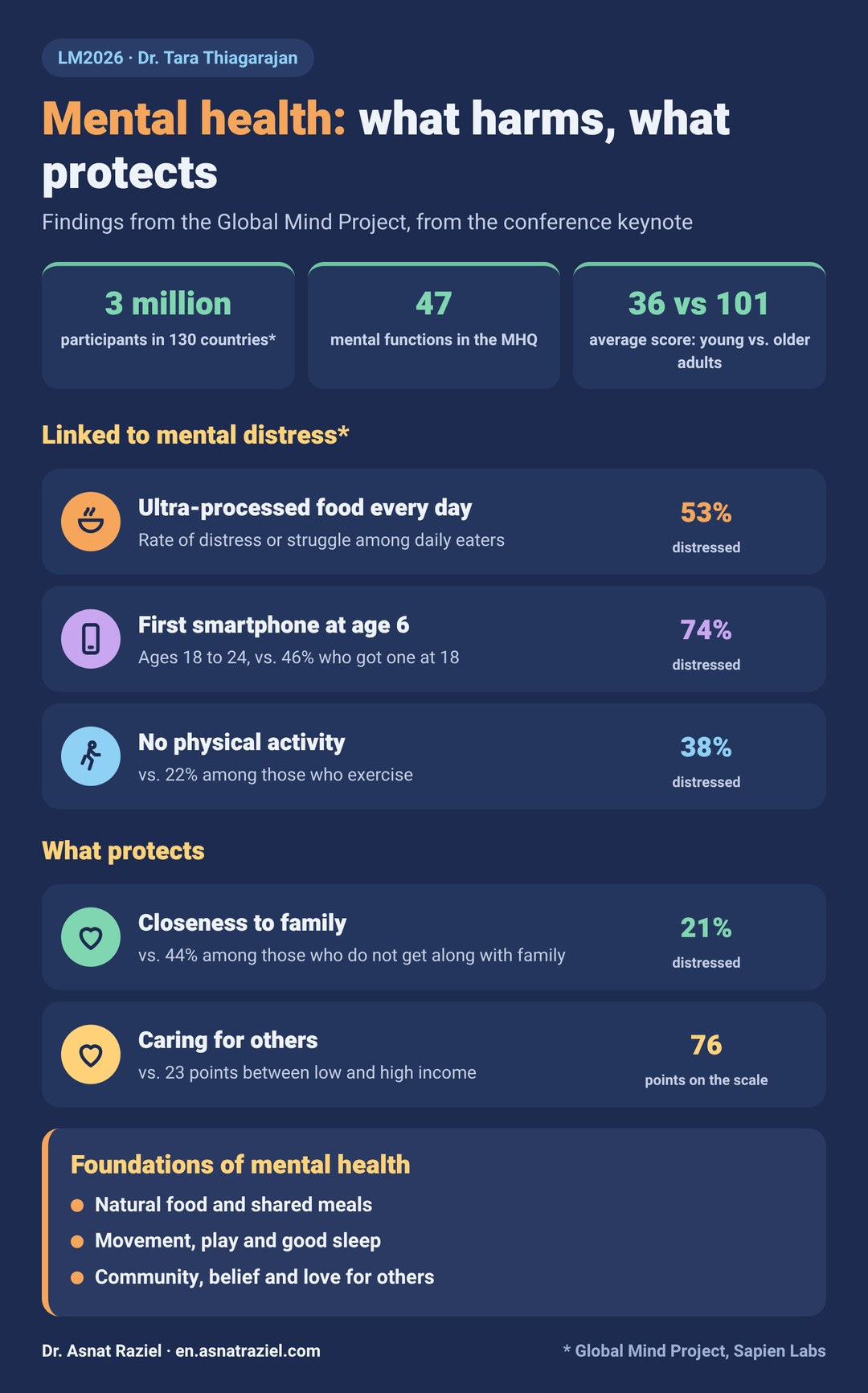
According to her, almost three million people in 130 countries have taken the questionnaire. They took part in the Global Mind Project. Older adults scored a global average of 101, close to the expected level. In contrast, the average for 18 to 24-year-olds was only 36. Among young people, sadness and anxiety were not the only problems. Suicidal thoughts, aggression, obsessive thoughts and a sense of detachment from reality also stood out.
Mental health and ultra-processed food
One of the strongest findings in the talk concerned food. According to her, 53% of people who eat ultra-processed food every day were distressed or struggling. This matters especially for young people: 54% of 18 to 24-year-olds eat such food several times a week or more. That compares with 27% of people aged 75 and over. In a study published by the team, about 400,000 people from 60 countries took part. The more often people ate such food, the lower their mental health score. The researchers accounted for income, exercise and trauma, and the link remained. They estimated that ultra-processed food is linked to 15% to 28% of clinical mental distress.
Interestingly, the main difficulty was not only sadness. It was trouble regulating emotions and thoughts: anger, poor focus and restlessness. The researchers suggest several possible mechanisms: food additives, pesticides and packaging residues, effects on the gut microbiome and inflammation. In another review they examined chemicals in food and drink, such as microplastics and bisphenols. The question was whether these feed the youth mental health crisis.
Her slides also covered plastic food and drink containers, for example. Among people who use them several times a week, 41% were distressed or struggling. Among others, the rate was 27%. The link remained after accounting for processed food. This is still a young field of research. The findings are statistical links, not proof of cause.
Exercise and an early smartphone
Movement also changes the picture. For example, 38% of people who do not exercise were distressed or struggling. That compares with 22% of those who exercise for at least half an hour a week. The differences stood out in mood, anxiety, energy, sleep and pain. Read more about how many steps a day you need.
The next finding concerns the age at which children get a smartphone. In a study of more than 100,000 young adults, the researchers looked at the age of the first smartphone. Those who got a smartphone before age 13 struggled more as young adults. The younger they were when they got it, the lower their score. Early access to social media explained about 40% of the link. In her slides, Thiagarajan showed the numbers: among 18 to 24-year-olds who got a smartphone at 18, 46% were distressed or struggling. At age 10 the rate rose to 61%, and at age 6 it reached 74%. The leading problems were suicidal thoughts, detachment from reality and aggression.
Social connection is the strongest factor
Similarly, 21% of people close to their family were distressed or struggling. That compares with 44% of those who do not get along with their family. And these ties are weakening: only 22% of 18 to 24-year-olds feel close to many family members. That compares with 45% of people aged 75 and over. The team also analyzed data from 270,000 adults in 32 countries. Too little social contact and too little sleep predicted mental distress more than any other factor.
The gap between an income of 30,000 and 150,000 dollars a year came to 23 points on the scale. On the other hand, people who care about others outside their family scored 76 points higher. The comparison was with people who care only about themselves. In other words, caring for others matters more for the mind than money.
Taken together, she said, these factors explain about 80% of the decline in mental health. She believes this figure is probably an underestimate.
What can we learn from the Hadzabe in Tanzania?
Among the countries studied, Tanzania reported the highest level of love and care for others. For instance, the Hadzabe are a tribe of hunter-gatherers who live in simple huts, with almost no money. Yet their young people had the best scores in the institute’s comparisons. In her slides she showed an average of 98 in offline populations in Tanzania. That compares with a global average of 36 for young people. A tribal elder told her that the leader should be the person who loves everyone the most.
Thiagarajan stressed that the goal is not to return to hunting or to romanticize poverty. It is worth asking what we lost along the way: real food, shared meals, movement, belonging and time with people.
Three weeks at summer camp
Thiagarajan also presented a study of 192 teenagers. They spent three weeks at a mountain summer camp with no devices. Instead, they lived in cabins and outdoors. Their scores rose, especially among those who arrived in distress. The largest gains appeared in teens who felt a stronger sense of belonging than at school. Exercise also contributed. Focus improved, and restlessness and hyperactivity decreased. According to her, brain wave recordings showed more orderly signals in the teens who reported improvement.
Mental health: what you can do today
Thiagarajan summed up the foundations of mental health: natural, clean food, a social fabric, shared meals, movement, belief, love for others and play. Clean water and air matter too. These are the practical steps I take from it:
Cut down on ultra-processed food: base your menu on vegetables, legumes and whole grains, similar to the Mediterranean diet.
Eat together: one family meal a day, with no screens.
Move every day: walking, dancing or playing outdoors.
Delay the smartphone: it is better to give children a personal smartphone only from age 13, and social media later.
Invest in relationships: family, friends, community and helping others.
Protect your sleep: read about healthy sleep and about the link between stress and obesity.
Bottom line
Dr. Thiagarajan’s talk reminds us that mental health is built outside the therapy room: on the plate, in movement, in the family and in the community. Most findings are links in survey studies, not proof of cause. But the direction is consistent. In the end, these recommendations are safe and cheap, and they improve physical health too. Anyone experiencing mental distress should seek professional help, and lifestyle change complements that care.
This article provides general information and is not personal medical advice. If you have suicidal thoughts or acute distress, seek help right away. Contact a professional or a crisis helpline.
References
Protecting the Developing Mind in a Digital Age: A Global Policy Imperative
Poor Separation of Clinical Symptom Profiles by DSM-5 Disorder Criteria
Limitations of PHQ-9 as a first line mental health screener in primary care
MHQ: constructing an aggregate metric of population mental wellbeing