By Dr. Asnat Raziel, bariatric surgeon specializing in obesity treatment, metabolic health and healthy longevity; Director of the Multidisciplinary Center for Obesity Treatment, Assia Medical, Assuta Ramat HaChayal, Tel Aviv
Lower back pain: what really helps?
Lower back pain is one of the most common reasons for doctor visits and sick days worldwide. In his keynote at the LM2026 Lifestyle Medicine Conference in Orlando, Dr. Michael Greger devoted a large part to what helps the back. He also covered what only seems to help. Greger, a physician and founder of NutritionFacts.org, bases his words on his new book, How Not to Hurt. In this article I gathered the main points and checked the key studies at the source.
The gap between evidence and treatment
Greger opened with sharp criticism. He mentioned a Lancet series that reviewed care for backache around the world. According to the review, much of usual care does not work. Some of it even harms. As a result, doctors refer people too often to imaging, injections, surgery and strong painkillers. Meanwhile, they recommend physical activity too rarely and explain too little.
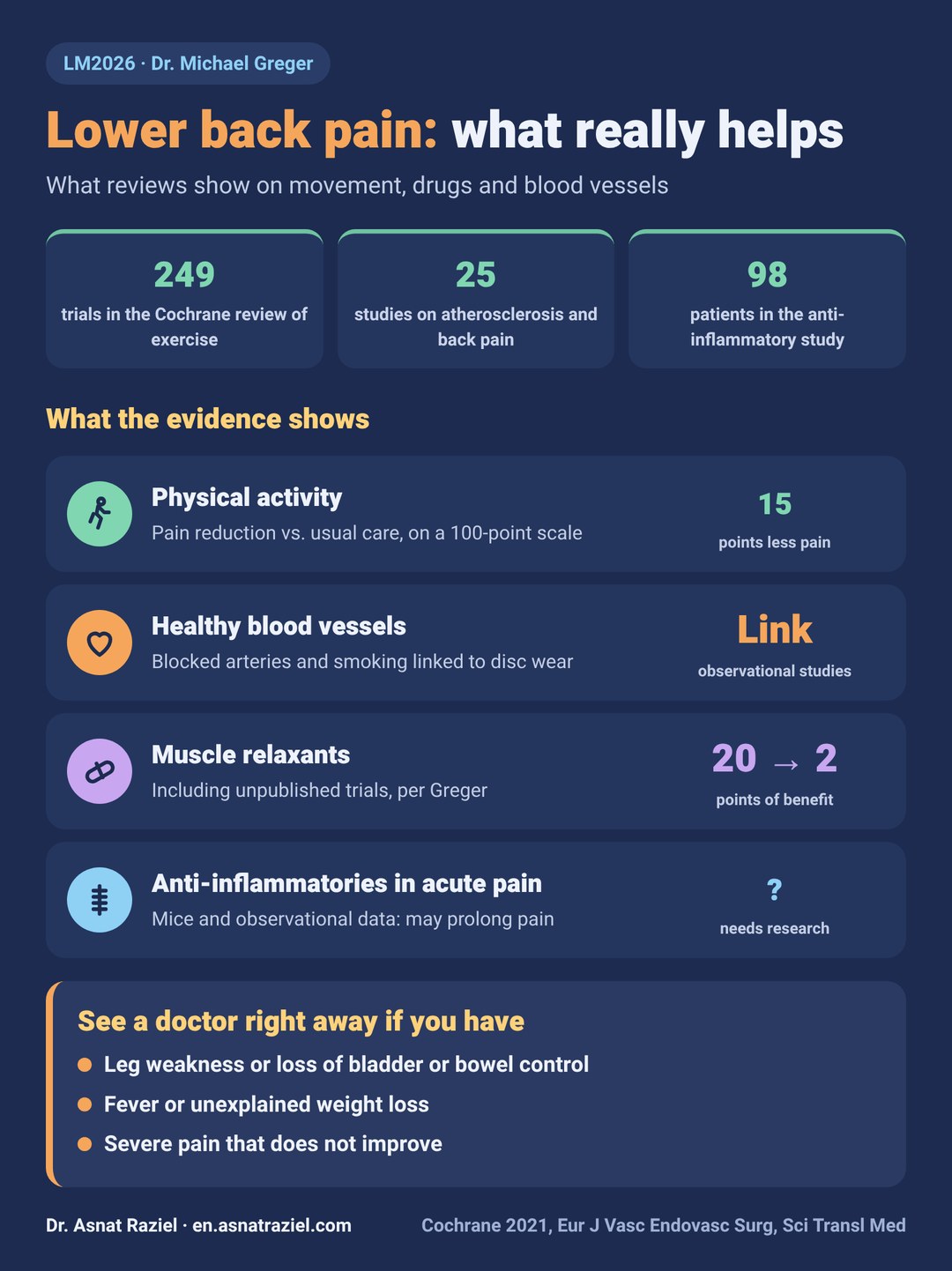
According to Greger, common drugs for the back also show little benefit. A systematic review of gabapentin and pregabalin (Lyrica) found little benefit in chronic backache, alongside a risk of side effects. He also said that when researchers added unpublished trials of muscle relaxants, their apparent benefit dropped from about 20 points to about 2 points on a 100-point scale.
Lower back pain and blood vessels
A topic Greger stresses in his videos is the link between blood vessels and the back. The spinal discs get their blood from small arteries that branch off the aorta. When these arteries narrow, the discs may suffer. A systematic review of 25 studies found a link between atherosclerosis of the aorta and disc degeneration and backache. Autopsy studies linked blocked lumbar arteries with lifelong backache. In population studies, smoking and high cholesterol were the most consistent factors.
The practical meaning is clear: the same habits that protect the heart, such as a diet low in saturated fat, not smoking and moving, may also protect the back. However, these are observational studies, so they show a link and not necessarily a cause.
Do anti-inflammatory drugs prolong lower back pain?
In a study in Science Translational Medicine, researchers followed 98 people with acute lower back pain. Among those who recovered, a short-lived inflammatory response protected against the move to chronic pain. Mice given early anti-inflammatory treatment felt better in the short term. But their pain lasted longer. Also, in UK Biobank data, people who took anti-inflammatory drugs had more lasting pain.
To be precise: this combines mouse experiments with observational data. It does not mean you must never take anti-inflammatory drugs. But it is wise to use the lowest dose for the shortest time.
Lower back pain and exercise
The treatment with the best evidence is also the simplest. A Cochrane review of 249 trials found that exercise reduces chronic backache by about 15 points on a 100-point scale. That compares with no treatment or usual care. That is a clinically meaningful difference. Side effects were mostly mild muscle soreness.
On the other hand, according to Greger, mechanical traction has not proven useful. Manual therapies are not always better than sham treatment. So it is better to choose an active movement program, a daily walk and core strengthening. Read more about how many steps a day you need.
Dr. Greger explains: cholesterol and back pain
Weight, sleep and stress
Excess weight loads the spine and usually comes with chronic inflammation. So moderate weight loss, as part of a lifestyle change, may ease the back too. Poor sleep and stress also amplify pain. Read about healthy sleep and about the link between stress and obesity. For foods tested against pain in general, see the article on Dr. Greger’s keynote.
Lower back pain: practical steps
Keep moving: long bed rest slows recovery. A light walk is better.
Choose an exercise plan: strength, flexibility and posture, with a physical therapist.
Protect your blood vessels: a plant-rich menu low in saturated fat, and no smoking.
Ask about the evidence: before an injection, surgery or a new drug, ask your doctor about the expected benefit and the alternatives.
Know when to seek care urgently: pain with leg weakness, loss of bladder or bowel control, fever or unexplained weight loss needs urgent evaluation.
Bottom line
Dr. Greger reminds us that with backache, more treatment is not necessarily better treatment. The strongest evidence supports movement, explanation and patience. There are also signs that protecting blood vessels protects the back as well. In the end, lower back pain is usually a passing condition. Lifestyle change is an important part of treating it.
This article provides general information and is not personal medical advice. Do not stop or change medication without consulting your physician.
References
Prevention and treatment of low back pain: evidence, challenges, and promising directions
Atherosclerosis and disc degeneration/low-back pain: a systematic review
Exercise therapy for chronic low back pain
Cholesterol and Lower Back Pain
How Not to Hurt: Discover the Foods Scientifically Proven to Fight Pain