By Dr. Asnat Raziel, bariatric surgeon specializing in obesity treatment, metabolic health and healthy longevity; Director of the Multidisciplinary Center for Obesity Treatment, Assia Medical, Assuta Ramat HaChayal, Tel Aviv
Diet for pain relief: a keynote lecture at LM2026
A diet for pain relief sounds like a social media promise, but Dr. Michael Greger asks us to judge it by controlled trials. Greger is a physician and the founder of NutritionFacts.org. He gave the keynote “How Not to Hurt” at the LM2026 Lifestyle Medicine Conference in Orlando. The talk is based on his new book, out on December 15. It draws on more than 6,000 references. He said he will give all the proceeds from the book to charity. His message: researchers have tested some simple foods in trials. They are safe, cheap and sometimes as effective as drugs.
Why look beyond medication at all?
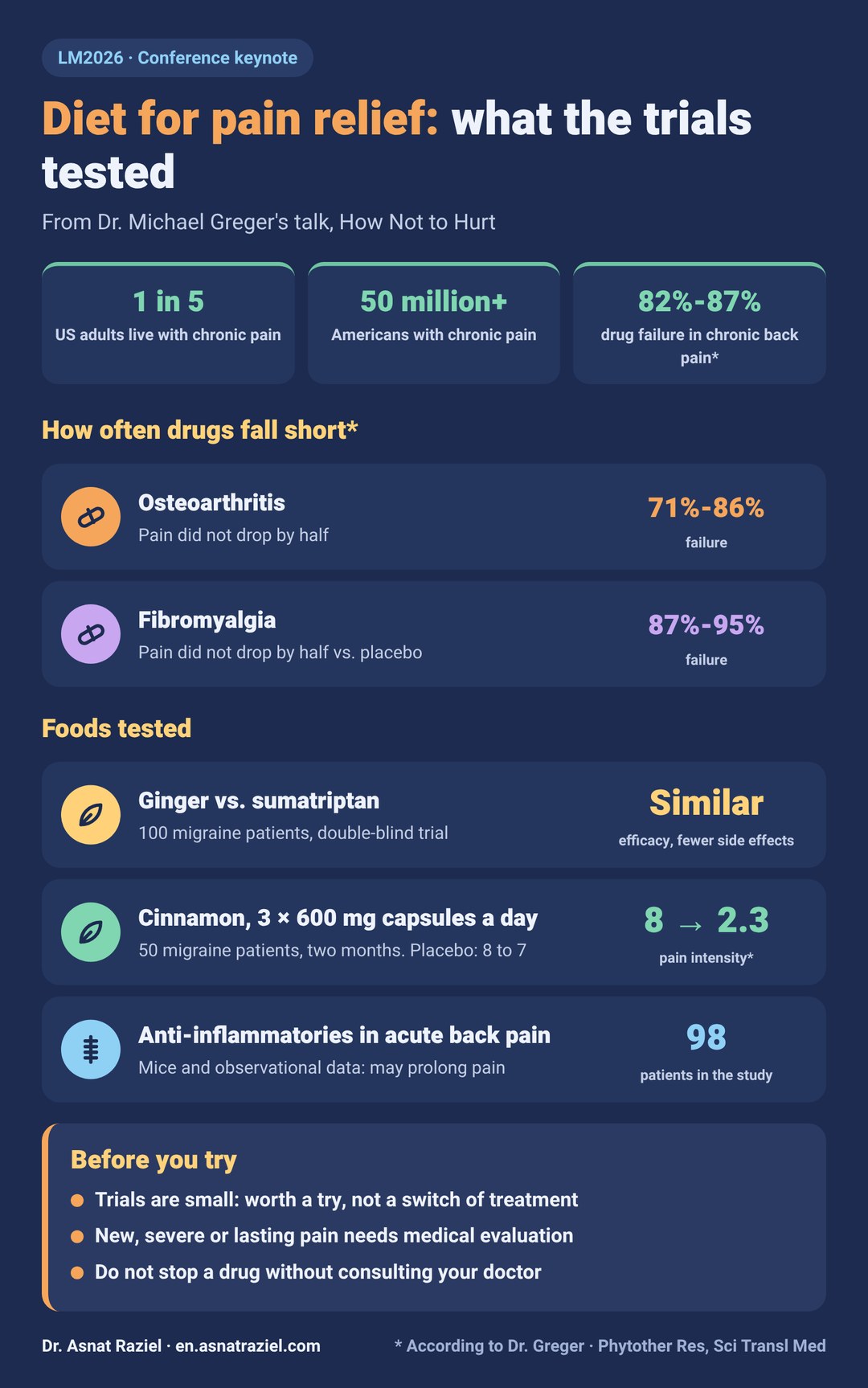
According to Greger, about one in five adults in the US lives with chronic pain. That is more than 50 million people. However, current drugs help only a minority. He cites an analysis of drug trials. In osteoarthritis, drugs failed to halve pain in 71% to 86% of people. For chronic low back pain the failure rate reached 82% to 87%. Fibromyalgia was worst, at 87% to 95%.
Over-the-counter drugs also come at a price. That is why a diet for pain relief interests many doctors. For example, an overdose of acetaminophen (paracetamol) harms the liver. So, he said, it is important to know about treatments that have no marketing budget behind them.
Can anti-inflammatory drugs prolong pain?
One of the surprising topics in the book is acute back pain. In a study in Science Translational Medicine, researchers followed 98 people with acute low back pain. Those who recovered had a short-lived inflammatory response by white blood cells. It protected them from chronic pain. Meanwhile, mice given early anti-inflammatory treatment felt better in the short term. But their pain lasted longer. In addition, in UK Biobank data, people who took anti-inflammatory drugs had a higher risk of lasting pain.
To be precise: this combines mouse research with observational data in humans. It is not proof, and you should not stop treatment without talking to your doctor.
Diet for pain relief: what did the trials test?
Next, Greger presented foods and spices tested in controlled trials. For example, two striking examples concern migraine:
Ginger versus a migraine drug
In a double-blind trial, 100 people with migraine without aura received ginger powder or sumatriptan. Notably, sumatriptan is a common migraine drug. Two hours after treatment, pain fell by a similar amount in both groups. Moreover, the ginger group had fewer side effects. According to Greger, the dose was about an eighth of a teaspoon of ground ginger. 44% of patients in each group were pain-free within two hours.
Cinnamon to prevent attacks
In another controlled trial, 50 people with migraine took cinnamon or placebo capsules for two months. The dose was three 600 mg capsules a day. The cinnamon group had fewer, milder and shorter attacks. In addition, the inflammatory markers IL-6 and nitric oxide dropped. According to Greger, pain in the cinnamon group fell from 8 to 2.3 on a 10-point scale. That compares with a drop from 8 to 7 with placebo.
Diet for pain relief: seven foods that keep coming up
In the talk, Greger listed seven foods tested in at least three different kinds of pain: cinnamon, garlic, ginger, turmeric, berries, flaxseed and green tea. Here are some of the trials he presented, after I checked them at the source:
Garlic and endometriosis pain
In a controlled trial with 60 women, the researchers added 400 mg garlic tablets to usual treatment. With garlic, overall pain fell from 6.5 to 1.8 on a 10-point scale within three months. In the placebo group, pain stayed high.
Flaxseed and cyclical breast pain
In a trial from Iran, about 180 women ate bread with flaxseed, took omega-3 or ate plain wheat bread. Overall, the trial lasted two menstrual cycles. Pain fell more in the treatment groups. Greger said several such trials led to a new recommendation. Canada’s society of gynecologists now lists flaxseed as a first-line option.
Blueberries for children with arthritis
In a trial with 201 children with juvenile arthritis, adding 50 mL of blueberry juice a day to a biologic drug improved the response to treatment. In addition, the blueberry group had fewer drug side effects.
A diet for pain relief in chronic disease
In the second part of the talk, Greger moved from single spices to a whole menu. The Dutch Plants for Joints trial included 66 people with knee or hip osteoarthritis and metabolic syndrome. For 16 weeks they received coaching for a whole-food, plant-based diet, physical activity and stress reduction. Compared with the control group, pain and function improved, and participants lost about 5 kg. A parallel trial in rheumatoid arthritis showed a drop in disease activity.
Greger also presented more striking reports with weaker scientific support. He said 17 of 21 people with painful diabetic neuropathy reported full relief within days. At the time, they followed a live-in plant-based diet program. He also described a case series of people with trigeminal neuralgia. Their pain fell sharply on a diet low in saturated fat. The researchers themselves wrote that a placebo effect cannot be ruled out. Moreover, controlled trials have not yet been done.
Common treatments that do not always help
Greger opened the talk with sharp criticism of common pain treatments. One example is steroid injections into the knee. In a controlled trial in JAMA, 140 patients received an injection every three months for two years. Cartilage loss was greater in the steroid group. Pain did not improve compared with saline injections. He added that drugs such as gabapentin and muscle relaxants show little benefit in back pain. Devices such as spinal cord stimulators have not proven a clear advantage.
I do not recommend stopping treatment because of a lecture. Still, it is worth asking your doctor about the evidence for each treatment. Ask about the alternatives too.
Watch: Dr. Greger presents his approach to pain
In this short video, Dr. Greger presents the main ideas of the book and his approach:
Diet for pain relief: what to remember before swapping a drug
The findings are interesting, but we should read them with care. Most trials are small, and some took place in a single center. So they justify a try, not a wholesale switch of treatment. Also, new, severe or persistent pain needs medical evaluation. Migraine with unusual signs, back pain with leg weakness or chest pain are not cases for self-treatment.
On the other hand, there is a broad message here that fits my own work with patients. A whole-food, plant-rich diet is a good basis for reducing inflammation. Good sleep, less stress and daily movement also affect how we feel pain.
A diet for pain relief in daily life: practical steps
Use spices: ginger and cinnamon are a safe addition in most cases, in normal food amounts.
Base your menu on whole foods: vegetables, fruit, legumes and whole grains, similar to the Mediterranean diet.
Keep a pain diary: write down attacks, food and sleep, to spot patterns.
Ask before you change: especially if you take blood thinners, because high doses of spices may interact.
Bottom line
Dr. Greger reminds us that the kitchen is part of the toolbox against pain. Controlled trials of some foods showed encouraging results. However, most studies are small, so diet complements medical treatment and does not replace it. In the end, a diet for pain relief is one more way to feel better, together with your doctor.
This article provides general information and is not personal medical advice. Do not stop or change medication without consulting your physician.
References
How Not to Hurt: Discover the Foods Scientifically Proven to Fight Pain
How Not to Hurt Trailer for Dr. Greger’s New Book on Chronic Pain Relief