By Dr. Asnat Raziel, bariatric surgeon specializing in obesity treatment, metabolic health and healthy longevity; Director of the Multidisciplinary Center for Obesity Treatment, Assia Medical, Assuta Ramat HaChayal, Tel Aviv
Women’s longevity: what 30 years of follow-up teach us
Women’s longevity is not just a matter of luck. At the LM2026 Lifestyle Medicine conference, I attended a fascinating talk by Dr. Kerry Reding-Amrofell of the University of Washington. She reviewed what we have learned from the Women’s Health Initiative (WHI), one of the largest studies ever conducted in women’s health. Her core message is simple and encouraging: movement, a sense of purpose, close relationships and a healthy weight are all linked to longer, healthier lives.
In this article, I have gathered the main findings from the published studies. I have also added what every woman can start doing tomorrow morning.
What is the Women’s Health Initiative?
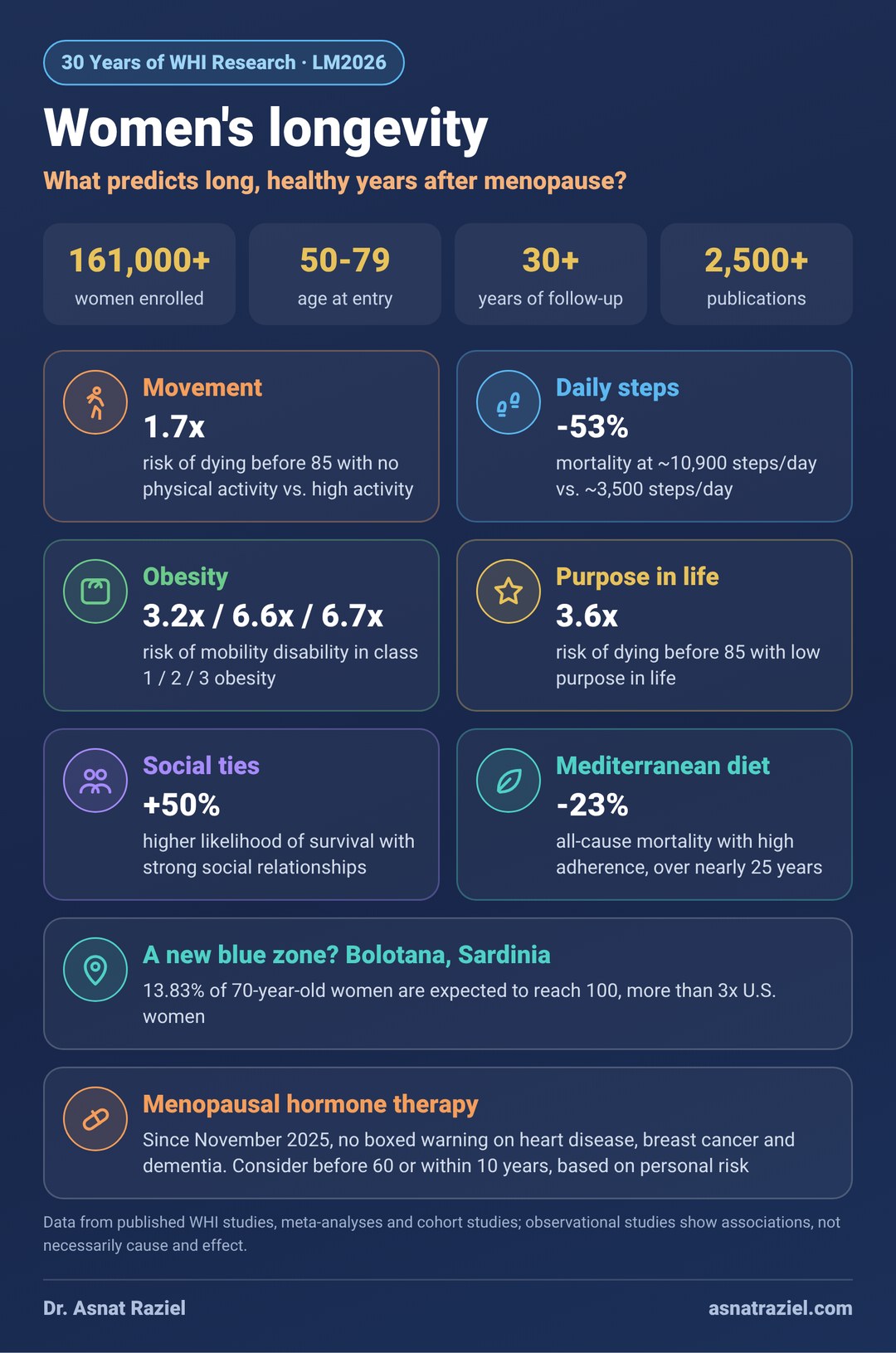
Between 1993 and 1998, the Women’s Health Initiative (WHI) enrolled more than 161,000 postmenopausal women aged 50 to 79. Researchers have now followed them for more than three decades. So far, this follow-up has produced over 2,500 scientific publications.
In practice, the study has two parts. The first included randomized trials, such as a hormone therapy trial and a dietary modification trial. The second is a large observational study that tracks how daily habits relate to health over the years. Today, many participants have reached 90, and some have even reached 100.
Hormone therapy: a lesson that changed over time
In 2002, researchers stopped the estrogen plus progestin trial early. The reason: the risk of invasive breast cancer crossed a prespecified safety boundary. In addition, the treatment raised the risk of coronary heart disease, stroke and pulmonary embolism. In 2004, they also stopped the estrogen-alone arm, which increased stroke risk with no overall benefit for preventing chronic disease.
These findings changed menopause care almost overnight. However, the women in the trial were 63 on average, many years past the start of menopause. Therefore, on November 10, 2025, U.S. health officials announced the removal of the boxed warning about heart disease, breast cancer and dementia from menopausal hormone therapy products. The endometrial cancer warning remains for estrogen alone. Current guidance is to consider treatment before age 60 or within 10 years of menopause onset, based on personal risk. The professional debate around this decision continues, so the choice is always individual.
Movement: a strong predictor of women’s longevity
One WHI study followed 49,612 women with an average age of 70 and looked at what happened to them by age 85. The results are clear. Women with no physical activity had 1.7 times the odds of dying before 85 compared with the most active women. They also had 1.6 times the odds of developing mobility disability.
Sitting matters too. Sitting 10 or more hours a day, compared with less than 5 hours, raised the odds of death by 1.2 times. Meanwhile, a meta-analysis of 15 cohorts found that mortality fell gradually as step counts rose. People who walked about 10,900 steps a day had a 53% lower risk than those who walked about 3,500 steps. In other words, every extra step counts, and there is no need to run a marathon. I wrote more about this in my article on walking and Alzheimer’s prevention.
Weight and belly fat: the cost is measured in independence
This is the finding that matters most to me as a physician who treats obesity. Another WHI study of 36,611 women found that obesity raised the risk of dying before 85. But the striking numbers relate to mobility. With class 1 obesity, the odds of mobility disability rose 3.2 times. With class 2 they rose 6.6 times, and with class 3, 6.7 times.
In addition, a waist circumference above 88 cm was linked to a higher risk of early death, new disease and mobility disability. In other words, obesity mainly steals our years of independence. The good news: this is a factor we can change. Today we have effective and safe treatments, as I described in my guide to treating obesity during menopause.
Purpose and optimism as drivers of women’s longevity
One of the most surprising findings comes from the mind. A study of 8,880 women who reached age 85 looked at their sense of purpose in life. Women with a low sense of purpose had a 3.6-fold higher risk of dying before 85. Beyond that, they had more disease and more mobility disability.
Similarly, a study of 159,255 women found that the most optimistic women lived 5.4% longer than the least optimistic. More than half of the women in that study, 53%, reached age 90 or older. The Japanese call this sense of purpose ikigai, as I explained in my article on Japanese wisdom for a long life.
Social connection: medicine without a prescription
An analysis of 148 studies with 308,849 participants found that strong social relationships raise the likelihood of survival by 50%. Complex measures of social integration showed an especially strong link, with odds of 1.91. According to the authors, the size of this effect is comparable to well-established risk factors for mortality.
Within the WHI, a study of 9,154 women with breast cancer showed a similar picture. Women with the highest social support had an 11% lower risk of death from any cause. So a family dinner or a regular walk with a friend is part of the treatment. Read more about social connections and longevity.
Nutrition: Mediterranean, more vegetables, less fat
A separate study of 25,315 women, followed for almost 25 years, found that high adherence to a Mediterranean diet was linked to a 23% lower risk of death from any cause. Part of the benefit came through lower inflammation and better blood lipids, weight and insulin resistance.
The WHI’s dietary modification trial, with 48,835 women, also adds to the picture. The diet included less fat and more vegetables, fruit and grains. The trial did not meet its main goals. However, over about 20 years of follow-up, the risk of breast cancer followed by death fell by 16%. In addition, the risk of diabetes requiring insulin fell by 13%. More details in my article on the Mediterranean diet.
Blue Zones and the secret of women’s longevity
Blue Zones are five regions of the world whose residents live especially long, healthy lives. Journalist Dan Buettner distilled nine principles from them: natural movement, purpose, stress reduction, eating until 80% full, a plant-based diet, belonging to a community, putting family first, a supportive social circle, and wine in moderation. Recently, researchers proposed a new blue zone: the town of Bolotana in Sardinia.
In Bolotana, it is the women who stand out. A 70-year-old woman there has a 13.83% chance of reaching 100, more than three times that of a U.S. woman. However, the researchers stress that longer follow-up is needed to confirm it. The WHI team is now testing, for the first time, whether the nine principles predict longevity in American women as well. The results have not yet been published, and I will update you when they are.
What about alcohol?
The “wine in moderation” principle is controversial. The International Agency for Research on Cancer stresses that alcohol raises cancer risk, and that cutting down or quitting lowers it. Interestingly, a study of people aged 90 and over in Sardinia actually found a link between wine drinking and higher mortality. So there is no reason to start drinking for your health.
What can you do starting today?
The good news is that most of these factors are in our hands. Here are practical steps based on the findings:
Move every day. Aim for 150 minutes a week of moderate activity, plus strength training. Also, get up from your chair every hour.
Watch your waistline. Above 88 cm, it is time to seek treatment. Today, medications such as semaglutide and tirzepatide, together with nutritional support, are changing the picture.
Nurture purpose. Volunteering, learning, grandchildren or a new hobby. Anything that gets you up in the morning with a reason.
Put social plans in your calendar. Just like a doctor’s appointment. A weekly meetup with friends is an investment in your health.
Eat Mediterranean. Plenty of vegetables, legumes, whole grains, olive oil and fish.
Talk about menopause. If you are under 60 and have symptoms, it is worth asking your doctor whether hormone therapy suits you.
In our clinic, we combine all of these in a multidisciplinary approach that includes medicine, nutrition, physical activity and emotional support, as I explained in my article on healthspan.
The bottom line: women’s longevity starts with habits
Thirty years of follow-up of more than 161,000 women teach an important lesson. Women’s longevity depends largely on the habits we choose: movement, a healthy weight, purpose, friends and good nutrition. It is never too late to start, and at any age we can add good years.
The information in this article is general and does not replace personal medical advice.
References
Elimination of the Black Box Warning on Menopausal Hormone Therapy
Daily steps and all-cause mortality: a meta-analysis of 15 international cohorts
Obesity and late-age survival without major disease or disability in older women
Optimism, lifestyle, and longevity in a racially diverse cohort of women
Social relationships and mortality risk: a meta-analytic review
Mediterranean Diet Adherence and Risk of All-Cause Mortality in Women
A new blue zone? exceptional late-life survival in Bolotana, Sardinia
Blue Zones: Lessons From the World’s Longest Lived
The IARC Perspective on Alcohol Reduction or Cessation and Cancer Risk