By Dr. Asnat Raziel, bariatric surgeon specializing in obesity treatment, metabolic health and healthy longevity; Director of the Multidisciplinary Center for Obesity Treatment, Assia Medical, Assuta Ramat HaChayal, Tel Aviv
Flourishing and longevity: the talk that moved us all
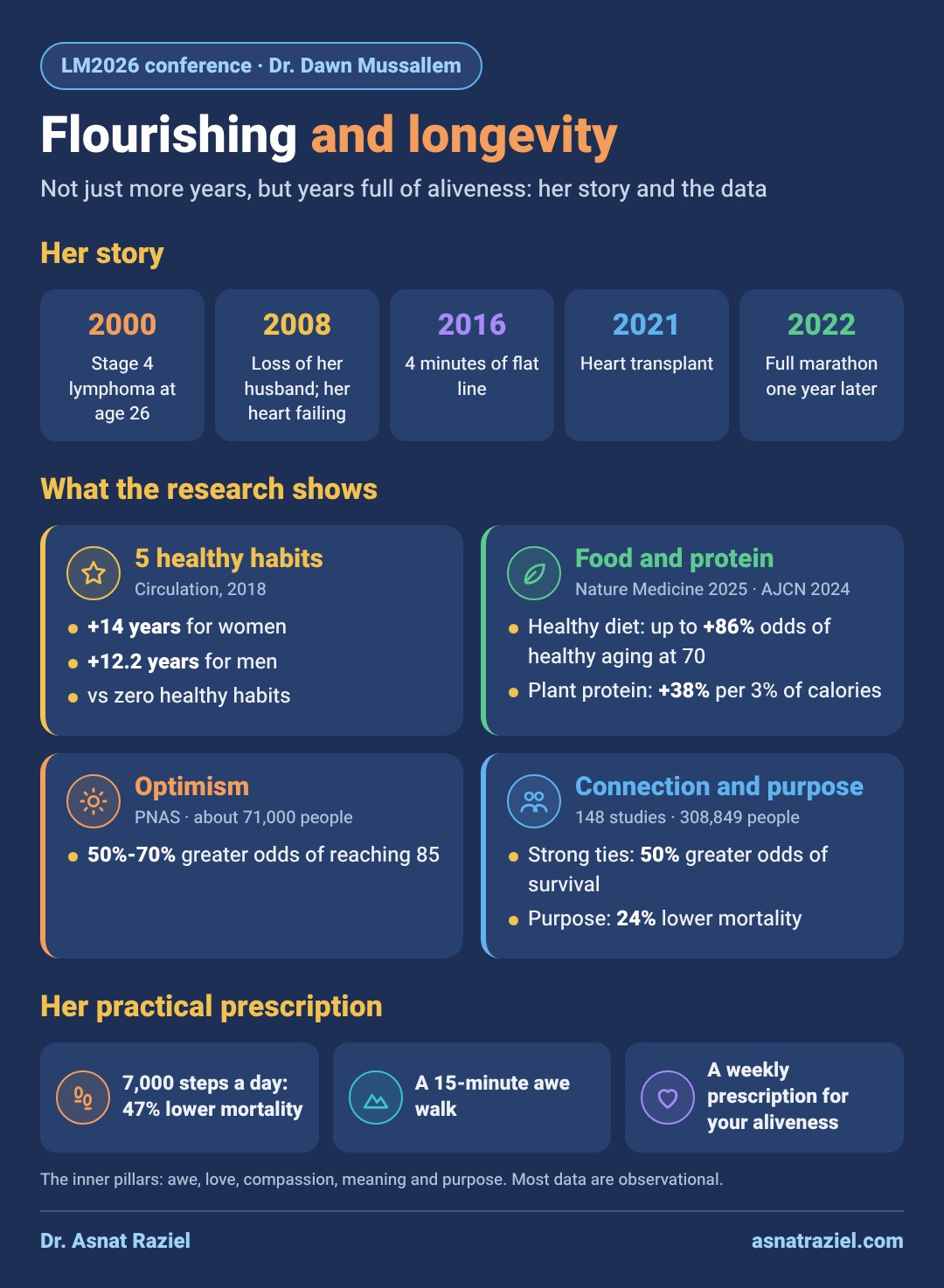
Flourishing and longevity are not the same thing. You can live many years, or you can fill those years with aliveness. That difference was the heart of today’s talk by Dr. Dawn Mussallem at LM2026, the lifestyle medicine conference in Orlando. I sat in the hall and heard one of the most moving lectures I have ever attended at a medical meeting. She did not just present data. She told her own story: stage 4 cancer, heart failure, four minutes of clinical death, a heart transplant, and a full marathon one year later.
Who is Dr. Dawn Mussallem
Dr. Mussallem spent about 25 years at Mayo Clinic. There she founded the Integrative Medicine and Breast Health Program at Mayo Clinic Florida, which brings lifestyle medicine into breast cancer care. She also helped bring lifestyle medicine into residency training through the American College of Lifestyle Medicine (ACLM). Since January 2026 she has been Global Chief Medical Officer of Fountain Life, a US longevity company. She is also the founding Chief Science Officer of IM8 Health. Her talk was titled “Choose Fully Alive,” and her slides sent me back to reread several of the studies.
She opened by saying this would not be her usual science-heavy lecture. Instead, she would share what she has learned as a patient and as a physician. Her goal: to move medicine beyond preventing and treating disease, toward flourishing, for patients and for clinicians themselves.
Her story: a dream from age four
By age four she already knew two goals. She wanted to be a doctor, and she wanted to be the oldest person in the world. She grew up in a home where healthy living was simply normal. But a few weeks into medical school, she started getting short of breath during exercise.
Two doctors diagnosed adult asthma without listening to her lungs. A third said it was all in her head. Eventually she collapsed. She turned out to be in cardiogenic shock, with a 16 cm (6 in) mass around her chest and heart that was pressing on the major blood vessels.
Thanksgiving 2000: stage 4 cancer
On Thanksgiving 2000, at age 26, doctors told her she had stage 4 cancer, lymphoma. Without treatment, they gave her three months. With treatment, twenty months. They also told her she would have to leave medical school and would never have children. What hurt most, she said, was the thought of giving up medicine, because that was where her meaning and purpose lived.
She found the right doctors and kept studying. Her oncologist even allowed her to exercise in the hospital, because there was no evidence it would harm her. So she sometimes started as early as 4 a.m., on a bicycle in or near her room. Purpose and vitality, she said, carried her through treatment.
Heart failure and loss
After remission, she and her husband had a daughter. A few weeks after the birth, the same symptoms came back. This time it was heart failure, with procedures, medications, improvement and relapse. In 2007 she had to step away from residency and received a pacemaker and defibrillator. In 2008, eight years after the tumor, her husband died suddenly of cardiac arrest, with no warning at all. Two hearts in one home: one stopped in a moment, the other slowly failing. She was the one who found him. She spoke about grief as a hard process that keeps coming back around, one that medical school had never prepared her for. The loss, she said, deepened her faith and her understanding that love endures.
Four minutes between life and death
On September 22, 2016, she was on her way to the Mayo Clinic boardroom. She planned to present her successful pilot program, breast cancer care built on lifestyle medicine, and ask to expand it. On the way she grew weak, could not open the door and could not move the cursor on the computer. Then she lost consciousness.
Her defibrillator recorded a flat line for four minutes. According to her, her Mayo electrophysiologist told her the device was not what brought her back. She described a deep sense of love, stillness and acceptance of the unknown. For her, the question of what brought her back matters less than the experience itself and the comfort she found in it.
A new heart and a marathon
Between 2016 and 2019 her condition worsened. After a MitraClip procedure to repair her mitral valve, she had a stroke and lost vision in her left eye. In December 2019 she was listed for a heart transplant. During the COVID period, while waiting, she discovered the ACLM. She said the teachings of lifestyle medicine and the work of Dr. Dean Ornish contributed greatly to her survival, and she recommended his book Undo It!.
In February 2021, after 18 years of heart failure, a matching heart arrived from a family who said yes on the worst night of their lives. She calls her new heart Grace. The transplant was complicated, with bleeding and a second surgery. During recovery she dreamed of a place of love and connection, and one word came to her: grace. When she woke at 2 a.m., a song called “Grace” was playing, and at the top of her inbox sat an email titled “Full of Grace.”
Later she asked her transplant surgeon whether she could run a full marathon on the first anniversary of her transplant. He said yes. She received her new heart on February 5, 2021. According to Mayo Clinic, she completed the 26.2 with Donna marathon in Jacksonville on February 6, 2022. That made her the first person to run a full marathon within a year of a heart transplant. She has since run nine marathons. She stressed that the times do not matter. What matters is the commitment to her body. By the way, in a transplanted heart the nerves that regulate the heart rate are cut, so the first ten minutes of every run are especially hard for her.
Flourishing and longevity: the heart keeps five percent
Dr. Mussallem used the heart as an image to explain flourishing and longevity. The first arteries that branch off the aorta turn back to feed the heart itself. So the heart keeps about five percent of every beat for itself, and gives the other 95% to the body. In other words, to give to others, we first need to care for ourselves. That is not selfish, she said. That is the design. “Longevity without aliveness is only a longer waiting room,” she said. That was her message to the clinicians in the room.
Alongside the six familiar pillars of lifestyle medicine, she proposed “inner pillars”: awe, love, compassion, meaning and purpose. A patient, she noted, can have perfect labs and still be miserable. So she suggests measuring flourishing too, with the Flourish Index developed by Prof. Tyler VanderWeele of Harvard: ten questions that take about three minutes. They cover happiness, physical and mental health, meaning, character and relationships.
What the research shows about flourishing and longevity
She presented a long series of studies on flourishing and longevity. Here are the key ones, with links to the studies themselves. Most are observational, as she herself emphasized. Even so, the populations are very large.
Flourishing and longevity: habits, food and movement
The gap. According to a comparison of 183 countries, the US gap between lifespan and healthspan is 12.4 years, the widest in the world. Those are years we can fill with health.
Five healthy habits. A Harvard study found that women with five healthy habits lived on average 14 years longer than women with none. For men the difference was 12.2 years. The habits: not smoking, a healthy BMI, at least 30 minutes of activity a day, moderate alcohol and a high-quality diet. She herself noted that the alcohol component is contested.
Food. In a study that followed more than 105,000 people for 30 years, only one in 11 reached age 70 free of major chronic disease, with body, mind and mood intact. Those who followed a healthy diet most closely had up to 86% higher odds of healthy aging. Her advice for patients: plants forward, whole, home.
Plant protein. The Nurses’ Health Study followed 48,762 women. Each additional 3% of calories from plant protein went with 38% higher odds of healthy aging. For animal protein the figure was only 7%. She herself recommends 1.2 to 1.6 grams of protein per kilogram of body weight, especially for older adults.
Steps. According to a 2025 meta-analysis, 7,000 steps a day went with 47% lower mortality compared with 2,000 steps. In other words, you do not need 10,000.
Sleep. In a study of 60,977 people, a regular sleep schedule went with 20% to 48% lower mortality. Regularity predicted mortality better than sleep duration.
Optimism, connection and awe
Connection. A meta-analysis of 148 studies with 308,849 participants linked strong social relationships with 50% greater odds of survival. She also cited the Harvard study on successful aging, in which a stable marriage, mature coping, exercise and not smoking before age 50 predicted who would thrive at 70 to 80.
Purpose and optimism. In a meta-analysis of 488,765 people, a strong sense of purpose went with 24% lower mortality. In addition, in a study of about 71,000 men and women, the most optimistic had 50% to 70% greater odds of reaching age 85.
Faith and giving. In her work with breast cancer patients, she saw that women who regularly attended religious services accepted their diagnosis more easily. In a study of 74,534 nurses, attending services more than once a week went with 33% lower mortality. According to her slides, further studies in men and women showed 26% lower mortality. As for giving, volunteering at least 100 hours a year after age 50 went with 44% lower mortality over four years.
Awe walks. In a randomized trial, 60 older adults took a 15-minute walk once a week for eight weeks. Those guided to look for awe on their walks reported more joy, compassion and gratitude, and their smiles grew bigger in the photos they took.
I want to highlight her honesty. Most of these figures come from observational studies. So she split her prescription in two: three things she prescribes today, and two she is still proving. We know today that lifestyle changes the course of disease, that purpose and connection track with longer lives, and that well-being practices improve well-being. However, no one has yet tested whether prescribing purpose or awe actually extends life.
Flourishing and longevity: her practical advice
Movement and fitness
Movement. You do not need 10,000 steps. She noted the big benefit already comes from going from 2,000 to 7,000 steps a day. It also helps to stand up every 20 to 30 minutes of sitting. In people who never exercise, three minutes a day of short vigorous bursts went with 40% lower mortality. A five-minute walk after a meal helps too, as does strength training twice a week. When she travels, she does air squats in her room.
Cardiorespiratory fitness. She sees VO₂ max, the maximal oxygen uptake, as an especially important functional measure. It is also one of the metrics checked before a heart transplant. In the middle of the talk, the entire audience stood up and danced for a full minute.
Sleep, stress and kindness
Sleep. In her view, sleep regularity may matter even more than hitting seven to nine hours. She advises not to panic over smartwatch sleep scores, and to consider a sleep study when in doubt.
Stress. Stress is part of life, and when managed well it can fuel growth. She led the audience through three rounds of cyclic breathing: inhale through the nose, add a short second inhale, then a long, slow exhale through the mouth. In a small trial, five minutes a day of this breathing lifted mood within a month.
Alcohol and tobacco. She reminded us that alcohol is classified as a Group 1 carcinogen, so it cannot be presented as beneficial. Her advice to patients: do not drink alone, and try low-sugar mocktails.
Kindness. Write a thank-you note or send a warm message to someone you love. She asked the whole hall to send one text: “Thinking of you today.”
Prescribing the inner pillars
She also offered simple “doses,” stressing that these reflect clinical judgment rather than trial-tested regimens: one shared meal a week with phones down, a 15-minute awe walk each week, about two hours a week helping someone who cannot repay you, and pairing a walk with a gratitude or mindfulness practice. She also suggests asking every patient four questions at the first visit: What matters most to you? What makes you lose track of time? Who would you call at two in the morning? And what is this health for?
A personal prescription for flourishing and longevity
At the end of the talk she returned to the image of the heart. She asked us not to judge ourselves harshly, and to give to ourselves, not only to others. Her assignment for each of us: write one prescription for your own aliveness for the coming week. What you will do, how much, and who will hold you to it.
I walked out with tears in my eyes and one thought about flourishing and longevity. Many of the tools that extend good lives, such as meaning, connection, optimism and kindness, are free. In her words, our enthusiasm for expensive longevity products must not push them aside. It also connects to what I heard yesterday at the conference opening about lifestyle medicine as a standard of care.
The bottom line on flourishing and longevity
Dr. Dawn Mussallem’s story is a reminder that longevity is not just a number of years. Flourishing and longevity are built from food, movement, sleep and stress management, but also from love, meaning, awe and connection. As her final slide put it: “We are not here only to extend life. We are here to deepen it. Starting with our own.” So what is your prescription for this week?
This article provides general information and is not personal medical advice. Before changing your treatment or physical activity, talk with your doctor.
References
Cancer survivor, heart transplant recipient marks 1-year anniversary with marathon
Dawn Mussallem leaves Mayo Clinic to become Fountain Life’s chief medical officer
Cancer survivor and heart transplant recipient to speak at Mayo Clinic commencement
Impact of Healthy Lifestyle Factors on Life Expectancies in the US Population
Optimal dietary patterns for healthy aging
Optimism is associated with exceptional longevity in 2 epidemiologic cohorts of men and women
Association of Religious Service Attendance With Mortality Among Women
Big smile, small self: Awe walks promote prosocial positive emotions in older adults
Global healthspan-lifespan gaps among 183 World Health Organization member states
Daily steps and health outcomes in adults: a systematic review and dose-response meta-analysis
Social relationships and mortality risk: a meta-analytic review
Brief structured respiration practices enhance mood and reduce physiological arousal