By Dr. Asnat Raziel, bariatric surgeon specializing in obesity treatment, metabolic health and healthy longevity; Director of the Multidisciplinary Center for Obesity Treatment, Assia Medical, Assuta Ramat HaChayal, Tel Aviv
Obesity in the IDF: the army’s silent war
Obesity in the IDF (Israel’s military) is a silent front, but a long-term one. While public attention is focused on the borders and on security, the army is also dealing with the obesity epidemic. This challenge is not just a matter of weight. It is a public health problem that burdens the healthcare system and harms young people’s quality of life. That is why it requires strategic thinking, just like any other threat.
What recruits’ weight data reveals about obesity in the IDF
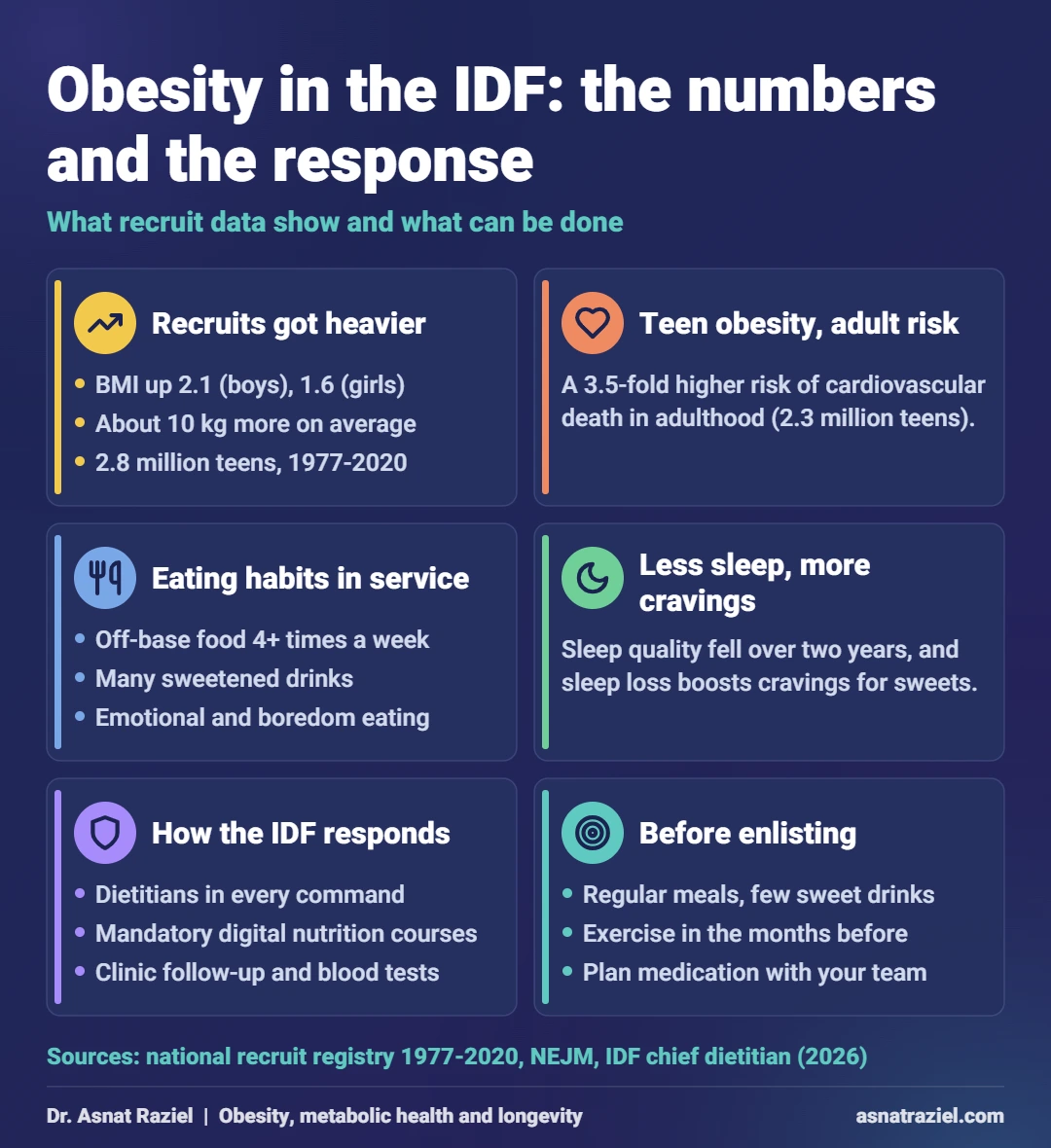
Before enlistment, every recruit has a medical exam that includes weighing and a height measurement. Over the years, these data have become a research database that is unique in the world. A nationwide study analyzed data on 2.8 million adolescents examined before service between 1977 and 2020. Over that period, average BMI rose by 2.1 units in boys and by 1.6 in girls. BMI, or body mass index, is a measure of weight relative to height. According to a news report on the study, the average weight of recruits rose by about 10 kg.
The trend continues. In February 2026, the IDF’s chief dietitian, Ira Shulman, said that recruits now arrive with worse health measures than in the past. According to her, she meets 22-year-olds with a BMI of about 40 and diabetes. She also describes a rise in gestational diabetes among women in career service.
Even so, the full picture is missing. Because of COVID-19 and the war, routine weight monitoring during service was interrupted, and some soldiers were not weighed at all. According to a health and nutrition survey by the IDF and the Ministry of Health, the average BMI of soldiers is 24. That is a normal value, but it is close to the upper limit. It is also worth remembering that BMI is affected by muscle mass, so it does not measure fat precisely.
Why obesity at 17 shapes the future
This is not about “tight pants”. Obesity at a young age raises the risk of type 2 diabetes, high blood pressure and heart disease. An Israeli study in the NEJM followed 2.3 million adolescents for decades. Adolescents with obesity had a 3.5-fold higher risk of death from cardiovascular disease in adulthood. In other words, today’s numbers are tomorrow’s illness.
How the army is tackling obesity in the IDF
According to Shulman, until the last decade the Medical Corps did not deal with nutrition in a systematic way. There were mainly ad hoc guidelines for combat soldiers. Today the picture is different. Dietitians work in every command and branch, supporting units, carrying out inspections and giving training sessions. In addition, dining halls have clear menu guidelines, including fresh salads and a balance between food groups.
The army is also working in several other directions:
- Short digital nutrition courses that are mandatory during training.
- Considering adding a nutrition item to the form a commander signs before an exercise.
- Nutrition services in clinics, including individual follow-up, blood tests and weigh-ins.
- Follow-up of bariatric surgery among career personnel.
- Cooperation with the Ministries of Education and Health even before enlistment.
Shulman estimates that the results will be visible in two to three years. Meanwhile, other militaries are already integrating lifestyle medicine into military routine to improve fitness and health.
What makes it hard for soldiers
The military environment is challenging. In a survey it conducted, the army found that soldiers buy food outside the base at least four times a week and drink a lot of sweetened beverages. In addition, Shulman describes emotional eating and eating out of boredom, especially in rear-echelon roles. Soldiers’ sleep quality has also declined over the past two years. Lack of sleep increases cravings for sweets and weakens self-discipline. I wrote about the link between stress and weight in my article on stress management for weight loss.
Moreover, female combat soldiers face unique challenges. According to Shulman, iron deficiency and poor body image are common among them. For this reason, the army holds a dedicated conference for them. This is an important reminder: the goal is health and fitness, not thinness at any cost.
Obesity in Israel and around the world
The phenomenon is not unique to the IDF or to Israel. According to the World Health Organization, in 2024 one in seven people in the world was living with obesity, about 1.1 billion people. In addition, 400 million children and adolescents aged 5 to 19 were overweight, and 170 million of them had obesity. You will find a broad overview in my article on obesity around the world.
Risk factors: what drives the epidemic
Obesity is not just a question of weight. It comes with diabetes, cardiovascular disease and metabolic disorders. The main risk factors are:
- Unhealthy eating patterns, with energy-dense food.
- Little physical activity, because of modern lifestyles.
- An environment that encourages fast food and processed food.
- Short sleep, psychological stress and emotional eating.
For example, ultra-processed food affects the hunger and satiety mechanisms in the brain. That is why the environment matters just as much as personal choice.
Preventing obesity in the IDF starts at home: what recruits can do
Preparing for service starts long before enlistment day. It is best to arrive with stable habits: regular meals, few sweetened drinks and as much sleep as possible. In addition, regular physical activity in the months before enlistment improves fitness and adaptation. On the base itself, make use of the unit dietitian and the clinic. And anyone already being treated with an obesity medication should plan ahead, together with their care team, how to continue treatment during service. In this way, obesity in the military turns from fate into a challenge that can be managed.
What needs to be done: a multi-system approach
Tackling the epidemic requires action on several levels at once. First, health education starting at school. Second, good food in public institutions, including army bases. In addition, encouraging physical activity, continuous medical follow-up and professional nutrition support. Finally, medical treatment for those already living with obesity. Since 2026, for example, Wegovy injections for adolescents have been included in the national health basket, Israel’s list of state-funded treatments. However, military service still does not guarantee continuity of this treatment.
In summary: obesity in the IDF is a national issue
While the headlines focus on fronts abroad, the fight against the obesity epidemic is one of the most important battles for public health in Israel. The IDF sees every young person at age 18, so it has a rare opportunity to make a difference. Obesity in the IDF reflects what is happening in homes and schools. If we do not address the root causes through cultural change, good nutrition and encouraging movement, we will keep paying the price in future generations.
The information in this article is general and does not replace personal medical advice.
References
Not just Iran and Gaza: the IDF’s war on the obesity epidemic (Walla, in Hebrew)
Within four decades, the average weight of IDF recruits rose by 10 kilos (Ynet, in Hebrew)
Body-Mass Index in 2.3 Million Adolescents and Cardiovascular Death in Adulthood