By Dr. Asnat Raziel, bariatric surgeon specializing in obesity treatment, metabolic health and healthy longevity; Director of the Multidisciplinary Center for Obesity Treatment, Assia Medical, Assuta Ramat HaChayal, Tel Aviv
Pilot fatigue: why it matters right now
Managing pilot fatigue is one of the most important areas of aviation medicine. During the 2026 campaign against Iran, Israeli Air Force pilots flew long, distant missions, often at night. In that kind of situation, the biggest challenge is not only technological. In fact, the real challenge is fatigue.
Fatigue is a silent enemy. It erodes concentration, slows reaction time and makes decisions harder. In an operational flight every second counts, so fatigue is a genuine risk factor. For this reason, air forces around the world have developed an entire field: operational fatigue management.
Where aircrew fatigue comes from
According to a 2025 report by the US Congressional Research Service, aircrew fatigue has several sources. These include an uncomfortable sleep environment, unpredictable schedules, long workdays and flights that cross time zones. In addition, the report notes that fatigue is especially strong in the small hours of the morning. That is when the body clock reaches its lowest point of alertness.
The problem also extends beyond the cockpit. According to the same report, a 2018 survey found that 64.3% of active-duty US service members did not sleep at least seven hours a day. In other words, many arrive at a mission already in sleep debt. I wrote about how sleep loss affects the body and metabolism in my article on improving sleep and metabolic health.
Managing pilot fatigue starts with planning
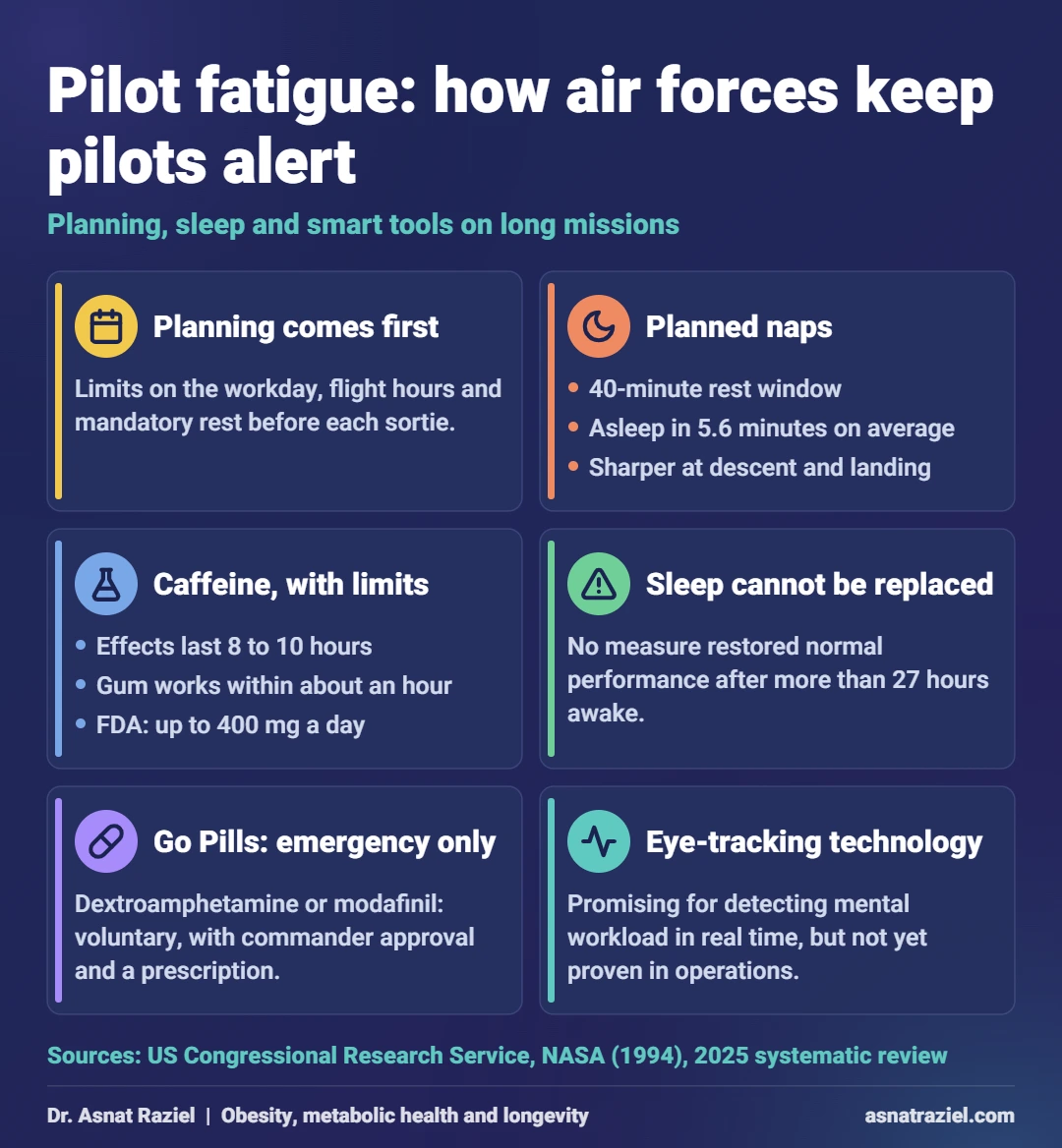
The modern approach does not rely on a single solution. Instead, it combines several tools, and the first of them is planning. All branches of the US military limit the length of the workday, total flight hours and mandatory rest time. As a result, the pilot arrives at each sortie after as much sleep as possible.
However, regulations alone are not enough. A 2021 review by researchers from the Royal Netherlands Air Force explains this well. In a military operation, they say, the limits sometimes have to be exceeded, so rules alone cannot be relied on. Militaries therefore also teach pilots to recognize the signs of fatigue in themselves and in their fellow crew members.
Short naps: the tool NASA tested
One effective tool is a planned nap. In a 1994 NASA study, pilots on long-haul flights were given a 40-minute rest opportunity during a quiet phase of the flight. On average, they fell asleep within 5.6 minutes and slept about 25.8 minutes. They used 93% of the opportunities to sleep.
The result was clear. Compared with the group that did not rest, the pilots who napped showed better alertness and performance, especially during descent and landing. Moreover, the nap did not disturb their sleep later on. Today many air forces build short naps into the schedule before a long mission or between missions.
Caffeine and pilot fatigue: simple and widely used
The most common way to stay alert is also the simplest: caffeine. Many militaries use caffeinated drinks, tablets and even gum. A committee of the US National Academy of Medicine examined the topic for the US military. According to the committee, caffeine improved alertness, mood and mental performance, even in people who had not slept. Some of the effects lasted 8 to 10 hours.
The committee preferred fast-absorbing forms such as gum, because the effect appears within about an hour. Still, caffeine has its limits. The US Food and Drug Administration (FDA) notes that 400 mg a day is generally not linked to negative effects in most adults. Above that amount, caffeine can cause a rapid heartbeat, anxiety and poor sleep. That is why militaries also use it in controlled doses.
What the latest review says
In a 2025 systematic review, researchers examined countermeasures against fatigue in military pilots. The review included only seven studies. According to the findings, caffeine and modafinil were the most effective short-term measures. They improved alertness, reaction time and performance during extended wakefulness.
But there is an important caveat. The effect depended on the individual pilot, on their personal sensitivity to fatigue and on the quality of their sleep. Furthermore, none of the measures restored performance to normal levels after more than 27 hours awake. For this reason, the researchers warn against relying on stimulants alone and call for putting sleep at the center.
Pilot fatigue and new technology
The next tool is already on its way. According to the review, systems that track eye movements show promise in detecting mental workload in real time. Even so, the researchers stress that this still needs to be confirmed under real operational conditions. In the future, such systems could alert the crew when a pilot’s alertness drops.
At the same time, the US military also permits “No-Go Pills”, sleep medications for short periods. They help pilots fall asleep in an uncomfortable environment or when sleep hours are shifted. After taking them, flying is prohibited for a set period of time. In this way, sleep itself becomes part of operational planning.
What about alertness-promoting drugs?
In extreme situations there are also pharmacological options, known as “Go Pills”, pills for staying alert. According to the US report, dextroamphetamine is approved for all branches of the US military. Modafinil, by contrast, is approved there for the Air Force only. Their use is voluntary and requires the commander’s approval and a prescription from a flight surgeon.
It is important to remember that these are emergency tools, not routine ones. They are used under close medical supervision and only in extreme operational situations. I covered the mechanism, research and risks of modafinil in another article on this site, “The pill that beats fatigue”.
And what happens in Israel?
For information security reasons, the exact aviation medicine protocols of the IDF (Israel’s military) are not public. Even so, it is known that the Israeli Air Force also places great emphasis on mission planning, on rest before sorties and on recovery after them. Like other air forces, its approach relies on a combination of planning, training and behavioral measures. I wrote about a broad preventive-medicine approach in military service in my article on lifestyle medicine in the military.
What pilot fatigue teaches us about everyday life
The lessons of pilot fatigue management also apply to shift workers, parents of babies and anyone who sleeps little during a stressful period. First, sleep is the foundation, and nothing replaces it. Second, a short nap of about half an hour can refresh you. Third, caffeine helps, but not in the hours before bedtime.
In addition, ongoing fatigue also affects appetite and weight. I wrote about this in my article on the link between sleep, the brain and appetite. Prolonged wartime stress also changes metabolism. For practical tools, see my article on stress management for weight loss.
The bottom line on pilot fatigue
Despite advanced technology, the person at the controls remains the center of the system. That is why managing pilot fatigue is not only about medication. Rather, it combines planning, sleep, naps, caffeine in moderation and technology. Ultimately, proper fatigue management has become an essential part of the Air Force’s operational capability.
The information in this article is general and does not replace personal medical advice.
References
Management of Sleep and Fatigue in Military Aviation
Fatigue in Aviation: Safety Risks, Preventive Strategies and Pharmacological Interventions
Caffeine for the Sustainment of Mental Task Performance: Formulations for Military Operations